

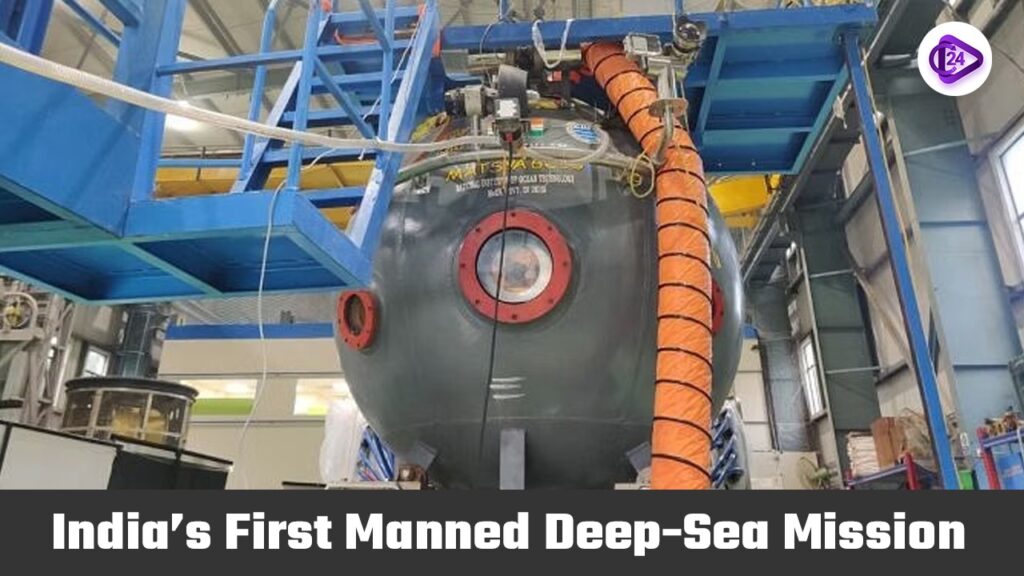
India’s Deep Ocean Mission will introduce its manned submersible Matsya 6000 in 2026 aiming to put India among five countries US, France, China, Russia, and Japan able to perform deep-sea exploration. The Samudrayaan Project at NIOT Chennai developed Matsya 6000 as their deep-sea submersible meant for ocean research studies. A ₹4,077 crore mission managed by the Earth Sciences Ministry strives to observe deep-sea biodiversity while studying marine ecosystems and valuing cobalt and manganese as well as rare earth element resources. Matsya 6000 incorporates modern safety and navigation systems to boost Indian deep-sea technology which enables research and resource exploration in deep ocean areas.
Context:
-
Under the Deep Ocean Mission (DOM) India will initiate its inaugural manned submersible Matsya 6000 during 2026.
-
The mission positions India inside the exclusive consolidated group of five nations (US, France, China, Russia, and Japan) that can execute deep-sea manned exploration.
-
A representative from the Union Minister of Earth Sciences approved the project.
What is Matsya 6000?
-
The underwater exploration capability of Matsya 6000 operates as a deep-sea manned submersible.
-
The development of Matsya 6000 took place under the Samudrayaan Project which functions as a component of the Deep Ocean Mission (DOM).
-
Matsya 6000 was constructed at the Chennai facility of the National Institute of Ocean Technology (NIOT).

Ministry & Budget
-
The Earth Sciences Ministry stands as the implementation authority for this program.
-
Deep Ocean Mission serves as a funding source which comprises ₹4,077 crore for deep-sea exploration objectives.
Aims and Objectives
-
The objective of surveying involves mapping deep-sea biodiversity alongside studying marine ecosystem dynamics.
-
The survey focuses on mineral exploration of cobalt along with manganese and copper and rare earth elements.
-
Research support for oceans will be combined with literacy campaigns for marine environments and tourist initiatives for the ocean.
-
India will enhance its technological competence for manned deep-sea explorations through this effort.
Key Features of Matsya 6000
-
Deep-sea Capability
-
Matsya 6000 functions between 6,000 meters under the ocean surface.
-
Operational endurance: 12-16 hours of deep-sea exploration.
-
Emergency survival: 96-hour life support for crew safety.
-
-
Structural Design
-
Crew Capacity: Houses three crew members.
-
The sphere structure has a diameter of 2.1 meters and consists of 80mm thick titanium alloy material to withstand extreme pressure conditions.
-
-
Advanced Navigation & Communication Systems
-
Ultra-Short Baseline (USBL) Acoustic Positioning System for real-time underwater tracking.
-
Continuous surface contact remains possible through voice and data communication systems installed on board.
-
-
Safety & Redundancy Measures
-
The safety measures incorporate triple redundant systems that distribute across buoyancy devices power systems and life support components which work together for maximum protection.
-
The syntactic foam flotation device can automatically return the equipment to the surface in case of emergencies.
-
Functions of Matsya-6000:
-
Deep-Sea Exploration
-
Scientists should perform biodiversity examinations at hydrothermal vents and methane seeps to study chemosynthetic organisms.
-
Researchers need to assess both the floor composition and health state of marine ecosystems.
-
-
Resource Assessment
-
Researchers should identify the mineral deposits of cobalt, manganese and rare earth elements.
-
Scientists need to evaluate the possibility of extractable minerals in deep-sea zones and develop methods to extract them sustainably.
-
-
Scientific Research & Technological Advancement
-
Marine archaeology should receive support alongside deep-sea engineering innovation development.
-
Deep-sea biodiversity serves as the study subject for contributing to research about climate change.
-
Conclusion
Matsya 6000 stands as a major achievement for deep-sea research in Indian territory because it simultaneously advances scientific discoveries and evaluates resources. The mission realizes India's goals of developing the blue economy together with technological self-reliance and ocean conservation projects.