

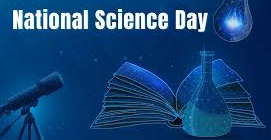
Indian people mark National Science Day every year on 28th February to remember Sir C.V. Raman's discovery of the ‘Raman Effect’ that won him a Nobel Prize in Physics in 1930. The observance of this day in 1987 established its mission to raise awareness about science and gauge India's progress in science and technology development. For 2047 when India seeks to become a developed self-reliant nation, the 2025 theme elects to empower India's youth to lead global science innovation towards VIKSIT BHARAT.

Objectives of National Science Day
-
The goal behind this activity involves raising public understanding about scientific methods used for everyday applications.
-
Next the public sees scientific advancements together with their benefits to human communities.
-
People should examine scientific problems and technological progress which help the nation develop.
-
Science and technology participation should be promoted among the general public.
Key Development in 2024
The year 2024 brought several essential scientific breakthroughs and technological developments to the world.
1. India’s Global Standing in Innovation and Intellectual Property
-
The country occupies position 39 across the Global Innovation Index 2024 global ranking.
-
6th position in global Intellectual Property (IP) filings as per the WIPO report.
-
The Network Readiness Index (NRI) 2024 rankings advanced to position 49 from its previous location at 79 in 2019 indicating better ICT infrastructure along with digital transformation development.
2. Anusandhan National Research Foundation (ANRF) – Driving Research & Inclusivity
-
ANRF Act 2023 established the foundation through its key scientific research programs including:
-
PM Early Career Research Grant (PMECRG) – Funding young researchers for independent studies.
-
EV Mission – Promoting innovation in electric vehicle technology for sustainable mobility.
-
Partnerships for Accelerated Innovation and Research (PAIR) – Encouraging collaborative scientific research.
-
Inclusivity Research Grant (IRG) – Supporting SC/ST researchers in frontier fields.
3. National Quantum Mission (NQM) receives ₹6003.65 crore in funding to build India's
quantum capabilities through an eight-year period.
-
The government invested ₹6003.65 crores over the span of eight years to progress quantum computing and communication and sensing while developing materials.
-
A total of 152 research workers from 43 organizations contribute to this mission.
-
The startup support mechanisms create systems that connect mentors with startups while providing funding along with resource distribution functions.
4. National Supercomputing Mission (NSM) – Expanding Computational Power
-
India achieved a 32 PetaFlops supercomputing capability in 2024 that increased by 5 PetaFlops during that year.
-
IUAC in New Delhi received the largest supercomputing system equipped with 3 PetaFlops computing power.
-
The future objective involves building the system to reach 77 PetaFlops capabilities with homegrown technology.
5. Artificial Intelligence & Cyber-Physical Systems
-
Under the National Mission for The Implementation of Commercially-Ready Informatics Products the BharatGen Initiative began its work on developing India's first multilingual and multimodal Large Language Model (LLM) for Generative AI.
-
The I-HUB Quantum Technology Foundation helps established startups in quantum computing and communication segments.
-
The Technology Innovation Hubs (TIHs) transition their focus towards Technology Translation Research Parks (TTRPs) to commercialize innovation products.
6. Geospatial Science – Expanding Awareness and Research
-
The Spatial Thinking Programs reached 116 schools situated across 7 states which included 6205 students as beneficiaries.
-
The total number of participants who received geospatial science training was 575 during Summer/Winter Schools programs.
-
The organization plans to spread to five additional states along with scheduling its first national research symposium.
7. Climate Research and Disaster Preparedness
-
The establishment of four new flood and drought risk mapping centers formed part of the Center of Excellence expansion.
-
Governments across the nation started implementing improved plans for nationwide disaster preparedness together with climate adaptation strategies.
8. Technology Development Board (TDB) – Funding Innovation
-
Seven major technology projects received a funding allocation of ₹220.73 crore which enabled critical sector development through breakthroughs.
The INSPIRE Program as part of scientific talent development
-
The Indian scientific community receives guidance through the Department of Science & Technology (DST) directed INSPIRE (Innovation in Science Pursuit for Inspired Research) program.
Key 2024 Achievements:
-
The research initiatives received support from 34343 INSPIRE Scholars together with 3363 INSPIRE Fellows and 316 INSPIRE Faculty Fellows.
-
Nine INSPIRE Fellows will share their research during the 15th JSPS-HOPE Meeting taking place between February 26th to March 1st 2024 in Kyoto Japan.
-
The annual INSPIRE Faculty Fellowship admission limit was raised to 150 openings.
-
The 11th National Level Exhibition & Project Competition (NLEPC) enrolled ten thousand students as thirty-one winners received recognition at Vigyan Bhavan New Delhi.
-
INSPIRE-MANAK 2024-25 received an unprecedented number of 1 million nominations for its program.
Future Vision for 2025:
-
INSPIRE-MANAK will grow to include students from Class 11 and Class 12 to boost their interest in scientific research.
The Gender Gap in STEM Fields
-
The DST founded WISE-KIRAN (Women in Science & Engineering) as a program that delivers help to women scientists from various career positions for gender equity in science.
Key Initiatives:
-
The WISE-PhD along with WISE-Post Doctoral Fellowship (WISE-PDF) initiative selected more than 340 women scientists for participation.
-
The Women’s International Grants Support (WINGS) provides grants for research training activities at international laboratories.
-
Women Leadership Programme: Empowering early & mid-level women scientists.
-
Through the Vigyan Jyoti Program the organization reached 29,000 schoolgirls from class IX-XII in 34 states and UTs.
-
CURIE Programme: Selected 22 Women PG Colleges for advanced research facilities.
Conclusion
Scientific progress in India demonstrates national determination towards independence as well as world-leadership and development through innovative methods. The future success of Viksit Bharat 2047 requires dedicated funding for research and technology development and inclusive scientific empowerment throughout the country.