


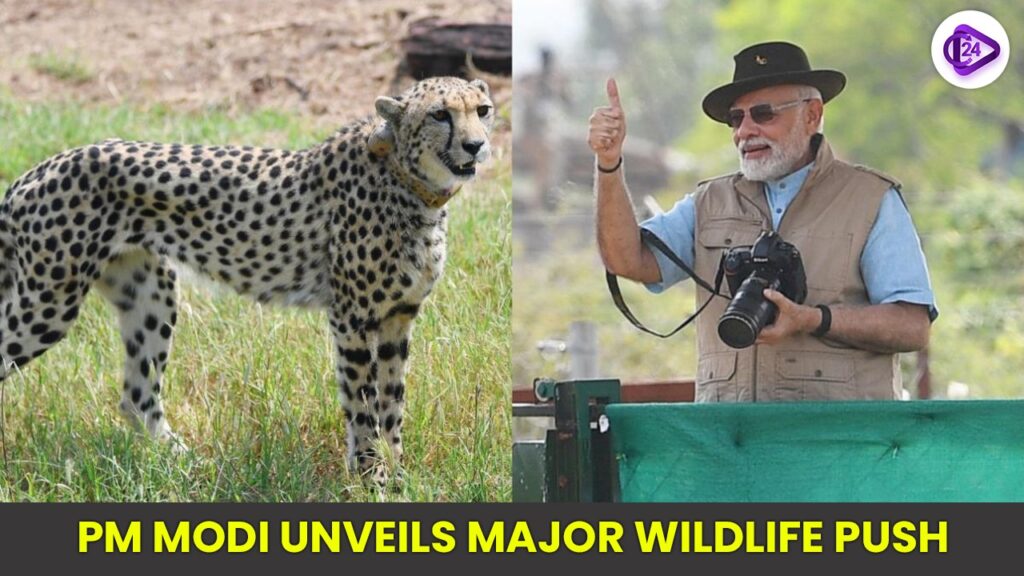
Prime Minister Narendra Modi chaired the 7th meeting of the National Board for Wildlife at Gir National Park in Gujarat. During this gathering he announced several essential wildlife preservation projects. India advances its environmental promises through multiple wildlife-related strategies that protect species alike while emphasizing habitat protection as well as technological innovations for wildlife management.
Highlights of the event:
-
India released its first-ever scientific study on the population numbers of riverine dolphins.
-
Expansion of the cheetah reintroduction program,
-
16th Asiatic Lion Population Estimation (2025),
-
National Referral Centre for Wildlife at Junagadh,
-
Wildlife monitoring adopts geospatial technology alongside AI to improve its operations.
-
New conservation initiatives for gharials, tigers, and the Great Indian Bustard.
The country shows dedicated effort toward protecting biodiversity while supporting sustainable wildlife management between environmental protection and human development ambitions.
Key Highlights of the Initiatives
1. Riverine Dolphin Estimation Report: First-ever census of riverine dolphins in India
-
The research team conducted the very first riverine dolphin population count spanning across 28 Indian waterways among eight territorial states.
-
The census recorded 6,327 dolphins in the areas Uttar Pradesh, Bihar, West Bengal, and Assam had the highest dolphin densities.
-
The project supports dolphin conservation through Project Dolphin guidelines as it rallies communities to defend riverine ecosystems.

-
Key Findings of the Survey:
-
Scientists recorded 6,327 dolphins and experts computed the dolphin population between 5,977-6,688.
-
Uttar Pradesh leads with 2,397 dolphins, followed by Bihar (2,220) and West Bengal (815).
-
Indus river dolphins are rare in India, with only three recorded in Beas River of Punjab.
-

-
Conservation and Significance of River Dolphins:
-
The freshwater ecosystem's health relies heavily on the Ganges river dolphin as an essential indicator of its well-being.
-
Habitats for these dolphins are critical due to their natural low reproduction rate.
-
The primary threats facing these animals result from habitat ruin combined with chemical contaminants along with water infrastructure expansion projects.
-
-
Project Dolphin and Government Initiatives:
-
Through Project Dolphin which started its operations in 2020 the government seeks to safeguard river dolphins together with their living spaces.
-
A 8000+ km survey was conducted through boat and road-based investigations across 58 rivers.
-
Scientists monitored regions that have always hosted dolphins to obtain correct information for their study.
-
-
Regional Distribution of Dolphins:
-
There are dense Ganges river dolphin populations in Uttar Pradesh and West Bengal along with Bihar.
-
The surveys in Assam identified 635 dolphins throughout the Brahmaputra region.
-
The dolphin populations in Central and Western India remain small because only three Indus dolphins inhabit Punjab and the numbers decrease to two in Rajasthan and one in Madhya Pradesh.
-

2. National Referral Centre for Wildlife (NRCW), Junagadh
-
A first-of-its-kind wildlife disease management center in India.
-
The institution tracks wildlife diseases by conducting research and implementing coordination systems for early detections and disease control programs.
-
Why is it important?
-
The growing number of diseases that pass between animals and humans will benefit from the surveillance activities at NRCW.
-
This project will establish better veterinary practices and wildlife conservation medicine operations throughout India.
-
16th Asiatic Lion Population Estimation (2025)
-
The account of Asiatic lions will take place in 2025 after researchers completed their last survey in 2020.
-
Key focus areas:
-
The preservation of food resources for lions requires actions to restore habitat and grow prey numbers.
-
Staff at Barda Wildlife Sanctuary will observe how lions naturally disperse through the region.
-
Conservation programs need to match up with eco-tourism development by reinforcing tourism facilities.
-
-
Why is it significant?
-
The natural environment of Gir National Park remains the exclusive residence for all living Asiatic Lions across the world.
-
The program helps preserve different genetic traits which prevents the risk of captive animal populations growing too similar by breeding within their own group.
-
The conservation initiatives for lions benefit from active involvement from the local residents.
-
3. Expansion of the Cheetah Reintroduction Program
-
Additional areas have been selected for cheetah reintroduction projects after Kuno National Park demonstrated successful cheetah reintroduction.
-
Gandhi Sagar Sanctuary (Madhya Pradesh)
-
Banni Grasslands (Gujarat)
-
Why is this important?
-
The program established to reintroduce cheetahs in India aims to restore ecological balance because these big cats existed in the Indian territory until 1952.
-
Through this plan the habitats can be restored and new areas will receive increased prey populations.
-
The project supports India's commitment toward wildlife conservation both locally and internationally.
-
4. Human-Wildlife Conflict Mitigation
-
A Centre of Excellence at SACON (Wildlife Institute of India, Coimbatore) will be established
-
Focus on:
-
Researching causes of human-wildlife conflict.
-
Research teams will create new methods to stop animal conflicts with tigers, leopards and elephants and other species.
-
Community-based conservation strategies.
-
-
Use of advanced technology:
-
Remote sensing together with AI combined with geospatial mapping allows officials to monitor animal movements in real time.
-
An AI collaboration formed by BISAG-N alongside the Wildlife Institute of India works for resolving conflicts.
-
-
Why is this necessary?
-
Increasing human populations has led to more instances of dissatisfaction between humans and wildlife.
-
This approach stops habitat destruction and establishes ways for human wildlife coexistence.
-
Conservation of Key Species
-
Gharial Conservation Project
-
Conservation measures must be initiated immediately because Gharials have become almost extinct.
-
The project implements three main strategies which include breeding initiatives together with environmental defense measures and public education programs.
-
-
National Action Plan for Great Indian Bustard (GIB)
-
Researchers have confirmed that only fewer than 150 GIB individuals exist in the wild today.
-
Conservation strategy:
-
The conservation plan includes protecting environments while minimizing power lines risks and establishing breeding centers.
-
-
Conservation of Tigers Outside Protected Areas
-
The protection of wild tigers residing beyond national parks and sanctuaries constitutes a new conservation effort.
-
Key focus areas:
-
Reestablishing wildlife pathways promotes free animal travel throughout habitats.
-
Reducing poaching and habitat encroachment.
-
-
Community Engagement & AI-driven Conservation Strategies
-
A rise in community participation in conservation activities has established a significant growth of sixfold in community-managed habitat areas throughout the last ten years.
-
AI systems now document traditional preservation knowledge which enables its retrieval by other wildlife sanctuaries.
-
The deployment of motorcycles as a tool for forest staff helps them conduct better patrols and safeguards endangered species within their territories.
-
Significance of These Initiatives
-
Strengthens India’s biodiversity conservation strategy.
-
Promotes sustainable development and eco-tourism.
-
The use of technology for wildlife protection receives an improvement through these initiatives.
-
People from the community actively join conservation activities because of this approach.
-
These initiatives support the global sustainability goals SDG 15 (Life on Land) and the Convention on Biological Diversity.
Conclusion
PM Modi's wildlife conservation initiatives unite all essential components of scientific investigation and technological development together with governmental policy adjustments and local stakeholder involvement. The focus on population estimation, habitat restoration, and human-wildlife conflict mitigation showcases India’s global leadership in biodiversity protection.
The sustainable continuation of India's wildlife conservation programs demands these initiatives because they protect species along with ecological balance while ensuring biodiversity preservation for generations ahead.