

The Namami Gange Programme (NGP) emerged as a principal Indian government initiative in 2014 to conserve and improve the Ganga River status. The program receives major financial investments to carry out pollution reduction measures and restore ecological systems for sustainable water management practices. The Namami Gange Programme executed multiple important restorative strategies starting from sewage treatment into biodiversity conservation alongside forest development alongside public outreach programs. Namami Gange Programme holds a widespread mission that aims to maintain clean and flowing water within the Ganga River alongside the preservation of its cultural heritage and environmental value.
Key Points:
Namami Gange Programme (NGP):
-
The Namami Gange Programme began operation in 2014 using ₹20,000 crore before extending its funding objective to ₹22,500 crore through 2026.
-
Focuses on pollution control, ecological restoration, and sustainable water management.
Ganga River Basin:
-
The region spans across 27% of India’s land territory and sustains 47% of its human population.
-
The river faces multiple difficulties because of heavy water extraction and environmental contamination.
Vision for Ganga Rejuvenation:
-
Aviral Dhara (Continuous Flow) and Nirmal Dhara (Unpolluted Flow).
-
Emphasis on Integrated River Basin Management (IRBM) through scientific research and multi-sectoral interventions.
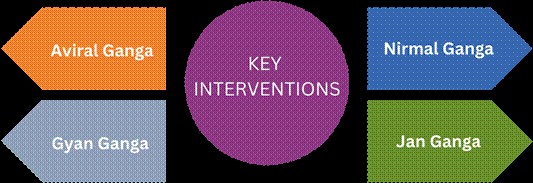
Key Interventions:
-
Pollution Abatement as part of Nirmal Ganga involves creating sewage treatment plants (STPs) and implementing effluent control programs and waste management practices.
-
Through Ecology and Flow Improvement (Aviral Ganga) the project works to improve the natural river ecosystem together with steady water sources.
-
Community Engagement (Jan Ganga): Awareness campaigns and active participation of local communities.
-
The department of Gyan Ganga focuses on developing scientific studies and mapping processes and formulating policies for sustainable water governance.
Progress Overview (As of January 2025):
-
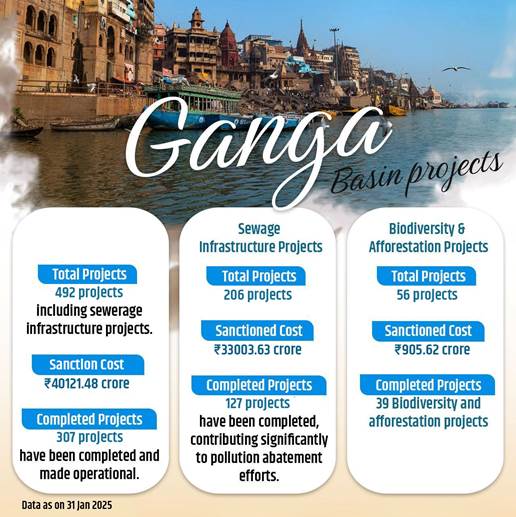
The authority launched 492 projects which received a total funding of ₹40,121.48 crore.
-
The Ganga project team successfully finished 307 tasks while obtaining completion of 127 sewage treatment projects.
-
As part of their initiatives the government authorized 56 biodiversity and afforestation projects that help maintain a sustainable balance between nature in the Ganga basin.
Recent Government Initiatives:
-
Major sewage treatment projects received approvals from the government as hybrid annuity and DBOT models for Varanasi and Bhadohi.
-
Implementation of a National Framework for Safe Reuse of Treated Water.
-
Seven biodiversity parks together with afforestation activities are being implemented across 33,024 hectares of land.
-
A program has been established to ranch 143.8 lakh Indian Major Carp (IMC) fingerlings for the conservation of fish biodiversity and river dolphins.
-
Industrial pollution prevention requires the development of Common Effluent Treatment Plants (CETPs).
The Ganges-Brahmaputra-Meghna (GBM) River Basin
-
This enormous river system receives its source from Himalayan glaciers and rainfall plus tributary streams and precipitation.
-
From the Himalayas the Ganges River streams toward the south and east and creates a wide chasm.
Ganga River System
-
The rivers Bhagirathi and Alaknanda give birth to this water system.
-
Origin: It starts at Gaumukh (3700m) where gangotri glacier resides in Uttarkashi district of Uttarakhand state.
-
Merges: The Ganga receives the Alaknanda stream at Devprayag before it attains its namesake status as the Ganga.
-
Total length in India: The Ganga River runs for 2,525 kilometers across four Indian territories which start in Uttarakhand then extend to Uttar Pradesh and continue to Bihar and terminate in West Bengal.
-
Basin area in India: 8.6 lakh sq km.
Major Tributaries of Ganga
Right Bank Tributaries
-
Yamuna: Yamuna stands as the longest tributary because it springs from Yamunotri Glacier and converges with Ganga at Prayagraj.
-
Son: Son originates from the Amarkantak Plateau before it joins Ganga near Patna.
-
Damodar: The Hugli River receives Damodar's tributary stream which creates the sorrowful condition known as "Sorrow of Bengal."
-
Punpun: Punpun originates in Jharkhand then passes through Bihar before entering its stream.
Left Bank Tributaries: Gomati, Gandak, Ramganga, Kosi, Ghaghara, Mahananda.
-
Gandak: Gandak starts in Nepal Himalayas before uniting with the Ganga near the city of Patna.
-
Ghaghara: Ghaghara commences its course in Tibet before joining the Ganga near Chhapra in Bihar.
-
Kosi: Coming from Mt. Everest vicinity the Kosi River acquires its local name as "Sorrow of Bihar".
-
Ramganga: Ramganga comes from the Garhwal Himalayas and reaches Ganga near Kannauj.
-
Mahananda: Mahananda begins in Darjeeling while being the westernmost left-bank tributary in West Bengal.
Key Confluences (Prayags) of Alaknanda
-
Vishnu Prayag – Dhauli & Vishnu Ganga meet.
-
Karna Prayag – Pindar meets Alaknanda.
-
Rudra Prayag – Mandakini joins Alaknanda.
Importance of the Ganga River in the Indian Context
The Ganga River stands amongst the most important rivers in India since it supports essential functions for agriculture while also driving the economy and protecting the environment and maintaining cultural and religious traditions. The Ganga River begins its passage at the Gangotri Glacier in Uttarakhand and then traverses various states before discharging into the Bay of Bengal while supporting the justified needs of millions of inhabitants and local biodiversity.
1. Agricultural Importance
-
The world's largest granary region constitutes the Indo-Gangetic plain which exists as one of the most productive farming areas because The Ganga River along with its tributaries provides irrigation support.
-
The river's alluvial soil sediments support the growth of four basic crops which include rice alongside wheat together with sugarcane and pulses.
-
The Ganga Canal alongside its expansion systems convey irrigation benefits to Uttar Pradesh and West Bengal as well as Bihar.
2. Economic and Industrial Significance
-
The river sustains water supply to textile production facilities and tanneries together with paper-making plants and sugar refinement centers.
-
As a main waterway of India National Waterway 1 (NW-1) which includes the Ganga stream improves trading activities and lowers freight expenses.
-
Hydropower Generation and renewable energy objectives in India receive support from numerous hydroelectric projects situated along the river.
3. Cultural and Religious Importance
-
The Indian waterway Ganga serves as a goddess to followers of Hinduism and provokes millions to visit sites like Varanasi along with Haridwar and Prayagraj.
-
The Ganga Aarti ceremonies along with ash immersion and river bathing rituals are seen to cleanse the sins of the performers.
-
Kumbh Mela and Ganga Dussehra are important religious events that center on the river which drives cultural tourism.
4. Ecological and Environmental Significance
-
The river exists as a biodiversity hotspot because it serves as a home for numerous animal and plant species while protecting the endangered Gangetic dolphins which inhabit its waters.
-
Wetlands that thrive in the area receive support from the river which additionally enables fishermen to practice inland fisheries for their subsistence.
-
Strict pollution problems including industrial waste and sewage discharge and plastic contaminants endanger the river's ecological health so Namami Gange Mission was initiated to advance river rejuvenation.
5. Social and Human Development Role
-
Drinking water sustainability along the Ganges is essential because millions of people extract their water supply from the river thus safeguarding public health remains vital.
-
Various economic activities such as agriculture, fisheries, tourism and small-scale industries derive employment opportunities from the river throughout the region.
-
The river’s water flow undergoes changes because of climate change alongside glacial melting and unpredictable monsoon occurrences which in turn affects both drinking water access and agricultural practices.
Conclusion:
The National Mission for Clean Ganga (NMCG) continues to pursue worldwide leading methods and scientific strategies for preserving the river. Continuous governmental work alongside communal support is turning the future dream of maintaining both Ganga's cleanliness and thriving state into reality