


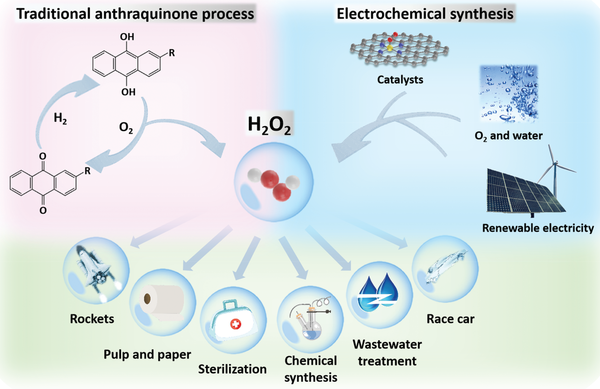
Indian researchers have developed an eco-friendly and energy-efficient method to produce hydrogen peroxide (H₂O₂) using sunlight. This innovative approach utilizes Covalent Organic Frameworks (COFs) as photocatalysts, enabling sustainable production without harmful by-products. The new method significantly reduces energy costs and enhances industrial efficiency. With applications in disinfection, paper bleaching, and chemical synthesis, this breakthrough could revolutionize multiple industries. The research marks a major step toward greener and more sustainable chemical manufacturing.
Research teams have developed an energy-saving sustainable approach to manufacture hydrogen peroxide (H₂O₂) which serves as a fundamental chemical throughout various industries such as disinfection together with paper bleaching and chemical synthesis.
Key Highlights of the Research:
Significance of Hydrogen Peroxide (H₂O₂):
-
The synthetic product serves environmental disinfection needs and supports chemical synthesis as well as paper bleaching and fuel cell operations.
-
Economic interest in hydrogen peroxide continues to grow owing to public health concerns about disinfection and the escalating surgical procedures alongside hospital infections.
Limitations of Existing Industrial Methods:
-
Industrial manufacturing of H₂O₂ through anthraquinone oxidation produces more than 95% of the entire H₂O₂ created globally.
-
Hydrogen Peroxide production requires excessive energy at high expense which leads to dangerous by-products.
New Eco-Friendly Approach:
-
Scientists work to create financially viable sustainable systems that use renewable resources.
-
The recent emergence of Covalent Organic Frameworks (COFs) as photocatalysts brings potential because of three important features.
-
Modifiable catalytic sites.
-
Efficient light-harvesting in the visible range.
-
Good water affinity.
-
Research team at S. N. Bose National Centre for Basic Sciences in Kolkata:
-
Scientists designed hydrazone-linked COFs which demonstrated improved water reacting properties.
-
These COFs promote key reactions:
-
Water Oxidation Reaction (WOR).
-
Oxygen Reduction Reaction (ORR).
-
The photocatalytic system effectively produced H₂O₂ through sunlight activation.
-
Key Achievements:
-
H₂O₂ production quantities exceeding 550 μmol g⁻¹ h⁻¹ were achieved by this photocatalyst under sunlight illumination which surpassed most organic photocatalysts.
-
The combination of water-benzyl alcohol solution at 90:10 produced H₂O₂ production of 21,641 μmol g⁻¹ h⁻¹.
-
The material shows readiness to be used in continuous flow reactors which can enhance industrial production capabilities.
Conclusion:
-
The renewable H₂O₂ synthesis method holds promise as an environmentally friendly method for industrial production.
-
This development enables the transfer of lab-based technologies into industrial operation which yields advantages across different business sectors.
-
The method has potential to develop a sustainable H₂O₂ production system which decreases environmental impact in comparison to existing H₂O₂ manufacturing processes.