


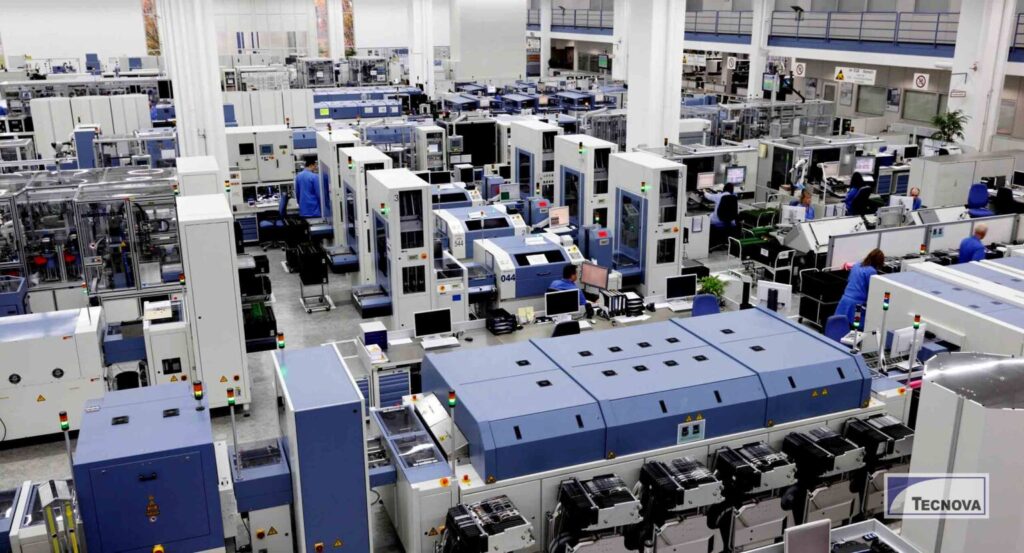
Make in India’s Leap in Electronics Manufacturing & Exports

Indian industry has established itself as a leading electronics manufacturer worldwide which has allowed it to minimize its dependence on foreign imports. Through its Make in India initiative the government successfully brought both investments and increased manufacturing capabilities to the country. The world now recognizes India as the second-largest producer...

Make in India’s Leap in Electronics Manufacturing & Exports

Indian industry has established itself as a leading electronics manufacturer worldwide which has allowed it to minimize its dependence on foreign imports. Through its Make in India initiative the government successfully brought both investments and increased manufacturing capabilities to the country. The world now recognizes India as the second-largest producer of mobile phones while mobile phone exports grew 77 times from 2014 to 2024. The Production Linked Incentive (PLI) Scheme together with the Phased Manufacturing Programme (PMP) and Semicon India Program have positioned India strongly in the global electronics sector and semiconductor industry. Electronics production targets from the government reach a goal of USD 300 billion for the year 2026.

Key Points

Transformation in Electronics Manufacturing

  • Since 2014 India had two mobile manufacturing units yet today there exist more than 300 such domestic facilities.

  • By December 2024 the local production of mobile phones in India reached 99.2% while starting from 26% in 2014-15.

  • The number of exported mobile phones grew from ₹1,566 crore during 2014-15 to ₹1.2 lakh crore during 2023-24.

  • Between FY14 and FY24 mobile phone manufacturing values increased dramatically from ₹18,900 crore to ₹4,22,000 crore.

  • The country currently produces between 325 and 330 million mobile phones yearly for more than 1 billion active devices.

Key Government Initiatives

Make in India Initiative

  • The initiative arose in 2014 to transform India into a world-class production destination.

  • The initiative seeks to achieve three objectives: investment attraction and innovative solutions alongside first-class infrastructure development.

  • The government promoted 'Vocal for Local' to build up domestic production.

Phased Manufacturing Programme (PMP)

  • The 2017 policy launched a program to support domestic value added operations in mobile phone production.

  • The government launched a program that strengthened manufacturing from SKD products to complete CKD products.

  • Local component production and supply chain strength received increased investment leading to their national development.

Production Linked Incentive (PLI) Scheme

  • The scheme started in 2020 with the goal to drive up large-scale electronics manufacturing across the nation.

  • New production incentives under this scheme offer between 3% and 6% of current and future sales for domestically manufactured items.

  • As of February 2025:

    • ₹10,905 crore cumulative investment.

    • ₹7,15,823 crore cumulative production.

    • ₹3,90,387 crore cumulative exports.

    • 1,39,670 direct jobs created.

Semicon India Program

  • The 2021 initiative received a budget allocation of ₹76,000 crore to develop semiconductor production in India.

  • The approved five major projects received funding of ₹1.52 lakh crore.

  • An indigenous semiconductor chip made in India will commence production in 2025.

  • Key projects include:

  • Micron's ₹22,000 crore investment in a semiconductor facility.

  • Tata Electronics' ₹91,526 crore Semiconductor Fab facility in partnership with PSMC, Taiwan.

  • CG Power & Industrial Solutions' ₹7,584 crore OSAT facility.

  • The semiconductor packaging facility of Kaynes Technology India operates out of Gujarat with a total investment value of ₹3,307 crore.

India Semiconductor Mission

  • A commercial semiconductor fab secured its first agreement in March 2025 to be established in Dholera of Gujarat.

  • The project includes manufacturing of semiconductors and display technology along with OSAT facilities and semiconductor research and development activities.

Scheme for Promotion of Manufacturing of Electronic Components and Semiconductors (SPECS)

  • Under this scheme businesses can acquire financial incentives worth 25% for their capital spending on electronic components and semiconductor technologies.

  • The initiative seeks to build up national manufacturing strength while cutting down import demands.

Conclusion

Through the Make in India initiative India achieved self-sufficiency while becoming a competitor in the global electronics manufacturing market. Through well-developed policies and substantial funding together with strategic partnerships India will reach its objective of USD 300 billion electronic production by 2026. The rise from two mobile manufacturing units in 2014 to over 300 today highlights India’s commitment to innovation and economic growth. Through its strengthening semiconductor and electronics business ecosystem India positions itself to lead globally in technology production and manufacturing.


Cabinet approves Emergency Credit Line Guarantee Scheme 5.0
Cabinet Approves Increase in Supreme Court Judge Strength to 37
Union Cabinet Approves Mission for Cotton Productivity in India
Vande Mataram Insult to Become Punishable Offence, Cabinet Clears Amendment
UDGAM Portal Update: 30 Banks Integrated to Help Legal Heirs Trace Unclaimed Funds
Malcolm Adiseshiah Award 2026, Raghav Das Gaiha Honoured
07 May 2026
06 May 2026
05 May 2026
04 May 2026
02 May 2026
01 May 2026
30 April 2026
29 April 2026
17 April 2026
16 April 2026

Start Learning Today with Class24

Buy a course

SSC

Railway

Banking

Teaching Exams

Rajasthan Exams

K12 Courses

Class24 Mobile Application

Class24 also has a mobile application so that it becomes easily accessible and convenient. This can be downloaded on an Android device. Users have appreciated this app and the content provided as 4.1 out of 5 is its rating in the App Store. People loved it because Class24 is giving content which is extremely rich in every sense. The app comprises a wide variety of features for smooth learning:

  • User-Friendly Interface: The app is categorized into various sections so that students can navigate and access various resources with ease.
  • Offline Access: The study materials can be downloaded and the student can access them even when not connected to the internet.
  • Inbuilt eBook Reader: There is a lightning-fast reader for eBooks within the app, so reading is seamless.
  • Progress Tracking: The app tracks student’s progress in preparation and keeps them organized and focused.

Courses and Subjects Offered

The total syllabus will be covered, and there are in-depth practice materials so as to give deep preparation in the courses designed to each one of them. All the subjects come under the aegis of courses offered by Class24 to meet different needs of various aspirants such as:

Preparation Tips for All Exams

Preparation tips for all exams mentioned below:

  • Previous Year Papers: Try to attempt at least 5-10 years of question papers to know the pattern of questions, how much difficulty one would face while answering, and how many frequently asked topics were in the examination.
  • Take Mock Tests: Attempt Mock Tests regularly in order to time and accuracy. You may analyze the performance and make an improvement for weak areas.
  • Focus on Time Management: Solve questions in the given time to make a habit of having speed and efficiency. Allocate time sensibly between Paper 1 and Paper 2, while appearing in the examination.
  • Current Affairs: For Current Affairs and TET exams, be updated about current affairs, teaching aptitude, and general awareness.
  • Regular Revision: Spend your daily and weekly time for revisions to not forget concepts and formulas. Use flashcards or do self-summary notes for quick revisions.
  • Understand the Exam Pattern and Syllabus: Understand the pattern of your exam paper and syllabus very well. Both Current Affairs and CSIR NET examinations are two-tier ones and involve both Paper 1, which consists of general aptitude and Paper 2 that involves specific aptitude subjects.
  • Make a Study Plan: Divide the preparation time into three phases of concept building, revision, and mock tests. Allocate more time to weaker areas while maintaining equilibrium with stronger sections.
  • Online Coaching or Study Groups: Enroll in online coaching programs like Class24 to get proper guidance and a structured approach to the study. Study groups will be useful to discuss doubts and share resources.
  • Stay Consistent and Motivated: Maintain a steady study schedule. Stay motivated by making small achievable goals.
  • Use Quality Study Materials: Suggested study material refers to a textbook, a set of previously published question papers, and web sources such as Class24.

Conclusion

Class24 is a one stop solution for aspirants preparing for Current Affairs, CSIR NET, SET, UP PGT English, UP TGT PGT, UPHESC Assistant Professor, TET, IGNOU B.Ed and other competitive exams. There are structured courses, live classes, mock tests along with the guidance of experts to assist candidates in achieving success in their respective fields.

Get success in your hand. Start study anytime anywhere.

The journey becomes simple and enjoyable when you start taking interest in it. And through our app “Class24”, we will be your trusted partners in developing that interest.

Daily Quizzes
Mock Tests
Ongoing

No ongoing tests right now.