


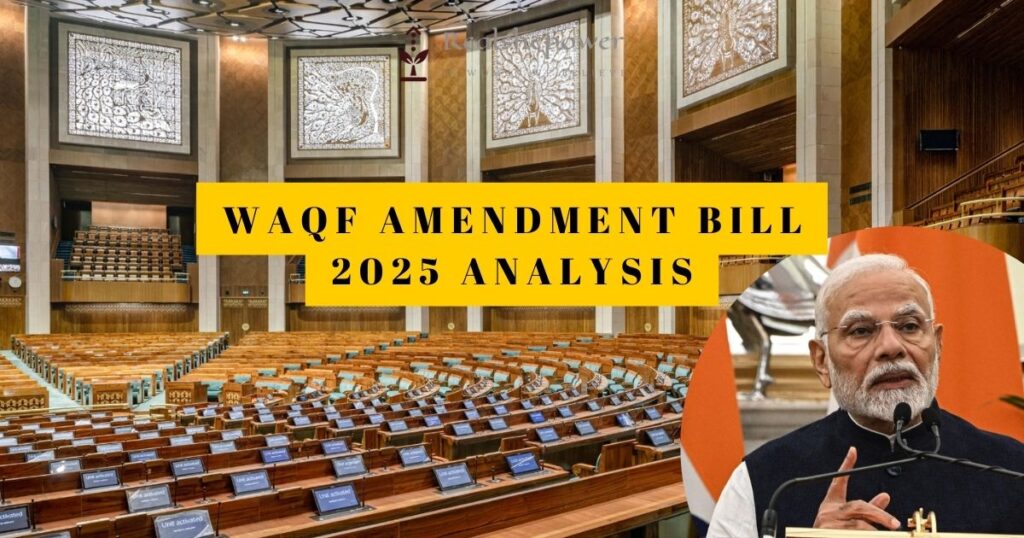
The Waqf Amendment Bill from 2025 tries to update the administration of Indian Waqf properties by improving transparency and operations while also creating clear laws. Muslim religious institutions known as Waqf properties contributed historically to religious activities and social care while serving economic functions through different reforms in legislation. The bill extends protection for Waqf properties through modern provisions that improve existing Waqf Acts from 1954 and 1995.
-
Waqf, a key institution in Islamic law, refers to the permanent dedication of movable or immovable property for religious, charitable, or pious purposes.
-
The management of Waqf properties in India dates back historically as new regulations appeared to protect these properties against misuse and mismanagement.
-
Independently managed Waqf properties started to become standardized through the creation of Waqf Boards during the historical period of the Waqf Act 1954.
-
The Waqf Amendment Bill of 2025 presents India's latest attempt to strengthen governance and optimize Waqf property usage toward present-day requirements.
Arguments for Removing Section 40 of Waqf Act
-
In 2025 the Lok Sabha introduced the Waqf Amendment Bill with objectives to modify certain provisions of the Waqf Act from 1995.
-
The most controversial aspect of this bill eliminates Section 40 because it conferring power on Waqf Boards for Waqf property determinations.
Understanding the Waqf Board:
-
The Waqf Board exists as a statutory institution designated to oversee properties dedicated in Islam for religious or charitable purposes. Its functions include:
-
The Waqf Board needs to maintain the proper use of donor-designated properties according to original intentions.
-
Preventing encroachment and mismanagement.
-
The government must operate administration functions using transparent and efficient processes.
Key Aspects of Section 40:
-
The Waqf Board achieved authorities through Section 40 of the Waqf Act which included:
-
The official duty of the Waqf Board involves examining all suspected Waqf property to establish its actual status.
-
The authority makes independent decisions free from external disputes by executive powers.
-
The Board must examine trust properties from other societies and decide their eligibility as Waqf properties.
-
Only the Waqf Tribunal could make the final determination about property status when facing disputes.
Historical Evolution of Waqf Laws in India:

-
The Mussalman Wakf Validating Act, 1913:
-
Muslims received legal permission in 1913 to establish family Waqfs that might transform into charitable institutions in the future.
-
The law made attempts to strengthen governance systems but it relied on weak implementation capabilities.
-
-
The Mussalman Wakf Act, 1923:
-
The Waqf management received enhanced financial accountability alongside transparency through this legislative addition.
-
-
The Mussalman Wakf Validating Act, 1930:
-
The 1930 Validating Act enhanced family Waqf legal authority.
-
-
The Waqf Act, 1954:
-
The State introduced Waqf Boards as managerial institutions to oversee Waqf properties throughout the country.
-
The Central Waqf Council obtained its establishment through government legislation in 1964 for supervisory and policy-related activities.
-
Amendments to the Waqf Act, 1954 (1959, 1964, 1969, and 1984):
-
Enhanced administration and management of Waqf properties.
-
-
The Waqf Act, 1995:
-
The law eliminated both the 1954 Act alongside all additional changes made to it.
-
The system of Waqf Tribunals was established to handle disputes in an efficient manner.
-
The Waqf (Amendment) Act, 2013 strengthened both Waqf Board institutional powers and Chief Executive Officer operational capabilities.
-
-
The Waqf (Amendment) Act, 2013:
-
Waqf Tribunals received three members who include someone specialized in Muslim law.
-
Every State Waqf Board must include two members who are women according to the intervention.
-
Waqf properties could not be sold or given away by any means.
-
The extension of lease durations will enable better performance of properties.
-

-
The Waqf Amendment Bill, 2025:
-
This law seeks modernization of Waqf management in order to resolve legal discrepancies.
-
The amendment focuses on three essential aspects for transparent governance, increased efficiency and clear legal structures in Waqf administration.
-

Government Schemes for Waqf Development:
-
Quami Waqf Board Taraqqiati Scheme (QWBTS):
-
The government provides funding support through State Waqf Boards to improve their digitization efforts and administrative systems.
-
-
Shahari Waqf Sampatti Vikas Yojana (SWSVY):
-
The organization extends financing without interest to produce business ventures across Waqf properties.
-
The QWBTS program received Rs 23.87 crore while the SWSVY received Rs 7.16 crore from the government budget for 2019-20.
-
Overview of Waqf Properties in India
-
Statistics on the WAMSI portal show 8.72 lakhs of Waqf properties span more than 38 lakh acres in India.
-
The digitization process of Waqf documentation includes 9,279 property title documents and 1,083 Waqf deeds.
Conclusion
India's governing bodies have transformed the management of Waqf properties through legislation to safeguard their efficient use for public health. Through the Waqf Amendment Bill, 2025 the government advances administrative modernization by establishing enhanced transparency while maintaining Waqf property accountability for the public benefit. These present reforms aim to stop mismanagement and guarantee that Waqf properties fulfill their intended religious and charitable functions accurately.