

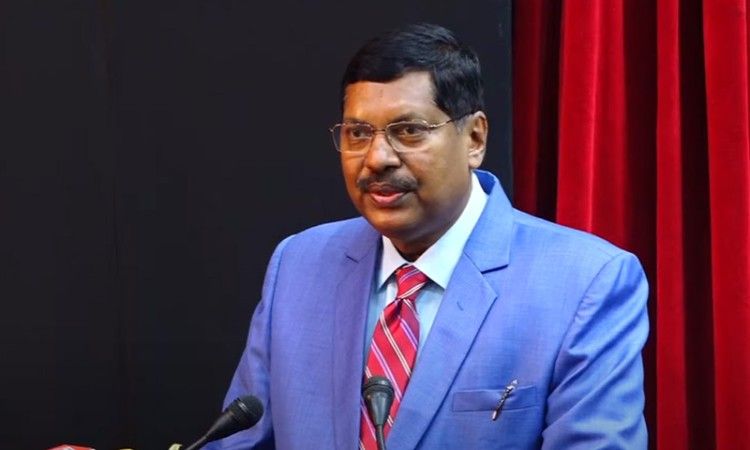
The Chief Justice of India Sanjiv Khanna officially nominated Justice B R Gavai to follow him in his position by sending him to the Union Law Ministry. The approval process will establish Justice Gavai as the 52nd Chief Justice of India before he takes office after CJI Khanna's retirement date of May 13 2025. The appointment of Justice B R Gavai as CJI will span from May 13, 2025 until his retirement date on November 23, 2025. The President chooses Supreme Court judges according to Article 124(2) of the Indian Constitution.
Summary
-
Justice B R Gavai will be the 52nd Chief Justice of India after the retirement of current serving CJI Sanjiv Khanna.
Background and Legal Career
-
Justice Gavai hails from Amravati, Maharashtra.
-
Justice Gavai established his legal practice in 1985 by focusing on constitutional and administrative law cases at the Nagpur Bench of the Bombay High Court until his retirement as Additional Judge.
-
During his career he worked as Assistant Government Pleader before becoming Additional Public Prosecutor and eventually taking the position of Government Pleader for the state.
-
Judge Gavai received promotion as additional judge of Bombay High Court during 2003 before becoming permanent in 2005.
-
His appointment to the Supreme Court took place on May 24th of 2019.
Detailed Judicial Contributions
-
Article 370 Verdict
-
In his role on the Constitution Bench Justice Gavai sanctioned the Center's decision to revoke Article 370 thus strengthening national ties between India and Jammu and Kashmir.
-
-
Electoral Bonds Scheme
-
The judge joined the historic decision which invalidated the political funding scheme because of its insufficient transparency.
-
-
Demonetisation Ruling (2023)
-
Justice Gavai ruled in favor of the central government when it rendered Rs 500 and Rs 1,000 currency notes invalid in 2016.
-
-
Reservation and Creamy Layer
-
Justice Gavai presented a proposal in August 2024 to sub-divide the SC/ST groups by removing the creamy layer category for ensuring genuine equality.
-
-
Bulldozer Demolitions (November 2024)
-
The bench under his leadership decided that property demolitions executed unlawfully breach legal principles.
-
The influence of Article 124(2) funds the appointment of Chief Justices of India through Presidential selection.
-
Constitutional Provision of Judges in the Supreme Court of India
Appointment
-
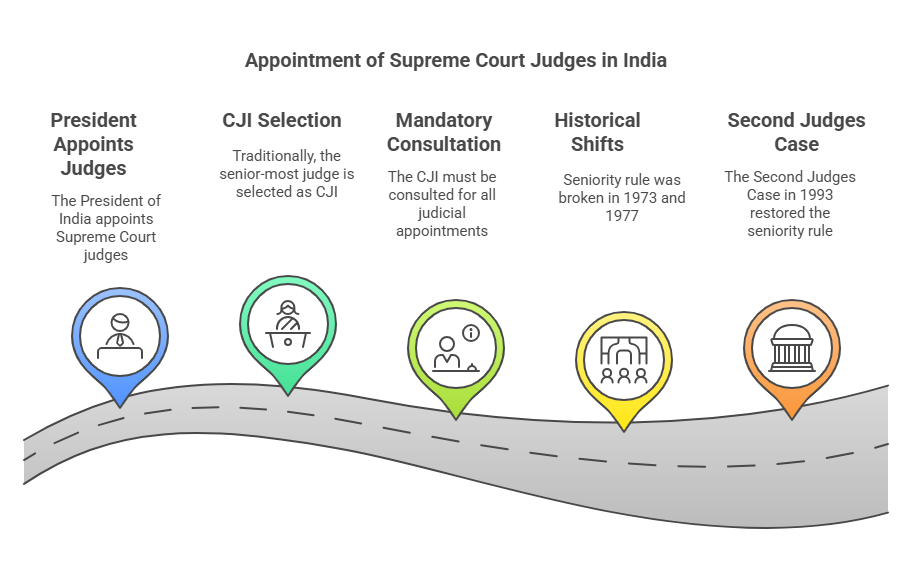
Article 124(2) within the Constitution allows the President to nominate Supreme Court judges.
-
The President obtains advice from judges from the Supreme Court and high courts he believes are necessary for selecting the CJI.
-
In court tradition the most senior Supreme Court Judge becomes entitled for the position of CJI.
-
A consultation with the CJI becomes mandatory whenever anyone is being selected as a Supreme Court judge after the position of Chief Justice.
Historical Note:
-
The law was followed during 1950 to 1973 which always brought the most senior judge to the role of CJI.
-
The custom to appoint the senior-most judge as CJI ended in 1973 (A N Ray) and a second time in 1977 (M U Beg).
-
Through the Second Judges Case (1993) judicial decision the executive branch emphasized that selection of CJI must always fall to the senior most Supreme Court judge.
Qualifications
-
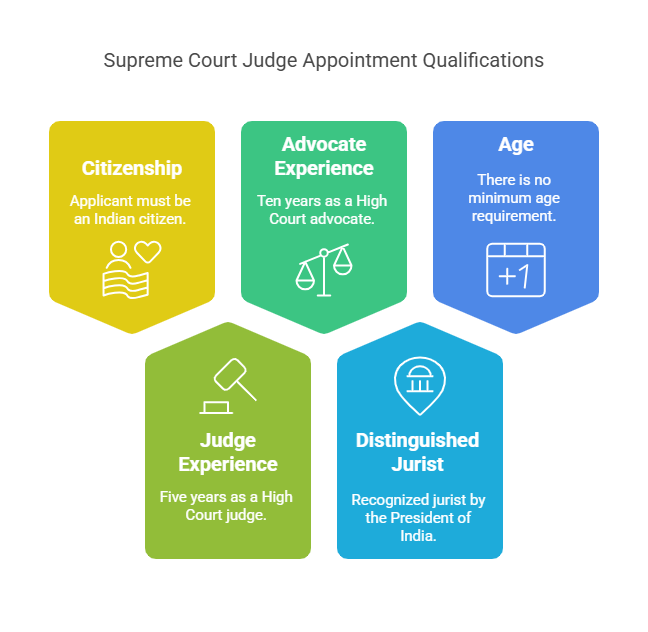
Must be a citizen of India.
-
A candidate should fulfill either one of these conditions:
-
They should have been a high court judge for 5 years or;
-
They should have practiced law as a high court advocate for 10 years.
-
-
Additional requirements:
-
Must be a jurist recognized as distinguished by the President.
-
-
The President selects a distinguished jurist through his own judgment.
-
The Constitution does not set any requirements for age eligibility to serve as the Chief Justice of India.
Role and Powers
-
The top judge maintains full authority to distribute cases to specific benches as well as regulate hearing dates.
-
As Supreme Court head of the Collegium he functions as the primary advisor for High Court and Supreme Court judicial selection.
-
Through Article 127 the Justice of India serves as an appointing authority for temporary Supreme Court judges.
-
A presidential approval allows the SC to relocate its seat from Delhi to another location.
Removal
-
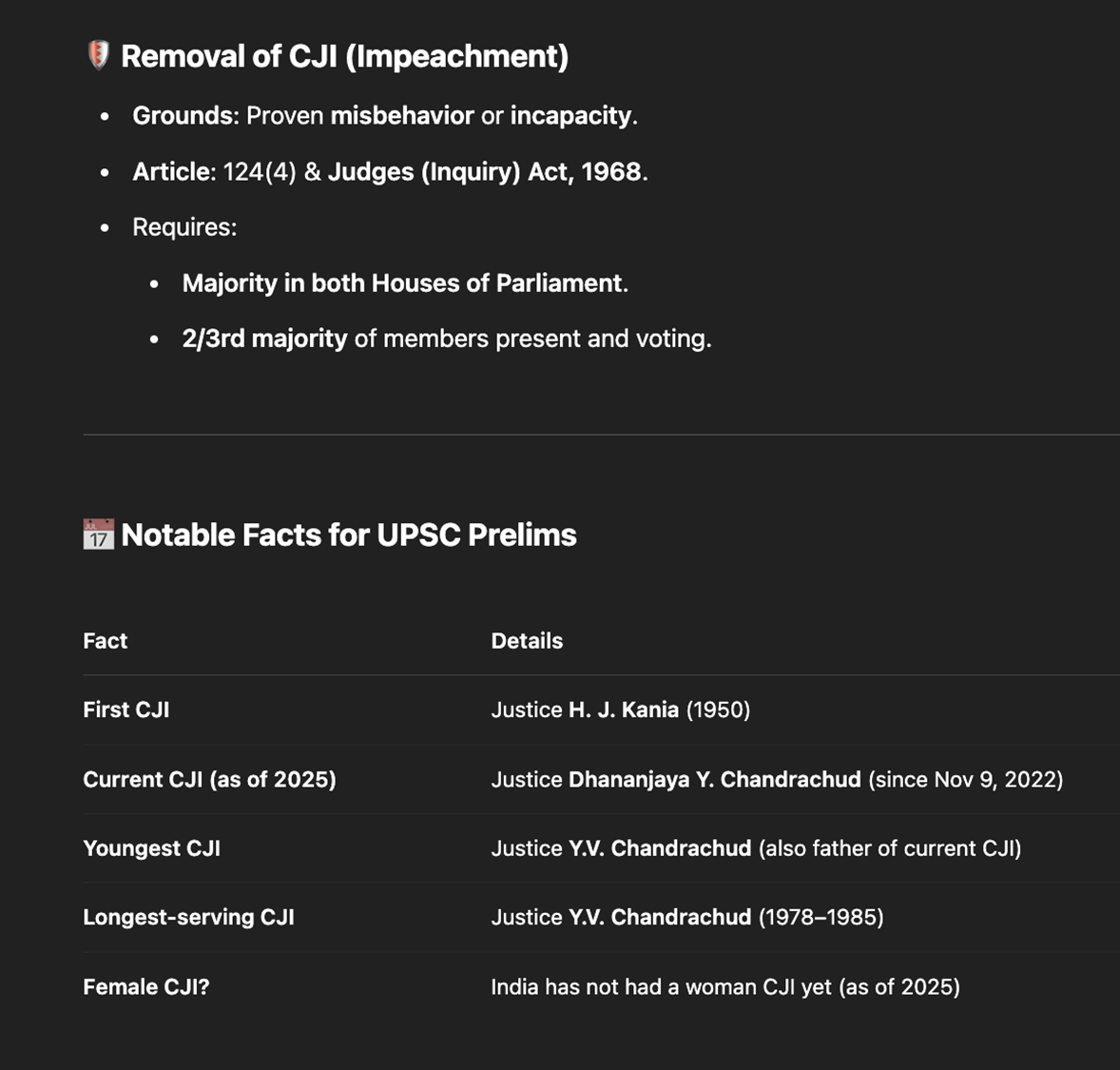
The President requires Parliament to pass a special address following which he can remove the CJI through the process.
-
This requires both Houses to achieve a special majority based on total membership and two-third of present voting members.
Appointment of Judges
-
The President holds the responsibility to appoint judges who work in the Supreme Court.
-
Before making any judicial appointments the President obtains mandatory feedback from the Chief Justice of India together with necessary additional advice from judges.
-
The Chief Justice of India holds an obligatory advisory role during appointee selection procedures that focus on positions beyond the top judicial position.
Collegium System
-
The Supreme Court introduced this procedure during the Three Judges Cases.
-
The collegium system has functioned in higher judicial appointments since 1998.
-
The Constitution and all its amendments fail to mention this procedure.
-
A panel of judges presided over by the CJI contains five members that include himself along with the next senior Supreme Court judges.
-
The appointment structure of Supreme Court collegium mirrors that of Indian High Court collegia.
-
The government can present names to the Collegium yet the final decision belongs to the body if it reaffirms approval.
-
The Supreme Court invalidated the NJAC proposal (2014) because it found the body unconstitutional.
Oath or affirmation
-
A judge must swear to demonstrate absolute loyalty toward the Constitution of India.
-
Indian sovereignty together with its national integrity requires the highest level of defense.
-
Execution of duties applies direct and unyielding loyalty through commitment to maximum ability regardless of bias or contrary relationships.
-
The Constitution along with its laws require full protection.
Tenure of Judges
-
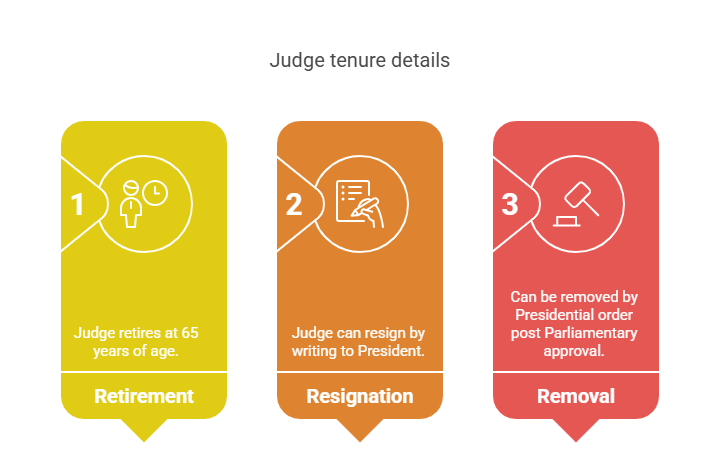
No fixed term; hold office until the age of 65.
-
The judiciary service ends through written notification to the President.
-
The President can discharge a judge after receiving parliamentary approval.
Removal of Judges
-
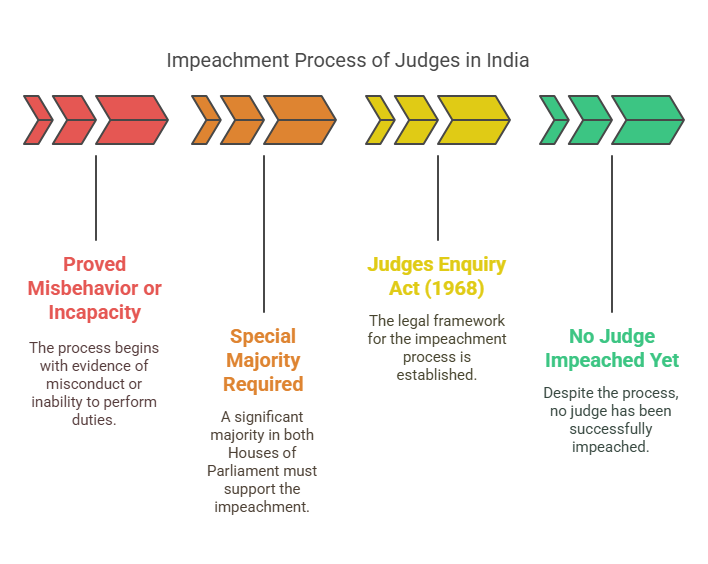
By Presidential order after an address by Parliament.
-
Both Houses must pass the decision with their clearance as a special majority.
-
Grounds: proved misbehaviour or incapacity.
-
The Judges Enquiry Act (1968) specifies the complete procedures to follow.
-
Till now, there have been no successful Supreme Court judge impeachment attempts to date.
Salaries and Allowances
-
Determined by Parliament.
-
The judge’s salary becomes unaffected by reductions unless a financial emergency exists after appointment.
-
The 2021 Bill modified the 1954 and 1958 Acts to alter the period of service for High Court as well as Supreme Court judges.
Conclusion
Justice B R Gavai creates a pivotal chapter in history by succeeding Chief Justice of India through his demonstrated commitment to constitutional values and equitable law enforcement. Through his defining decisions he proved dedication to judicial accountability and governance transparency alongside protection of citizen rights. The 52nd Chief Justice of India will determine key judicial progress during his upcoming term of office.