

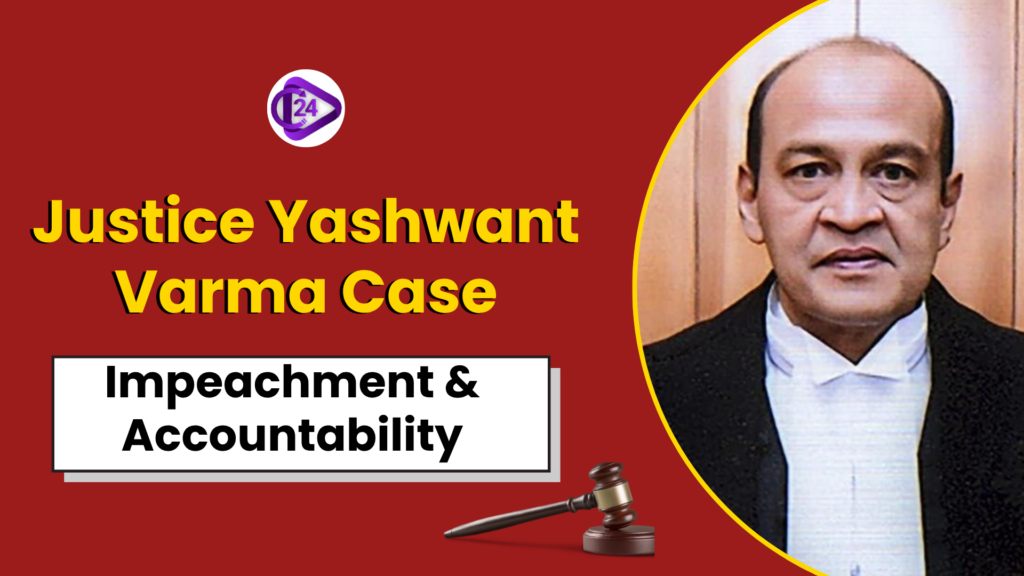
Impeachment Process of Justice Yashwant Varma

Following a major fire incident at his home in March, a 3-member panel suggested indicting Justice Yashwant Varma, from the Delhi High Court now serving at the Allahabad High Court. Later on, cash was found in his outhouse and this triggered demands from others for him to resign, but he...

Following a major fire incident at his home in March, a 3-member panel suggested indicting Justice Yashwant Varma, from the Delhi High Court now serving at the Allahabad High Court. Later on, cash was found in his outhouse and this triggered demands from others for him to resign, but he did not do so. An impeachment of a judge in India is governed by Article 124(4) and Article 217 which say the judge must lose the support of two-thirds of MPs and the approval of both Houses. A judge can also be removed under the law by first going through an Inquiry process known as the Judges (Inquiry) Act, 1968. The case now going on highlights the importance of how accountable and transparent our judges are.

Context 

  • Yashwant Varma was indicted because unaccounted money was found after a fire at his residence. 

  • Although many demanded he step down, he refused which then led authorities to apply Articles 124(4) and 217 of the Indian Constitution.

  • It illustrates difficulties in ensuring fairness and openness in courts.

Key Points

Background:

  • A committee formed by the Supreme Court found Justice Yashwant Varma (previously of Delhi High Court, presently at Allahabad High Court) to be indicted.

  • Cash not linked to his accounts was found in the outhouse after a fire at his Delhi house in March.

  • Justice Varma rejected the request to resign which prompted the next steps.

Legal Procedure: Impeachment of a Judge:

  • Gets its authority from Articles 124(4) and 217 of the Indian Constitution.

  • Requires:

    • 50 members of Rajya Sabha or 100 in Lok Sabha can initiate a motion.

    • An investigation was carried out by a committee of 3 people.

  • Removal only occurs when both Houses approve it with a supermajority of 2/3 (present and voting + total membership).

  • The present stage: A report has been submitted by the committee to Chief Justice of India D.Y. Chandrachud (previously Chief Justice Sanjiv Khanna).

Impacts

  • All-party consensus: To prevent the appearance that the case is being politically motivated.

  • Judicial accountability: Keeps judges and the justice system in check by requiring accountability.

  • Bipartisanship: It was necessary for both political parties to cooperate to get the 2/3rd majority in each House.

  • Public perception: Talks about judicial ethics, independence and connections between the executive and the judiciary.

Provision and Explanation:

  • Article 124(4): Methods for removing Supreme Court judges also apply to High Court judges according to Article 217.

  • Judges (Inquiry) Act, 1968 outlines the rules for inquiry, the production of a report and how removal may happen.

  • Grounds of removal: Proved misbehaviour or incapacity

Historical Context:

  • Among all the impeachment proceedings, only one reached the point of voting in Parliament (Justice V. Ramaswami, in 1993).

  • Support from the ruling party was missing which is why the motion did not succeed, showing how difficult it can be.

Problems Related to Ethics and Administration:

  • Deciding on the proper balance between judicial independence and accountability is a major issue for constitutions.

  • Internal transparency is very important for the judicial process.

  • Recovering money after a warehouse fire raises questions about trust and ethics.

Conclusion

This process for judges requires considering both the need for independence and the need for judges to be accountable. The experience of Justice Varma illustrates the issues judges face when their actions are reviewed.

UPSC Prelims Practice Questions

1. Which statement below describes how a judge can be impeached in India?

a) To trigger an impeachment motion, the President must agree and two-thirds of both Houses of Parliament must back it.
b) The Judges (Inquiry) Act, 1968, describes the steps needed for inquiring into and removing judges.
c) The Supreme Court is the only body that can start the impeachment process for a judge.
d) Removal of a judge can occur if the inquiry committee decides they have made a minor administrative mistake.

UPSC Mains Practice Questions

Q.1 Look at the legal and ethical aspects of impeaching judges in India based on the case of Justice Yashwant Varma as an illustration. How do the legal systems address the need for both independence and accountability of the courts?
Cabinet approves Emergency Credit Line Guarantee Scheme 5.0
Cabinet Approves Increase in Supreme Court Judge Strength to 37
Union Cabinet Approves Mission for Cotton Productivity in India
Vande Mataram Insult to Become Punishable Offence, Cabinet Clears Amendment
UDGAM Portal Update: 30 Banks Integrated to Help Legal Heirs Trace Unclaimed Funds
Malcolm Adiseshiah Award 2026, Raghav Das Gaiha Honoured
07 May 2026
06 May 2026
05 May 2026
04 May 2026
02 May 2026
01 May 2026
30 April 2026
29 April 2026
17 April 2026
16 April 2026

Start Learning Today with Class24

Buy a course

SSC

Railway

Banking

Teaching Exams

Rajasthan Exams

K12 Courses

Class24 Mobile Application

Class24 also has a mobile application so that it becomes easily accessible and convenient. This can be downloaded on an Android device. Users have appreciated this app and the content provided as 4.1 out of 5 is its rating in the App Store. People loved it because Class24 is giving content which is extremely rich in every sense. The app comprises a wide variety of features for smooth learning:

  • User-Friendly Interface: The app is categorized into various sections so that students can navigate and access various resources with ease.
  • Offline Access: The study materials can be downloaded and the student can access them even when not connected to the internet.
  • Inbuilt eBook Reader: There is a lightning-fast reader for eBooks within the app, so reading is seamless.
  • Progress Tracking: The app tracks student’s progress in preparation and keeps them organized and focused.

Courses and Subjects Offered

The total syllabus will be covered, and there are in-depth practice materials so as to give deep preparation in the courses designed to each one of them. All the subjects come under the aegis of courses offered by Class24 to meet different needs of various aspirants such as:

Preparation Tips for All Exams

Preparation tips for all exams mentioned below:

  • Previous Year Papers: Try to attempt at least 5-10 years of question papers to know the pattern of questions, how much difficulty one would face while answering, and how many frequently asked topics were in the examination.
  • Take Mock Tests: Attempt Mock Tests regularly in order to time and accuracy. You may analyze the performance and make an improvement for weak areas.
  • Focus on Time Management: Solve questions in the given time to make a habit of having speed and efficiency. Allocate time sensibly between Paper 1 and Paper 2, while appearing in the examination.
  • Current Affairs: For Current Affairs and TET exams, be updated about current affairs, teaching aptitude, and general awareness.
  • Regular Revision: Spend your daily and weekly time for revisions to not forget concepts and formulas. Use flashcards or do self-summary notes for quick revisions.
  • Understand the Exam Pattern and Syllabus: Understand the pattern of your exam paper and syllabus very well. Both Current Affairs and CSIR NET examinations are two-tier ones and involve both Paper 1, which consists of general aptitude and Paper 2 that involves specific aptitude subjects.
  • Make a Study Plan: Divide the preparation time into three phases of concept building, revision, and mock tests. Allocate more time to weaker areas while maintaining equilibrium with stronger sections.
  • Online Coaching or Study Groups: Enroll in online coaching programs like Class24 to get proper guidance and a structured approach to the study. Study groups will be useful to discuss doubts and share resources.
  • Stay Consistent and Motivated: Maintain a steady study schedule. Stay motivated by making small achievable goals.
  • Use Quality Study Materials: Suggested study material refers to a textbook, a set of previously published question papers, and web sources such as Class24.

Conclusion

Class24 is a one stop solution for aspirants preparing for Current Affairs, CSIR NET, SET, UP PGT English, UP TGT PGT, UPHESC Assistant Professor, TET, IGNOU B.Ed and other competitive exams. There are structured courses, live classes, mock tests along with the guidance of experts to assist candidates in achieving success in their respective fields.

Get success in your hand. Start study anytime anywhere.

The journey becomes simple and enjoyable when you start taking interest in it. And through our app “Class24”, we will be your trusted partners in developing that interest.

Daily Quizzes
Mock Tests
Ongoing

No ongoing tests right now.