
The initial Comprehensive Annual Modular Survey (CAMS) of India gives meaningful clues about Internet accessibility and digital literacy in India. The penetration of broadband is now at 76.3 but there are significant differences between rural and urban, caste, and income level. The survey also presents obstacles of digital literacy, as rural regions and lower-income societies experience huge lacks in Internet usage and computer literacy, including emailing, spreadsheets, and online transactions of funds.
Context
-
The CAMS survey, carried out by the National Sample Survey Office (NSSO) provides an end-to-end view of digital infrastructure and digital skills in India.
-
It highlights inequalities in access to broadband internet and digital literacy in India, which might potentially result in the failure to reach an SDG4 goal of inclusive and equitable education.
Key Points
Broadband Access
-
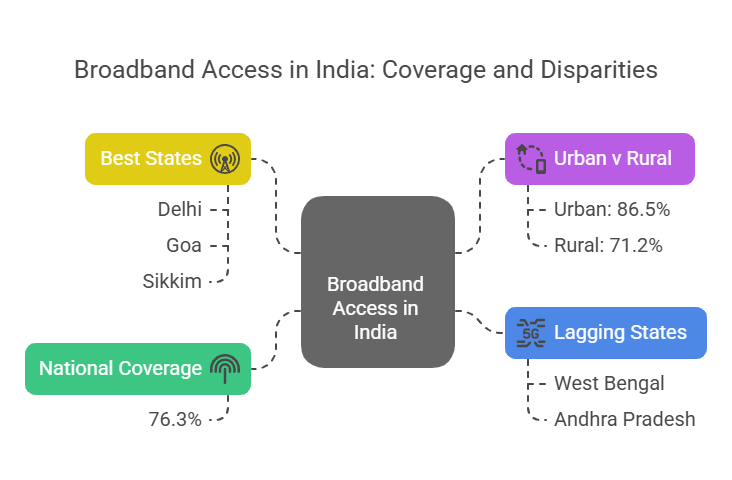
National Coverage: Broadband penetration in Indian households is 76.3%
-
Urban v Rural: Urban access is 86.5 percent rural is 71.2%
-
Best States: Above 90% access is in Delhi, Goa and Sikkim.
-
Lagging States: West Bengal, Andhra Pradesh and some states being less than 70%.
The Economic Inequality and Caster Disparities
-
Caste-wise Access:
-
General: 84.1%
-
OBC: 77.5%
-
SC: 69.1%
-
ST: 64.8%
-
Income Impact:
-
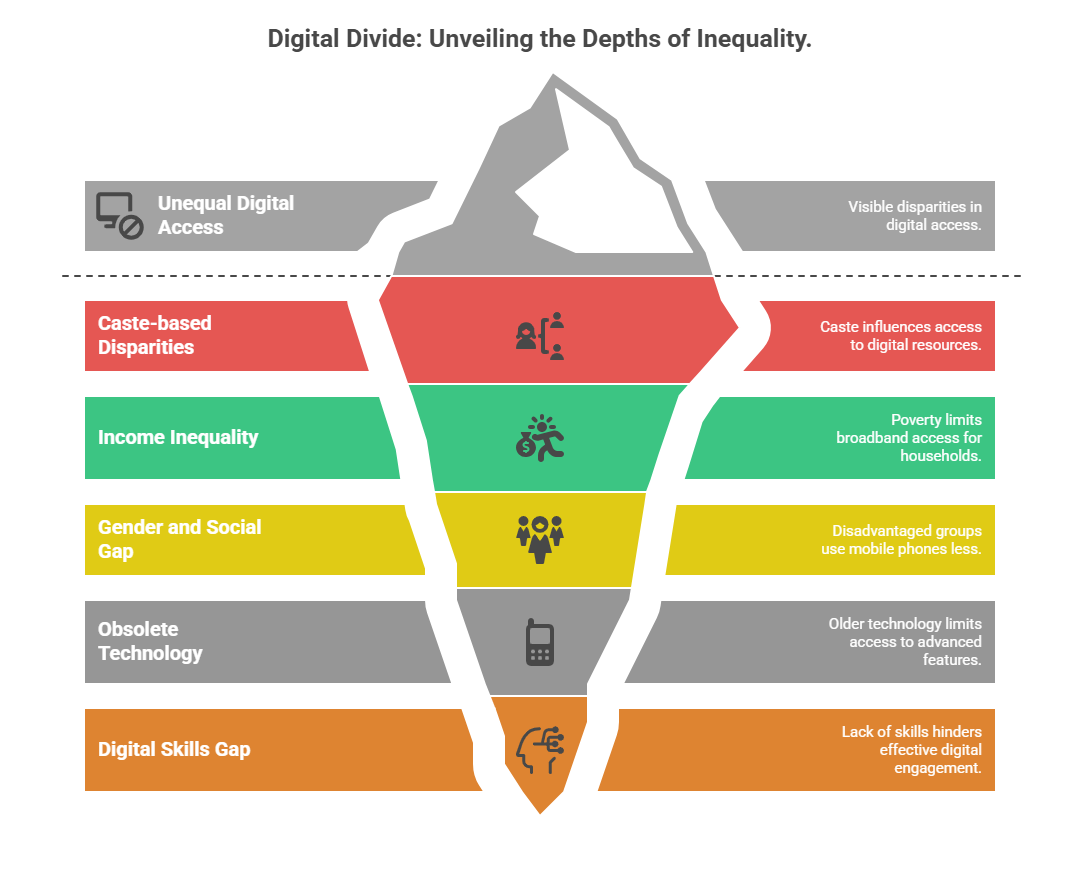
71.6% of the poorest households do not have access to broadband.
-
Access is lacking only in 1.9% of the richest households.
Mobile phones and 4G connectivity
-
Mobile Ownership:
-
Rural: 94.2%
-
Urban: 97.1%
-
Gender and Social Gap: Less use of mobile phones is made by women and other disadvantaged groups.
-
- 4G Usage:
-
Rural: 53.6%
-
Urban: 74%
-
Obsolete Technology: 40.4% of the respondents use the older technology in mobiles; there is low usage of 5G.
-
Digital Skills and Literacy
- Internet Use:
- Rural: 53.6%
- Urban: 74%
- Simple Digital Task:
- Users of email: 20% (rural), 40% (urban)
- Online banking: It is used by only 37.8%
- Advanced Skills: Few have the ability to operate on spread stones, or other productivity tools.
Government Initiatives:
-
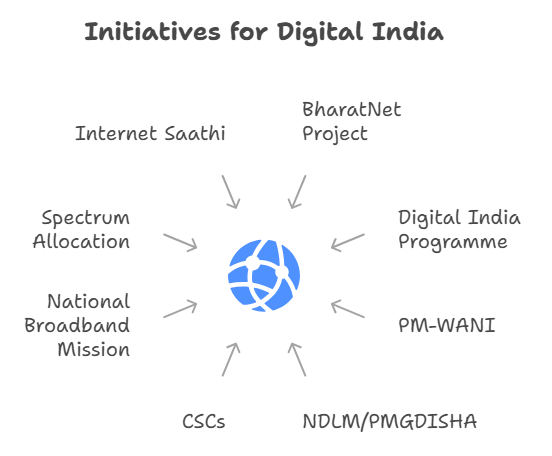
BharatNet Project
-
Goal: To give high-velocity broadband availability to every 2.5 lakh gram panchayats.
-
Coverage: Emphasizes optical fiber coverage on the rural and remote locations.
-
Status: The largest rural broadband project in the world (a project still in phases).
-
-
Digital India Programme
-
Launched: 2015
-
Vision: To make India a digitally enabling nation.
-
Major pillars: digital infrastructure, digital governance and services on demand, digital literacy.
-
-
Wi-Fi Access Network Interface- PM-WANI
-
To install a system of public Wi-Fi hotspots by means of PDOs (Public Data Offices).
-
Advantage: Low cost of wide-spread internet access without any license fee to the operators.
-
-
National Digital Literacy Mission ( NDLM ) / PMGDISHA
-
Other name: Pradhan Mantri Gramin Digital Saksharta Abhiyan
-
Target: To digitally literate 6 crore rural households.
-
Digital Skills in India: Elementary computer and internet knowledge.
-
-
Common Service Centres (CSCs)
-
Roles: Offer e-governance services in the countryside (banking services, education services).
-
Internet Use: Serve as the source of the internet in unserved areas.
-
-
National Broadband Mission
-
Aim: Access to every village via universal broadband, by 2025.
-
Infrastructure: Works on fiber, mobile towers and promotes private investment.
-
-
Spectrum Allocation & Telecom Changes
-
Focus: Catalyze 4G/5G roll.
-
Support: The spectrum auctions, sharing infrastructure and de-regulation.
-
-
Google & Tata Trusts Internet Saathi
-
Digital India supported it although it was not a government run initiative.
-
Goal: The rural women should be trained in digital skills in India and the use of the internet.
-
Effect of Education and Employment:
-
In accordance with SDG 4 ( Education ) quality education is connected with digital skills in India.
-
Digital illiteracy limits access to online education/career opportunities especially to the rural and poor communities.
Digital Divide:
-
Based on the data, it is apparent that although India is progressing on the path of digital inclusion, the gap is still large especially in rural parts of India, among women, and at the bottom of society.
-
These disparities are of essence when it comes to inclusive development.
Conclusion
On the one hand, the CAMS survey shows that in India the improvement of provision of broadband has been maintained, but there is still a high level of inequality in access and digital literacy in India. In particular, inequality is observed among rural populations, the poor castes, and the poorer households. To reach this objective, specific measures will have to be implemented: subsidizing the access to broadband as well as enhancing digital literacy. Digital skills in India and infrastructure should also be a priority among the policymakers in order to have equal and inclusive development, particularly within education and labor.
UPSC Prelims Practice Question
Q.1 Which of the following is/are the key findings from the Comprehensive Annual Modular Survey (CAMS) 2025 regarding digital literacy and broadband access in India?
-
Broadband penetration in India is 76.3%, with a higher penetration in urban areas (86.5%) compared to rural areas (71.2%).
-
71.6% of the poorest households in India lack access to broadband.
-
Women and disadvantaged social groups make significantly higher use of mobile phones than urban populations.
-
The BharatNet Project aims to provide high-velocity broadband to every 2.5 lakh urban areas.
Select the correct answer using the code below:
(a) 1 and 2 only
(b) 1, 2, and 4 only
(c) 1, 2, and 3 only
(d) 3 and 4 only
UPSC Mains Practice Question
Q.1 Discuss the implications of the findings from the Comprehensive Annual Modular Survey (CAMS) 2025 on India’s digital infrastructure and literacy. What measures should the government take to address the existing inequalities in broadband access and digital skills, especially in rural and disadvantaged regions, in the context of SDG 4 (Quality Education)?