

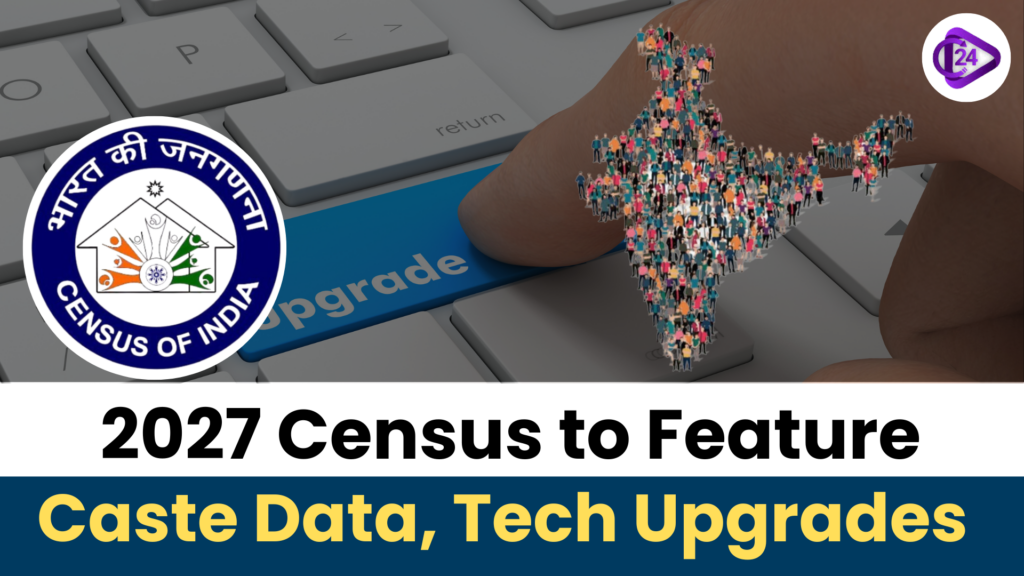
The 16th Census of India, due to take place in 2027 will also be a landmark digital exercise and it will mean a change of direction of data collection. The Census will comprise two stages viz., house-listing and population enumeration with the use of mobile applications, GPS tagging, and an efficient data security system. It also will be the first Census to enumerate caste since 1931 and with new variables of migration, use of technology and gender identification. There will be support in terms of more than 30 lakh enumerators and quality control mechanisms to enhance accuracy and inclusiveness in the process.
Context:
-
In the notice published by the Union Home Ministry in relation to the 2027 Census, there is a plan to conduct a digital two step enumeration which broadly will happen in two stages with the aim of deriving more accurate demographic data.
-
It is going to include new categories along with such perennial problems as caste enumeration, digital literacy, and the gathering of social-economic data.
Key Points
Freezing date and boundaries census:
-
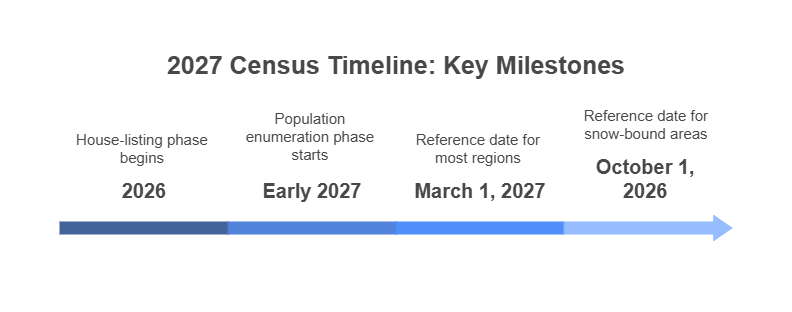
The 2027 Census will commence with the house-listing in the year 2026 and the population enumeration stage will commence in the early period of 2027.
-
Most of the regions will also maintain the reference date as March 1, 2027, except those areas which are snow-bound (Ladakh, Jammu & Kashmir, Himachal Pradesh, and Uttarakhand) as they will have the reference date of October 1, 2026.
-
Administrative boundaries would not be changed before the Census process is over and the integrity of the data collection process would not be impeded by State interference.
What is the Census in India?
-
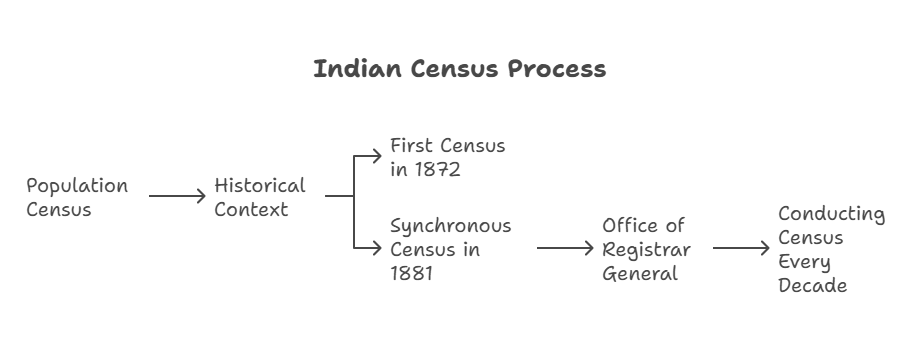
Population Census: It gives rudimentary statistics of the human resources, demographics, culture and the local, regional and national economic structure.
-
History of Census: The Census started in the year 1872, and that too was just a non-synchronous exercise, the first synchronous Census was held in 1881 during the reigns of the British under the guidance of W.C. Plowden.
-
The office of the Registrar General and Census Commissioner of India under the ministry of Home Affairs is charged with the duty of conducting the Census in every decade.
Legal/ Constitutional Census in India:
-
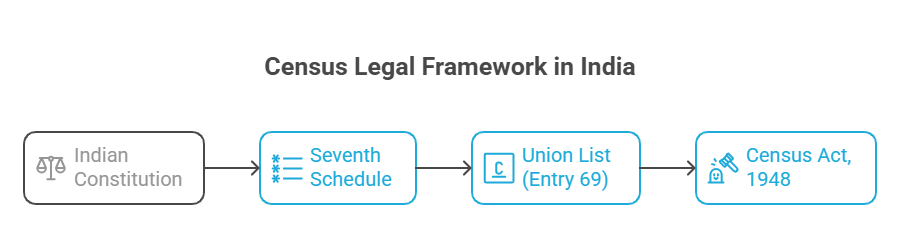
Legal Source: In the Seventh Schedule of the Indian Constitution, under the Union List (Entry 69) the Census is included.
-
Census Act, 1948: The Census is done under the provisions of an enactment called Census Act, 1948.
Two Phase Census Process:
-
Phase 1 (House-listing): This will be between March 2026 and September 2026 and data in buildings, household amenities, and infrastructure will be gathered.
-
Phase 2 (Population Enumeration): Based on individual person level demographic data such as occupation, conditions of inhabitants and personal demographics.
Caste Enumeration:
-
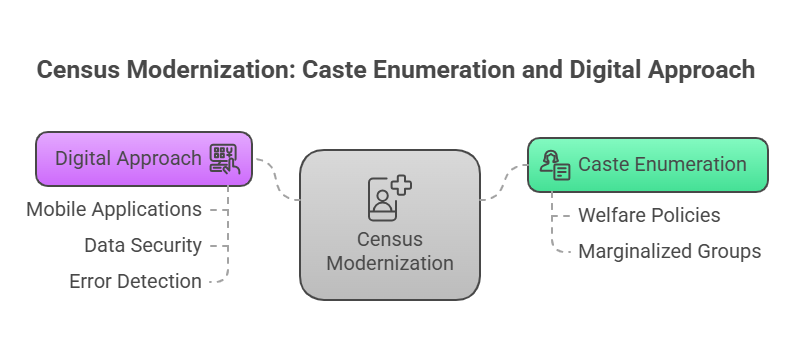
Caste enumeration will be included in the Census after the last time in 1931 and it is a long-standing requirement that caste based data be collected.
-
This will be of great contribution in the architecture of specific welfare policy towards the marginalized groups.
Digital Approach:
-
Census will be done through mobile applications whereby the application will have GPS tagging, offline data collection, and real-time synchronization when there is an availability of connectivity.
-
Strict data security modalities will be put in place to guarantee safe collection, transmission and storage of the data.
-
A computerized system will raise the alert of any mistakes and this will aid in ensuring that a data difference is raised like unrealistic age groups or duplication of data.
New categories introduction:
-
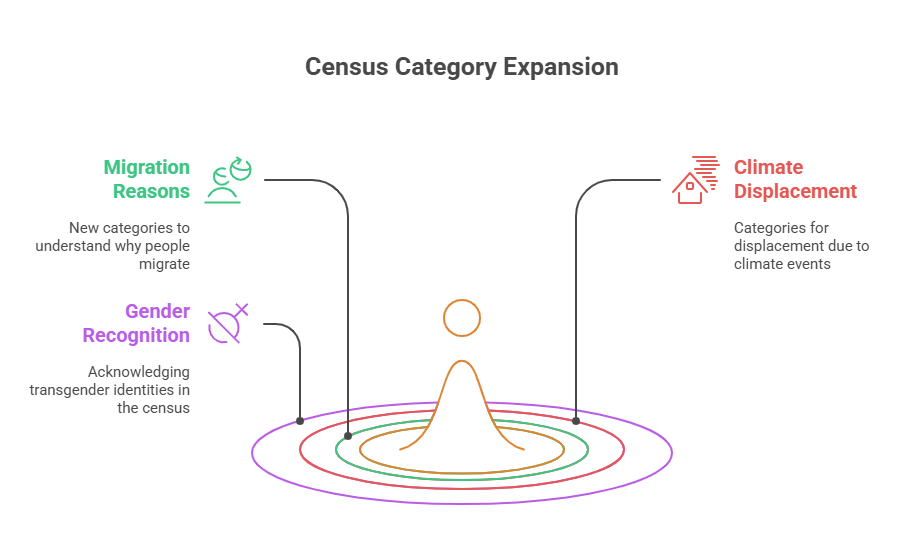
The Census will also create new categories linked to migration, among which there will be reasons, displacement caused by climate events or natural disasters.
-
It will be possible to acknowledge new gender because people will be able to call themselves transgender.
Technological Problems/ Solutions:
-
The Census app is developed to work even in the offline mode in the regions with low connectivity, and the addition of the field support and diagnostic tools will help resolve technical problems in real-time.
-
To facilitate the easy collection of data, enumerators will be extensively trained on electronic literacy, soft skills and the relevant provisions of the law.
Personnel Involved:
-
There are about 34 lakh enumerators and supervisors and 1.3 lakh Census functionaries that will be set to work across India in two phases.
National Population Register (NPR):
-
There is no official news about the revamp of the National Population Register (NPR) and 2027 Census as yet.
-
NPR was updated the last time in 2015, and some NPR stages are not expected this time.
Influence on the Policy Planning:
-
The Census will play a major role in future welfare schemes of India particularly since it uses caste and migrational data.
-
It will assist in the shaping of specific interventions and resource distribution on marginalised communities.
-
Since it has been scheduled before the next Lok Sabha election of 2029, it will be important in terms of delimitation of constituencies and redistribution of parliamentary seats.
Quality Assurance and training:
-
The enumerators will be heavily trained, to make sure that they would be adequately competent when it comes to data collection, digital literacy, and remarks of the people.
-
Automated systems and periodical checks will also make sure that the accuracy of data is maintained and correction can be made before submitting data.
Conclusion
The 2027 Census will become an historical moment in the history of demographic data collection in India, as the country goes digital to achieve improved accuracy, efficient, and inclusive data collection. The Census will be valuable in support of policy guidelines particularly to the disadvantaged groups with the new items such as caste, reasons of migration and gender identity. The improved technological path with the help of millions of enumerators will make this Census one of the most accurate and complete enumerations of the population ever in the history of India.