

‘Beej Utsav’ Celebrates Indigenous Seeds and Agricultural Sustainability Across 3 States

In the tribal areas in the states of Rajasthan, Madhya Pradesh and Gujarat, the seed festival or the Beej Utsav was celebrated in four days highlighting the role of indigenous seeds in ensuring agricultural sustainability. More than 9,400 tribal community members, including women and children, came across the techniques of...

‘Beej Utsav’ Celebrates Indigenous Seeds and Agricultural Sustainability Across 3 States

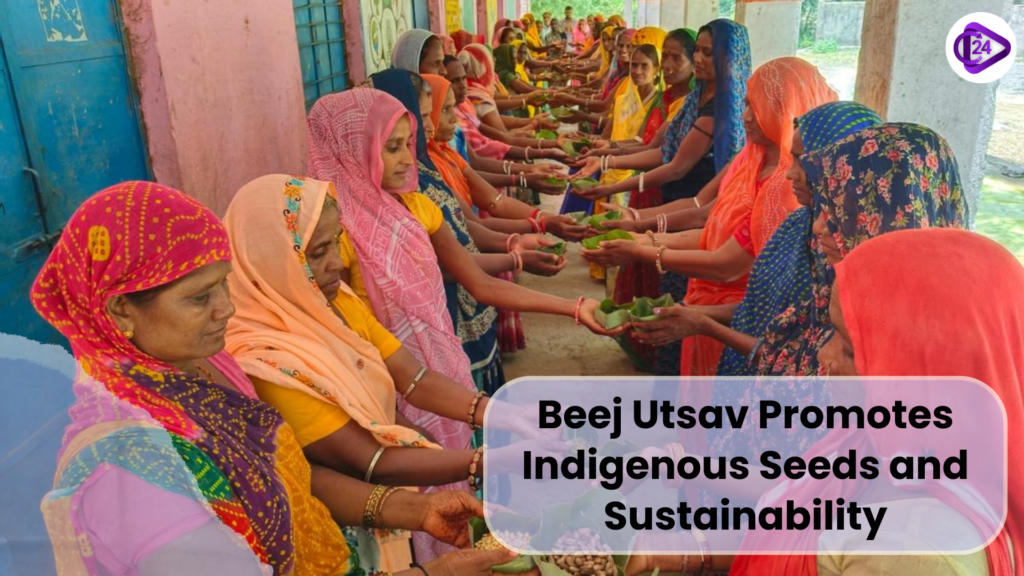
In the tribal areas in the states of Rajasthan, Madhya Pradesh and Gujarat, the seed festival or the Beej Utsav was celebrated in four days highlighting the role of indigenous seeds in ensuring agricultural sustainability. More than 9,400 tribal community members, including women and children, came across the techniques of preservation and utilization of indigenous seeds and to know the importance of preserving seeds in the context of maintaining biodiversity and ensuring climate resilience. There were activities like Beej Samvad (seed dialogue), seed balls and plantation drives at the festival. Independent community institutions such as Vaagdhara were very instrumental in the organizing of the event.

Context 

  • In the states of Rajasthan, Madhya Pradesh and Gujarat, the agenda of Beej Utsav was the maintenance of indigenous seeds to ensure sustainability of farms. 

  • The focus of the festival was intended to be to make people aware of the heritage of seeds, biodiversity and climate-friendly farming methods.

Key Points

  • Objective:

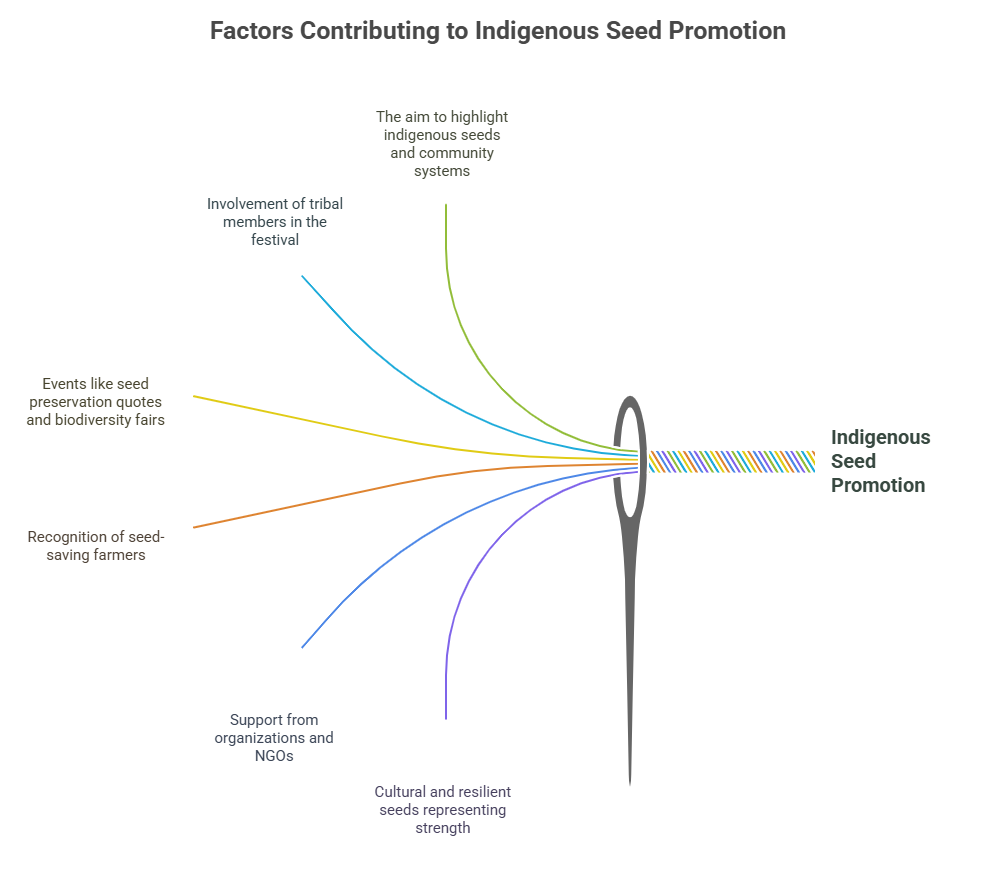
    • The festival aimed to highlight the importance of indigenous seeds in sustainable agriculture and promote community-led seed systems.

    • Allow tribal people to regain seed sovereignty.

  • Participation and coverage:

    • More than 9400 tribal members took part in it.

    • Took place in 60 panchayats and in Indian states.

  • Key Activities:

    • Beej Samvad -Seed preservation quotes.

    • Biodiversity fairs – Exhibition of local seed types.

    • Seed ball preparation-plantation drive- promote environment-friendly cultivation.

  • Honors & Awards:

    • Such arrangements were naming certain farmers as seed-saving Beej Mitra and Beej Mata.

    • In a bid to show appreciation to seed heritage custodians.

  • Institutional Involvement:

    • Organisers: Krishi Evam Adivasi Swaraj Sangathan, Gram Swaraj Samooh, Saksham Samooh, Bal Swaraj Samooh.

    • Backed by Vaagdhara (NGO of Rajasthan).

  • What is the meaning of Indigenous Seeds?

    • The kids are regarded as cultural representations of strength and identity.

    • Provide resilience to climate, nutrition and diversity.

    • Demand transition to community-based systems, away from hybrid and market dependent seeds.

What are Traditional Seeds? 

Definition:

  • Indigenous crop strains farmed, preserved, and traded by farmers through generations.

  • Open-pollinated: able to replenish without losing genetic structure (as hybrid/GM seeds).
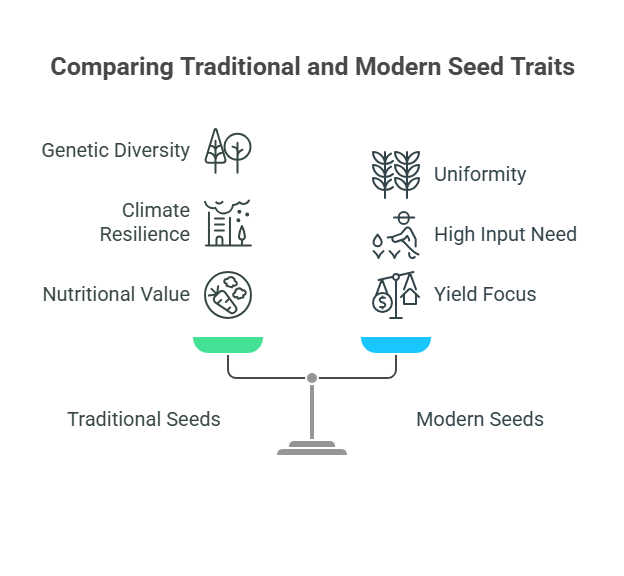
Major Properties of Conventional Seeds

  • Genetic Diversity:

    • Adjusted to the place (land, climate, pests).

    • E.g.: Eastern India with flood resistant traditional varieties of rice.

  • Climate Resilience:

    • Resist natural calamities like droughts, floods and pests.

    • E.g.: Desi cotton consumes 70% less water as compared to Bt cotton.

  • Minimum Input Need:

    • Grow flourishing with no artificial fertilizer or pesticides.

    • Affordable to small farmers.

  • Nutritional Value:

    • It is high in antioxidants, fiber and micronutrients.

    • E.g.: 3 times more calcium of ragi (finger millet) than that of milk.

  • Cultural and Ecological Meaning:

    • Inherent dinners in tribal fare, and in tribal fests in addition to agroecology.

    • Represent food sovereignty and Indigenous knowledge.

Significance of traditional seeds in India

  • Biodiversity Conservation:

    • Retain special genetic material which is essential in food security.

    • E.g.: Pokkali rice (Kerala) is found in salty water.

  • Climate Adaptation:

    • Able to withstand unpredictable climatic conditions and new pests.

    • e.g.: Bhut Jolokia (Assam) likes the humid environment.

  • Nutritional Security:

    • Greater meal fiber and micronutrients.

    • E.g.: Kodo millet contains 3x more fiber in comparison with wheat.

  • Farmer Autonomy:

    • Less reliance on seeds bought on the market.

    • E.g.: 80% of the cotton growers now depend on the expensive GM seeds.

  • Health and Sustainability of the Soil:

    • Increase the fertility of soil and ecological balance.

    • E.g: The Red Rice (Manipur) fertilizes the soil naturally.

Conclusion

The ‘Beej Utsav’ seeks to highlight the importance of indigenous seeds in the sustainability of agriculture especially in the tribal agricultural societies. The festival is directly contributing to the traditional agriculture in the community after popularizing the idea of preserving seeds within the community that is also eco-friendly but culturally relevant to the society. Such a project can become a successful example of the struggle against the problems of climate change and world food safety.

Bengaluru Records Highest Number of Cybercrime Cases in India
Shashi Shekhar Vempati Appointed New CBFC Chairman
India to Host First IBCA Summit in June 2026
Cabinet approves Emergency Credit Line Guarantee Scheme 5.0
Cabinet Approves Increase in Supreme Court Judge Strength to 37
Union Cabinet Approves Mission for Cotton Productivity in India
08 May 2026
07 May 2026
06 May 2026
05 May 2026
04 May 2026
02 May 2026
01 May 2026
30 April 2026
29 April 2026
18 April 2026

Start Learning Today with Class24

Buy a course

SSC

Railway

Banking

Teaching Exams

Rajasthan Exams

K12 Courses

Class24 Mobile Application

Class24 also has a mobile application so that it becomes easily accessible and convenient. This can be downloaded on an Android device. Users have appreciated this app and the content provided as 4.1 out of 5 is its rating in the App Store. People loved it because Class24 is giving content which is extremely rich in every sense. The app comprises a wide variety of features for smooth learning:

  • User-Friendly Interface: The app is categorized into various sections so that students can navigate and access various resources with ease.
  • Offline Access: The study materials can be downloaded and the student can access them even when not connected to the internet.
  • Inbuilt eBook Reader: There is a lightning-fast reader for eBooks within the app, so reading is seamless.
  • Progress Tracking: The app tracks student’s progress in preparation and keeps them organized and focused.

Courses and Subjects Offered

The total syllabus will be covered, and there are in-depth practice materials so as to give deep preparation in the courses designed to each one of them. All the subjects come under the aegis of courses offered by Class24 to meet different needs of various aspirants such as:

Preparation Tips for All Exams

Preparation tips for all exams mentioned below:

  • Previous Year Papers: Try to attempt at least 5-10 years of question papers to know the pattern of questions, how much difficulty one would face while answering, and how many frequently asked topics were in the examination.
  • Take Mock Tests: Attempt Mock Tests regularly in order to time and accuracy. You may analyze the performance and make an improvement for weak areas.
  • Focus on Time Management: Solve questions in the given time to make a habit of having speed and efficiency. Allocate time sensibly between Paper 1 and Paper 2, while appearing in the examination.
  • Current Affairs: For Current Affairs and TET exams, be updated about current affairs, teaching aptitude, and general awareness.
  • Regular Revision: Spend your daily and weekly time for revisions to not forget concepts and formulas. Use flashcards or do self-summary notes for quick revisions.
  • Understand the Exam Pattern and Syllabus: Understand the pattern of your exam paper and syllabus very well. Both Current Affairs and CSIR NET examinations are two-tier ones and involve both Paper 1, which consists of general aptitude and Paper 2 that involves specific aptitude subjects.
  • Make a Study Plan: Divide the preparation time into three phases of concept building, revision, and mock tests. Allocate more time to weaker areas while maintaining equilibrium with stronger sections.
  • Online Coaching or Study Groups: Enroll in online coaching programs like Class24 to get proper guidance and a structured approach to the study. Study groups will be useful to discuss doubts and share resources.
  • Stay Consistent and Motivated: Maintain a steady study schedule. Stay motivated by making small achievable goals.
  • Use Quality Study Materials: Suggested study material refers to a textbook, a set of previously published question papers, and web sources such as Class24.

Conclusion

Class24 is a one stop solution for aspirants preparing for Current Affairs, CSIR NET, SET, UP PGT English, UP TGT PGT, UPHESC Assistant Professor, TET, IGNOU B.Ed and other competitive exams. There are structured courses, live classes, mock tests along with the guidance of experts to assist candidates in achieving success in their respective fields.

Get success in your hand. Start study anytime anywhere.

The journey becomes simple and enjoyable when you start taking interest in it. And through our app “Class24”, we will be your trusted partners in developing that interest.

Daily Quizzes
Mock Tests
Ongoing

No ongoing tests right now.