


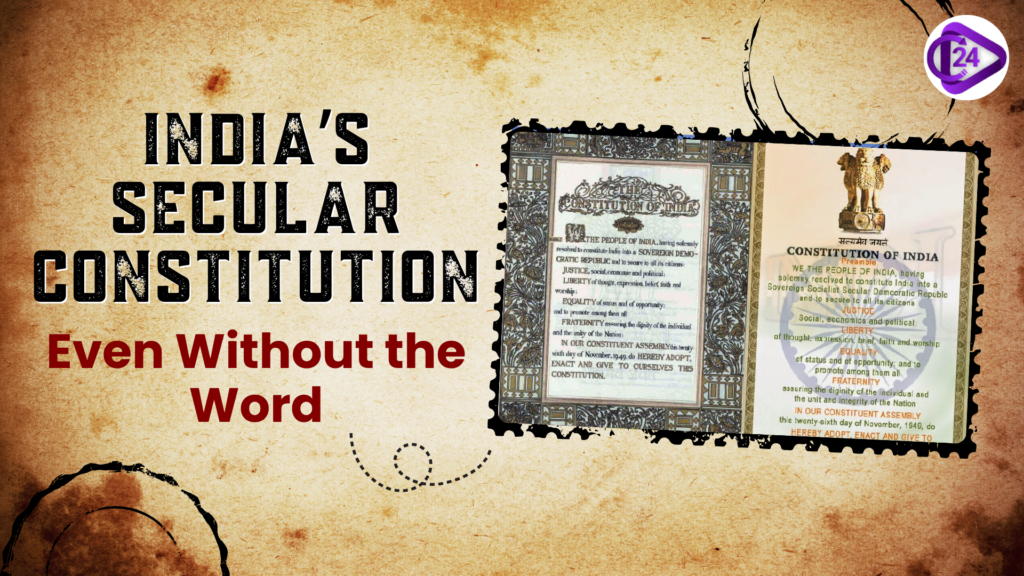
The use of the word secular in the Indian Constitution was brought about by a 42 nd Amendment in 1976. Nevertheless, the subject of secularism is entrenched in the Constitution in one way or another like the right to equality under Articles 14 and 15. Vice President Jagdeep Dhankhar recently referred to this edition of the word secular as a controversial decision and this view has been echoed by some politicians such as the Union Minister, Shivraj Singh Chouhan and Chief of RSS, Dattatreya Hosabale. Nevertheless, in spite of that, the key to secularism has never been forgotten, and the Constitution always tried to stress the distinction between state and religious life.
Context
-
The supplement of the term secular to the Constitution of India, 1976 was not regarded as necessary but also a major step out of totality, because under the Constitution of India even then it had provisions that guaranteed secularism.
-
Secularism has always been a major aspect with laws that facilitate equality and non-discrimination.
Key points
Preamble 42th Amendment:
-
During the amendment of 1976 the 42 nd Amendment was taken into the Preamble of the Constitution at the rearrangement of the term in respect of secular and socialist.
-
In the Preamble prior to the 42nd Amendment it was stressed how India was a Sovereign Democratic Republic.
The Constitution and Secularism:
-
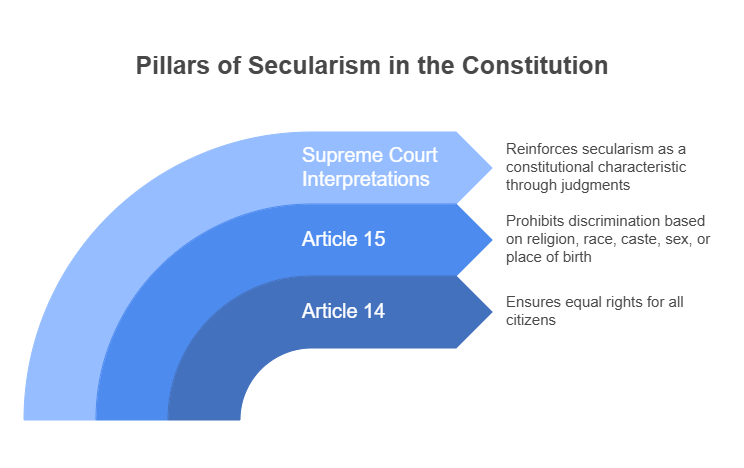
Another major value implied by the Constitution termed as Secularism can be found in Article 14, which gives equal rights, and Article 15 which does not allow discrimination grounds on the basis of religion, race, caste, sex or place of birth.
-
A clarification of this notion has been further strengthened by the Supreme Court which in a series of judgments has interpreted secularism as a constitutional characteristic.
Secularism the World As it Suddenly Happened:
-
In the regime of Indira Gandhi, a new term of secularism was inserted to signify adherence to the economic plan and vision of social justice of the Prime Minister in the country.
-
The same year in 1973, secularism was re-emphasised in the case of Kesavananda Bharati in which it was declared as being a basic structure of the Constitution.
The Mystery behind the changes:
-
The historical choice of including the term secular has been politically determinant as there was an inclination to include more political precipice on account of increased prevalence of Bharatiya Janata Sangh (the progenitor of the BJP).
-
Secularism is actually supposed to confront the increasing role of religion in politics at that time.
Effect and Legal Value of Law:
-
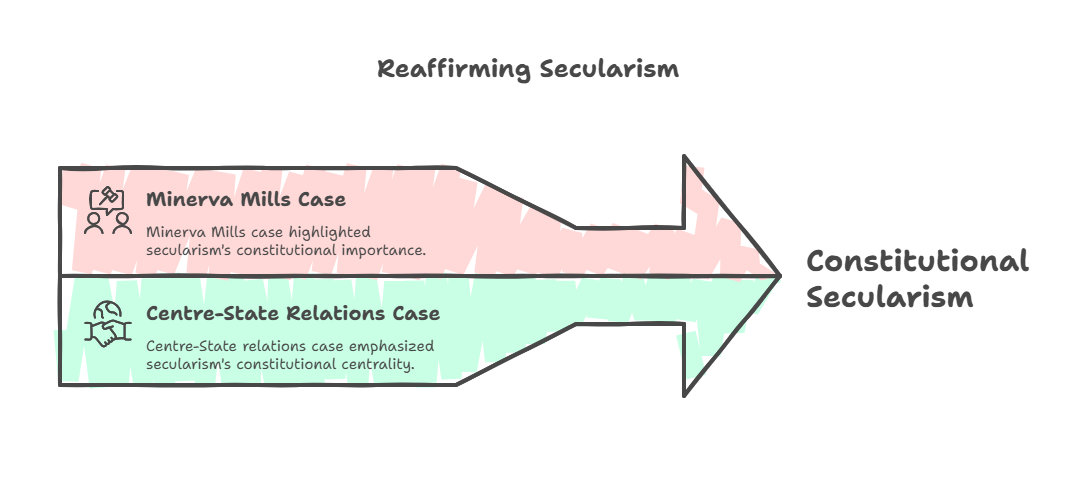
Minerva Mills v Union of India of 1980, in the Supreme Court, reaffirmed the significance of secularism.
-
The case of 1993 on Centre-State relations reiterated secularism as to be central to the Constitution by the Supreme Court.
About Secularism
Secularism:
-
Secularism is the elimination of religion in state processes so that the government is impartial towards religious beliefs.
It consists of two important aspects:
-
Dharm Nirpekshta (The withdrawal of religion and the state).
-
One religion is Sarva Dharma Sambhava (Equal respect of all religions).
Secularism in Indian Constitution:

-
Article 14: Ensures equivalence before the law and equal protection of laws to any citizen.
-
Article 16(1): Aims at giving equality of opportunity in employment under the state, which does not discriminate against a person based on religion, race, caste, sex, descent, place of birth and residence.
-
Article 25: Imparts the freedom of conscience that gives each individual the right to freely profess, practice and propagate his or her religion.
-
Article 26: It guards the rights of religious communities to formulate and manage religious and charity institutions and run their affairs in religious complexities.
-
Article 27: provides that no tax should be charged in promotion or upkeep of one specific religion or religious organisation.
-
Article 28: Permits educational establishments of religious affiliations to give religious teachings.
-
Articles 29 & 30: Present cultural and educational rights to minorities, as they can retain their culture, and obtain an education, without discrimination.
-
Article 51A: Harvardises duties, imposes on the citizens the obligation to upholding harmony and fraternal attitude of common brotherhood and protective care of the heritage of rich cultural heritage of composite Indian culture.
The 42nd Constitutional Amendment Act (1976):
-
The term secular found itself in the preamble of the Indian constitution which stated that India is a secular republic where no religion or religion was treated with inferiority.
Interpretation of Secularism in the courts:
-
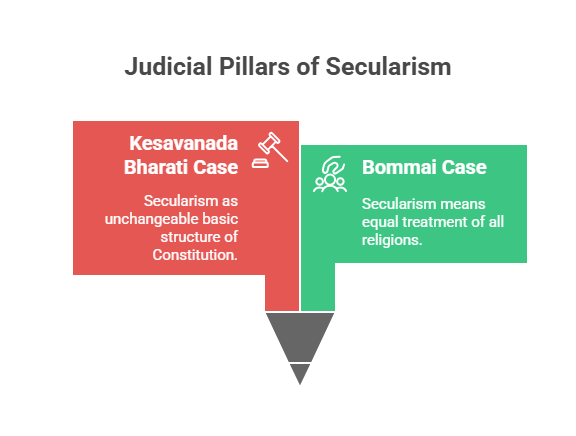
Kesavanada Bharati v. State of Kerala (1973): The court found out that secularism is an element of basic structure of the Constitution and, thus cannot be changed or have its destruction through amendments.
-
Bommai v. Union of India (1994): The Court explained the concept of secularism to mean treatment of all religions equally and indicated that secularism has become a part of Indian governance.
Conclusion
The term secular that was introduced to the Constitution of India as the 42 nd Amendment is symbolically treated. Secularism thinking was not new in the Constitution as it was, in part, incorporated into the Constitution with concepts encouraging equality, and banning any form of discrimination. Nevertheless, even after the changes, secularism is one of the central principles of the Indian judicial and political system that focuses on the division of the religious order and state affairs.