


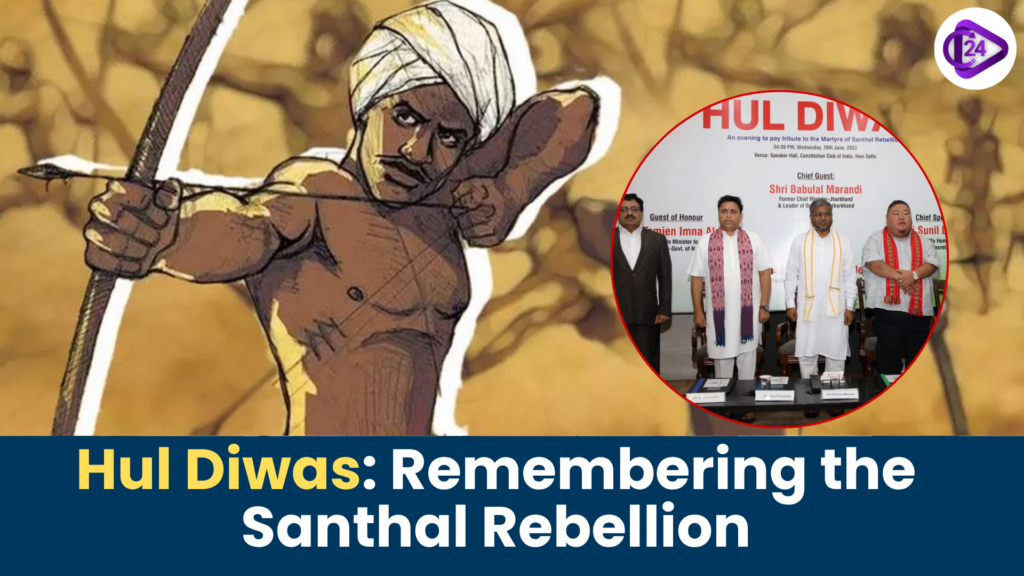
created by leaders of tribal community Sidha and Kanhu Murmu. The day represents the resistance by the tribe and their struggle towards justice. Although the rebellion was crushed, this became a basis to future fights on tribal rights and freedom. The after-effect of this movement is seen to reign amongst the tribal tribes in India, particularly in states of Jharkhand, West Bengal, Odisha, Assam, and Bihar.
Context:
-
In the annual Hul Diwas tribal village protest against the removal of the stage that was used to recall the 1855 Santhal rebellion, the police clashed against tribal villagers.
-
It is a politically controversial case where there is a singling out of police brutality against the tribal community.
Key Points
What is Hul Diwas?
-
The Hul Diwas is celebrated on 30 th June every year in remembrance of the Santhal Rebellion in 1855.
-
It is also the rebellion of Santhal people, mainly Sidho Murmu and Kanhu Murmu, against British colonialism and those policies of exploitation which existed in their local societies.
Meaning of “Hul”
-
The word, Hul in Santhali means revolution, uprising or resistance in Santhali language.
-
It is a battle against wrong, against the British government as well as local landlords, and moneylenders.
When or Where the Santhal Hul Occurred?
-
This revolt started on 30 th June of the year 1855 in Bhognadih which is now the Sahibganj district of Jharkhand.
-
It spread to some regions of Jharkhand, Bihar and West Bengal and continued till January 3 in 1856.
Important Personalities of Rebellion:
-
Main leaders, Sidho Murmu and Kanhu Murmu.
-
They have brothers (named) Chand Murmu and Bhairav Murmu.
-
Their sisters Phulo Murmu and Jhano Murmu who were instrumental in militant resistance as well.
The Women in the Period of Hul Diwas:
-
Women led some of the revolts and their leaders were Phulo Murmu and Jhano Murmu who joined men in the fight.
-
Their courage is now getting more popular and it has been an example to tribal women and girls.
Causes of Santhal Rebellion:
-
The Santhals were evicted on their native lands: Alienation of land.
-
Economic exploitation A large part of earnings got taken out by taxes and usurious loans by local moneylenders and zamindars.
-
Compulsory work and deprivation of self-control over tribal organization and law.
-
Indifference of the British on the tribal wrongs.
What was the nature of the Rebellion?
-
An estimated 60000 Santhals fought the rebellion armed with bows, arrows, axes, and spears.
-
The uprising established its government and proclaimed itself independent.
-
Successful at the start, it was later squashed by the British leading to the loss of thousands of lives amongst the tribals.
Legacy of the Hul Rebellion
-
The Hul Rebellion acted as a foreshadow to the 1857 Sepoy Mutiny.
-
It was a representation of tribal claim, courage and sacrifice.
-
The revolt also resulted in the creation of Santhal Pargana district in 1855 which was a significant administrative reform.
What is the Hul Diwas Celebration these Days?
-
Homage is also done at Sidho-Kanhu Memorial Park in Bhognadih and the statues of the leaders are also garlanded.
-
Santhali cultural programs with music and dances.
-
Demonstrations and marches of tribal groups.
-
Government organized a fair in Ranchi and Bhognadih.
Acknowledgement of Hul Diwas:
-
Considered a Government recognized State holiday by the Government of Jharkhand.
-
Growing national awareness because of programs geared towards the welfare of tribals.
India as a Modern Case:
-
Hul Diwas is a reminder of how the tribals resisted and gave their contribution to India becoming freely independent.
-
It talks about tribal rights, defense of land, language, and culture.
-
It highlights current issues affecting tribal communities such as displacement, marginality and exclusion of access to basic services such as education and healthcare.
Monuments on Hul Leaders:
-
Sidho-Kanhu Memorial Park at Bhognadih.
-
Monuments and statues in Ranchi, Dumka and Jharkhand.
-
The university is named Sidho-Kanhu University in Dumka, after them.
Conclusion
Hul Diwas is the day of cultural pride and opposition of tribal people, especially Jharkhand and it is a reminder of their fight towards justice and equality. Today, the Santhal Rebellion remains a source of inspiration to movements in India in the cause of tribal rights and social justice.