

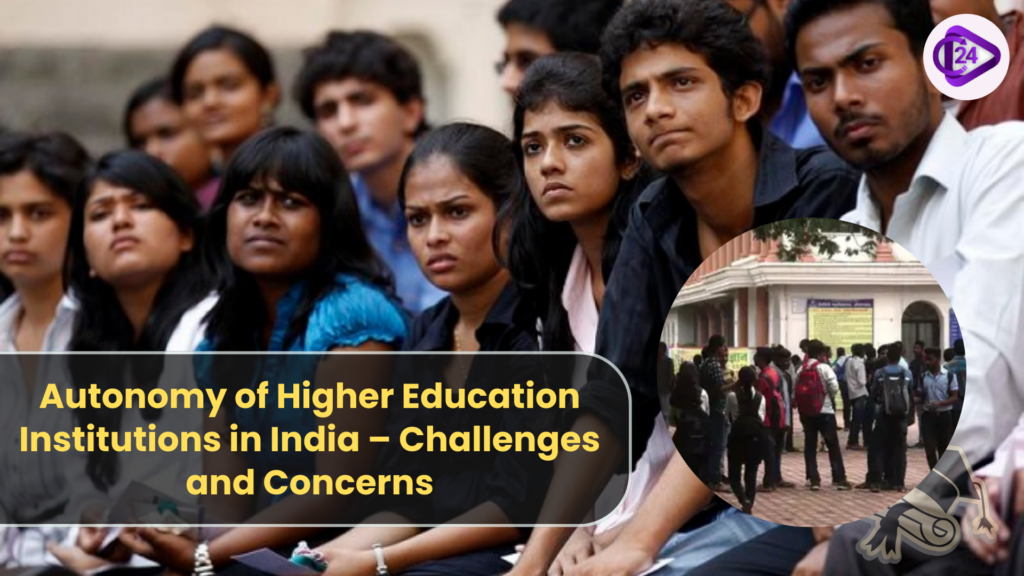
Autonomy of Higher Education Institutions in India – Challenges and Concerns

Higher education in India is in a downward trend wherein there is enormous interference at the political level especially in hiring the vice-chancellors and other faculty positions at the cost of merit and academic freedom. The independence, paramount in attaining excellence, is gradually being worn out by the control mechanisms,...

Autonomy of Higher Education Institutions in India – Challenges and Concerns

Higher education in India is in a downward trend wherein there is enormous interference at the political level especially in hiring the vice-chancellors and other faculty positions at the cost of merit and academic freedom. The independence, paramount in attaining excellence, is gradually being worn out by the control mechanisms, including the centralised position of regulation, licensing and funding on the part of the UGC. There is increasing power of ideologically based appointment which erupts the quality and pluralism and diversity within the campuses. Checks and balances of institutions on statutes are bypassed rather frequently and thus result in standardisation that suppresses innovations. The collapse in the standards of academic learning will increase faster without academic institutions taking initiatives to preserve their independence.

In News

  • Problem: The poor level of autonomy at the institutional level in universities because of political control in decision making, employment and programs.

  • Recent Trend: Appointments based on ideology particularly past 2014 and more prominence of RSS-BJP inclinations in appointment of both faculty and leadership.

  • Institutional Control: UGC is vested with collectively shared powers of licensing, regulating, as well as funding, so that neither checks nor balances can be used.

  • Effect: Quashing of otherness, pluralism and differentiation – forerunners in academic excellence.

  • Caution: Once autonomy is lost it is hard to gain back and once the institutions are compromised it will take decades to rebuild.

Background

  • Autonomy in Higher Education: This means the independence in the academic, administrative and financial decisions-making process allowing innovation and free-thinking.

  • Historical Context: Early political interference In the 1970s, there was initial political interference; it intensified with Emergency in 19751977, coalitions (19892014) later provided some checks and since after 2014, interventions have been more centralised and ideologically shaped.

Key Challenges

1. Political Interference

  • Increased appointment of VCs and faculty in ways that are increasingly not merit based but politically loyal.

  • By-passing statutory procedures of the appointments.

2. Institutional Capture

  • UGC plays a role of a regulator, licensor and fund-distributor- a server of centralisation.

  • Research control was influenced by the other bodies such as ICSSR, ICPR, CSIR, DST.

  • Issues with centralised admissions through NTA (CUET, JEE, NEET) with integrity issues.

3. Checks and Balances Erosion

  • Elimination of norms of seniority / rotation of the position of dean and HoD.

  • Selection-committee manipulation.

4. Influence on the Academic Quality

  • Suffocates diversity and pluralism, which is the principal to academic excellence.

  • The consequences of poor appointments are long term since one retires as a faculty.

Consequences

  • Academic decadence and an intellectual decline.

  • Politicisation of Campuses, minimising the room of autonomous thinking.

  • Perpetual loss of trust among people and reputation of institutions.

Way Forward

  • Amplify Statutory Autonomy: Intensify the legal provisions to defend the autonomy of universities.

  • Open Appointments: Search committees removed from the political fray.

  • Decentralisation: Divide among various bodies in regulation, accreditation and funding.

  • Capacity Building: Governor on ethics in governance academies.

  • Stakeholder Claim: University communities have to be on the front line of defending their autonomy.

Conclusion

The key to academic excellence, innovation and democratic culture is university autonomy. When politics takes grip on the administration of higher education, these values are eroded leading to a lasting damage which is difficult to correct. That the only way to protect the autonomy is not only to make systemic reforms and also resist actively by the academic communities but also to depend not on the goodwill of the government.
India to Host First IBCA Summit in June 2026
Cabinet approves Emergency Credit Line Guarantee Scheme 5.0
Cabinet Approves Increase in Supreme Court Judge Strength to 37
Union Cabinet Approves Mission for Cotton Productivity in India
Vande Mataram Insult to Become Punishable Offence, Cabinet Clears Amendment
UDGAM Portal Update: 30 Banks Integrated to Help Legal Heirs Trace Unclaimed Funds
08 May 2026
07 May 2026
06 May 2026
05 May 2026
04 May 2026
02 May 2026
01 May 2026
30 April 2026
29 April 2026
18 April 2026

Start Learning Today with Class24

Buy a course

SSC

Railway

Banking

Teaching Exams

Rajasthan Exams

K12 Courses

Class24 Mobile Application

Class24 also has a mobile application so that it becomes easily accessible and convenient. This can be downloaded on an Android device. Users have appreciated this app and the content provided as 4.1 out of 5 is its rating in the App Store. People loved it because Class24 is giving content which is extremely rich in every sense. The app comprises a wide variety of features for smooth learning:

  • User-Friendly Interface: The app is categorized into various sections so that students can navigate and access various resources with ease.
  • Offline Access: The study materials can be downloaded and the student can access them even when not connected to the internet.
  • Inbuilt eBook Reader: There is a lightning-fast reader for eBooks within the app, so reading is seamless.
  • Progress Tracking: The app tracks student’s progress in preparation and keeps them organized and focused.

Courses and Subjects Offered

The total syllabus will be covered, and there are in-depth practice materials so as to give deep preparation in the courses designed to each one of them. All the subjects come under the aegis of courses offered by Class24 to meet different needs of various aspirants such as:

Preparation Tips for All Exams

Preparation tips for all exams mentioned below:

  • Previous Year Papers: Try to attempt at least 5-10 years of question papers to know the pattern of questions, how much difficulty one would face while answering, and how many frequently asked topics were in the examination.
  • Take Mock Tests: Attempt Mock Tests regularly in order to time and accuracy. You may analyze the performance and make an improvement for weak areas.
  • Focus on Time Management: Solve questions in the given time to make a habit of having speed and efficiency. Allocate time sensibly between Paper 1 and Paper 2, while appearing in the examination.
  • Current Affairs: For Current Affairs and TET exams, be updated about current affairs, teaching aptitude, and general awareness.
  • Regular Revision: Spend your daily and weekly time for revisions to not forget concepts and formulas. Use flashcards or do self-summary notes for quick revisions.
  • Understand the Exam Pattern and Syllabus: Understand the pattern of your exam paper and syllabus very well. Both Current Affairs and CSIR NET examinations are two-tier ones and involve both Paper 1, which consists of general aptitude and Paper 2 that involves specific aptitude subjects.
  • Make a Study Plan: Divide the preparation time into three phases of concept building, revision, and mock tests. Allocate more time to weaker areas while maintaining equilibrium with stronger sections.
  • Online Coaching or Study Groups: Enroll in online coaching programs like Class24 to get proper guidance and a structured approach to the study. Study groups will be useful to discuss doubts and share resources.
  • Stay Consistent and Motivated: Maintain a steady study schedule. Stay motivated by making small achievable goals.
  • Use Quality Study Materials: Suggested study material refers to a textbook, a set of previously published question papers, and web sources such as Class24.

Conclusion

Class24 is a one stop solution for aspirants preparing for Current Affairs, CSIR NET, SET, UP PGT English, UP TGT PGT, UPHESC Assistant Professor, TET, IGNOU B.Ed and other competitive exams. There are structured courses, live classes, mock tests along with the guidance of experts to assist candidates in achieving success in their respective fields.

Get success in your hand. Start study anytime anywhere.

The journey becomes simple and enjoyable when you start taking interest in it. And through our app “Class24”, we will be your trusted partners in developing that interest.

Daily Quizzes
Mock Tests
Ongoing

No ongoing tests right now.