

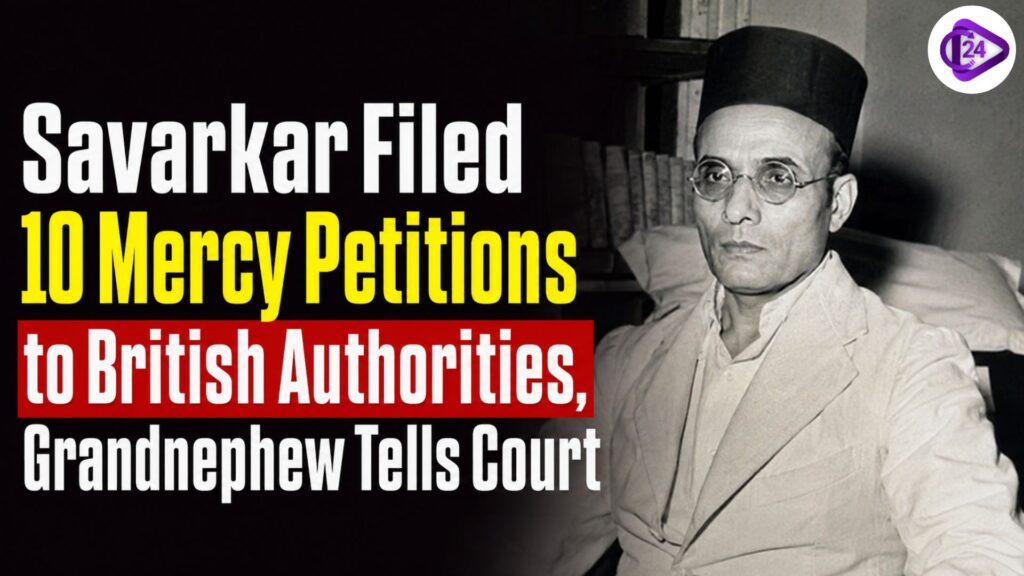
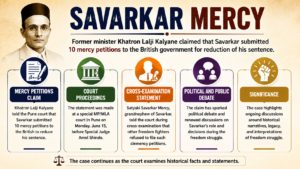
Savarkar Mercy: On Monday (June 15), a Pune-based member of the Congress and a former minister, Khatron Lalji Kalyane, at a special MP/MLA court in Pune, said that Savarkar had to have submitted 10 mercy petitions to the British government to have his sentence reduced.
Satyaki Savarkar Mercy, the grandnephew of Savarkar, who has filed a defamation case against Lok Sabha leader of opposition Rahul Gandhi, also told Special Judge Amol Shinde during cross-examination that other freedom fighters refused to file clemency petitions before the British, reported
Savarkar Mercy submitted Petitions to British Authorities: Key Highlights
- A court has been told that Savarkar had filed 10 mercy petitions while under the British during his lifetime, at his grandson’s hands.
- It was made in the midst of ongoing legal proceedings with regard to Savarkar’s legacy.
- The issue has raised a long-standing historical and political debate once again.
- The reasons and impact of the petitions is controversial among historians.
- But this time, the petitions are said to be planned and have been protested against differently by supporters and critics.
- The controversy has left its imprint on the running of public discourse concerning the freedom movement in India.
Who Was Vinayak Damodar Savarkar Mercy?
Vinayak Damodar Savarkar, popularly known as Veer Savarkar, was a freedom fighter, author, social reformer, and political ideologue.
Key Facts About Savarkar
| Particulars | Details |
| Full Name | Vinayak Damodar Savarkar |
| Popular Name | Veer Savarkar |
| Born | 28 May 1883 |
| Birthplace | Bhagur, Maharashtra |
| Organisation | Abhinav Bharat Society |
| Imprisonment | Cellular Jail, Andaman and Nicobar Islands |
| Year of Release | 1924 (with restrictions) |
| Notable Work | Hindutva: Who Is a Hindu? |
| Died | 26 February 1966 |
Why Did Savarkar Mercy Petitions to British Authorities?
- In 1911, Vinayak Damodar Savarkar Mercy was sentenced twice to two years each in the Cellular Jail, Andaman & Nicobar Islands.
- He was subjected to extreme treatment in prison, which consisted of solitary confinement and forced labour.
- Savarkar had made many mercy petitions from 1911 to 1920 for the “release” and the “relaxation” of his sentence.
- Savarkar’s petitions contained a plea for his release to assist him to make a constructive contribution to society and public life.
- Supporters believe the petitions were a tactic to keep the nationalists’ movement going beyond prison.
- They are seen by critics as pleas to be let off and work with British officials.
- In 2020, the Ministry of Culture had informed Parliament that the copies of these petitions were not available with the Andaman administration but that they were available in the archival sources.
Previous Year Questions (PYQs) on Veer Savarkar Mercy
| Year | Exam | Question | Answer |
| 2020 | NDA (GAT) | Who among the following organised, in 1904, a secret society of revolutionaries named ‘Abhinav Bharat’?
(a) Khudiram Bose (b) Shyamji Krishna Verma (c) Har Dayal (d) V. D. Savarkar |
(d) V. D. Savarkar |
| 2023 | UPSC CDS (General Studies) | Who among the following is the author of the book The Indian Struggle, 1920–1942?
(a) Vinayak Damodar Savarkar (b) Subhas Chandra Bose (c) Vallabhbhai Patel (d) Sarat Chandra Bose |
(b) Subhas Chandra Bose |
| 2019 | MPSC | Who authored the book The First War of Indian Independence, 1857?
(a) R. C. Majumdar (b) V. D. Savarkar (c) Bipin Chandra (d) S. N. Sen |
(b) V. D. Savarkar |
| 2018 | MPSC | Which organisation was founded by Vinayak Damodar Savarkar and Ganesh Damodar Savarkar?
(a) Anushilan Samiti (b) Ghadar Party (c) Abhinav Bharat Society (d) Hindustan Republican Association |
(c) Abhinav Bharat Society |
| 2017 | State PSC | Vinayak Damodar Savarkar was imprisoned in which of the following jails during British rule?
(a) Yerwada Jail (b) Cellular Jail (c) Alipore Jail (d) Mandalay Jail |
(b) Cellular Jail |
India’s Goods Exports Hit Record $45.2 Billion in May 2026
Conclusion: Savarkar Mercy Petitions to British Authorities
Debates on the reasons for Savarkar to approach the British authorities with mercy petitions have sparked considerable historical and political debate. Blanket opinion on the objectionable purpose of the petitions submitted by Vinayak Damodar Savarkar during his incarceration at the Cellular Jail seems to vary. These petitions see interesting support as a means to secure liberalisation and engage in National activities outside the prison, while their critics see it as a plea for clemency.
With the court statement by the grand nephew of Savarkar’s recent, there has been an interest in revisiting history and comprehending what was happening around the entire colonial period. Finally, a dispassionate evaluation calls for a careful study of the historical record, the conditions in prison and the intricacies of the freedom movement in India.