
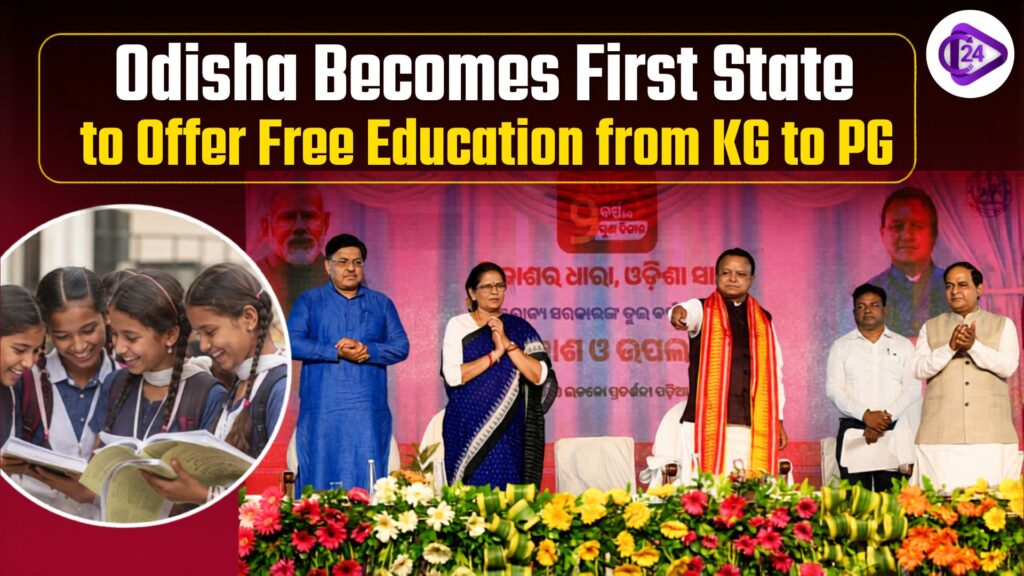
KG to PG: A landmark move towards a change in the education sector with Odisha Becomes First State to Offer Free Education from KG to PG. This groundbreaking project will drive positive change for millions of students by making quality education available without cost barriers, from kindy to post-graduate level. This announcement is greeted with great enthusiasm by educators, students and policymakers.
The state government’s goal of providing free education for every level is to increase enrollment rates, ensure low dropout rates and provide equal opportunities in education for every part of society. Consequently, there are several areas where Odisha is setting the benchmark for the first time, such as providing free education to all children from KG to PG classes.
Why Does Odisha Make Education Free from KG to PG?
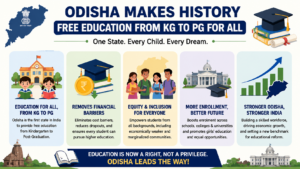
- Driven by free and universal education from Kindergarten to Postgraduate level
- Lowers the financial barriers leading students to drop out of higher education.
- Helps students from economically weaker sections of the state.
- Advances equity and inclusion in education.
- Higher enrolment in schools, colleges & universities.
- Promotes girls’ education and minimises middle school dropout
- Establishes new colleges and universities for access to higher education in remote areas and rural areas.
- This ultimately makes for stronger development and more long-term growth in human capital throughout the youth demographics.
- Its goal is to build a competent labour force for economic growth in the future.
- Establishes an unprecedented paradigm for educational reform in India.
Odisha’s Education Reforms and Future Vision – KG To PG
- Initiated free education for KG to PG in government institutions to make education universal and availability widespread.
- Implemented NEP 2020 across the state education system
- Set up Godabarish Mishra Model Primary Schools at panchayat levels to provide foundational learning.
- You granted its plan for four potential new universities to expand higher educational access.
- To also increase educational opportunity in rural India, 18 newly recruited government colleges have been opened.
- Continues to recruit teaching and non-teaching staff; Over 26,000; indicated that it will hire 45,000 teachers.
- Offers free textbooks until Class X for school education.
- Supports Tech & Innovation-led learning under the Odisha future roadmap for education.
- Centred on equity, inclusion and rural education progress across the board.
- Objective: To prepare a skilled, knowledge-based workforce to realise Odisha Vision 2036 and 2047
National Education Policy (NEP) PYQs
| Exam | Year | Question | Options | Answer |
| SSC CGL | 2023 | National Education Policy (NEP) was launched in which year? | A) 2018 B) 2019 C) 2020 D) 2021 | C) 2020 |
| RRB NTPC | 2022 | Which National Education Policy replaced the 1986 Education Policy? | A) NEP 2015 B) NEP 2018 C) NEP 2020 D) NEP 2022 | C) NEP 2020 |
| SSC CHSL | 2023 | Which ministry is responsible for implementing NEP 2020? | A) Ministry of Skill Development B) Ministry of Education C) Ministry of Social Justice D) Ministry of Culture | B) Ministry of Education |
| UPSC Prelims | 2021 | Under NEP 2020, the traditional 10+2 system is replaced by? | A) 5+3+3+4 B) 4+4+4+2 C) 8+4 D) 6+3+3+2 | A) 5+3+3+4 |
| SSC MTS | 2022 | NEP 2020 emphasizes education from which age group? | A) 3–18 Years B) 5–18 Years C) 6–18 Years D) 4–16 Years | A) 3–18 Years |
| RRB Group D | 2021 | Which language policy is recommended under NEP 2020? | A) One-Language Formula B) Two-Language Formula C) Three-Language Formula D) Four-Language Formula | C) Three-Language Formula |
| SSC GD | 2024 | NEP 2020 aims to achieve 100% Gross Enrollment Ratio in school education by which year? | A) 2025 B) 2030 C) 2035 D) 2040 | B) 2030 |
| UPSC CDS | 2022 | NEP 2020 targets Gross Enrollment Ratio (GER) in higher education to reach? | A) 40% B) 45% C) 50% D) 60% | C) 50% |
| SSC CPO | 2023 | Which body was replaced by the Higher Education Commission of India (proposed under NEP)? | A) UGC only B) AICTE only C) Multiple Regulatory Bodies D) NCERT | C) Multiple Regulatory Bodies |
| Railway NTPC | 2022 | Which committee drafted the National Education Policy 2020? | A) Kasturirangan Committee B) Kothari Committee C) Yashpal Committee D) Mudaliar Committee | A) Kasturirangan Committee |
| SSC CHSL | 2021 | Which Education Policy was in force before NEP 2020? | A) 1968 Policy B) 1975 Policy C) 1986 Policy D) 1992 Policy | C) 1986 Policy |
| UPSC CAPF | 2023 | NEP 2020 recommends vocational education exposure from which class? | A) Class 5 B) Class 6 C) Class 8 D) Class 9 | B) Class 6 |
| SSC CGL | 2024 | Which institution develops the National Curriculum Framework under NEP? | A) UGC B) NCERT C) AICTE D) NIOS | B) NCERT |
| RRB Group D | 2022 | NEP 2020 aims to increase GER in higher education to 50% by which year? | A) 2030 B) 2035 C) 2040 D) 2047 | B) 2035 |
| SSC GD | 2023 | Foundational Stage under NEP 2020 covers which age group? | A) 3–8 Years B) 6–11 Years C) 11–14 Years D) 14–18 Years | A) 3–8 Years |
Conclusion – KG To PG
Odisha Becomes First State to Provide Paid Free Education From KG To PG (CM Naveen Patnaik) | Historic Step Intervention Christian Decision. In fact, the state intends to eliminate all financial barriers between kindergarten and postgraduate education. Additionally, the project could boost literacy and higher education enrolment, lower dropout rates, and bolster economic development. Yet there are still implementation challenges — but long-term benefits should be worth the effort.