


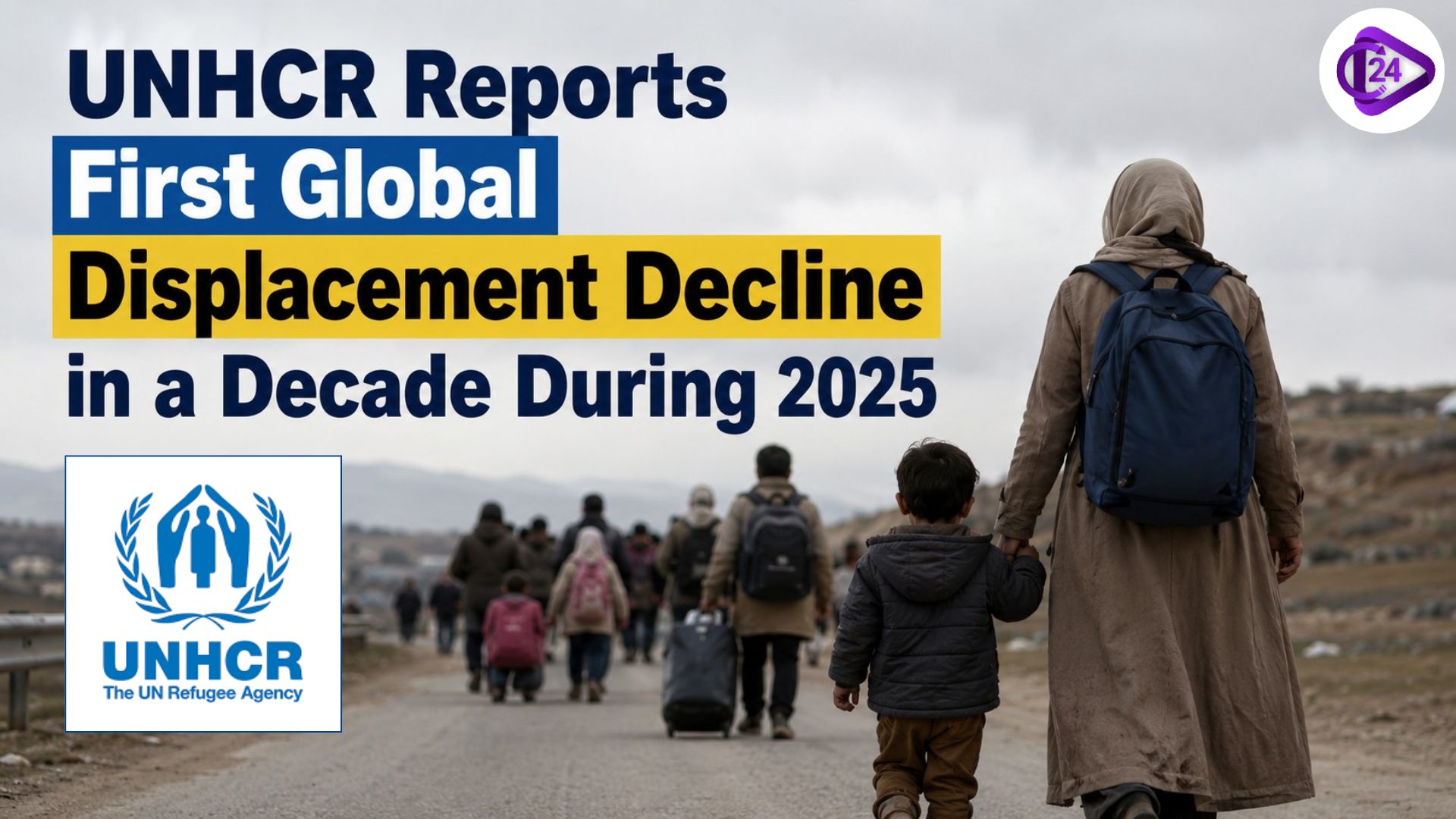
UNHCR Reports: First Global Displacement Decline in a Decade, in 2025, for the 1st time in 10 years. This is a major milestone in the world humanitarian landscape. Despite continued conflict, violence and persecution and extreme weather events driven by climate change displacing millions of people, there has been some progress in peace and conflict mitigation, as well as refugee returns, which have led to a slight decrease in the number of people displaced across the globe.
The news from the United Nations High Commissioner for Refugees (UNHCR) about the decrease in displaced populations after years of steep rises worldwide is encouraging. However, humanitarian conditions are fragile and continued international cooperation is needed to ensure this progress.
Key Highlights of UNHCR Reports First Global Displacement
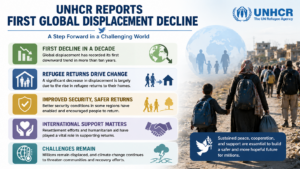
- There was an initial downward trend in global displacement for the first time in the past decade.
- One of the biggest reasons for the downward trend was in the number of refugee returns.
- Better security conditions in some areas led to a few returns. Few returns were facilitated by better security conditions in some areas.
- Resettlement initiatives were aided by international humanitarian support.
- There are still millions of people worldwide who are left displaced.
- UNHCR voiced its support for the value of continued support and peacebuilding.
- Moving to rebuild and resume a life that has suffered from the effects of climate change continues to be a concern.
Global Displacement Statistics in 2025
The UNHCR Reports First Global Displacement Decline in a Decade During 2025 after years of record-breaking increases. Although the reduction is modest, it demonstrates that coordinated humanitarian and diplomatic efforts can produce meaningful results.
| Indicator | 2024 | 2025 |
| Total Displaced Population | 122 Million+ | 120 Million+ |
| Refugees | 43 Million+ | 42 Million+ |
| Internally Displaced Persons | 68 Million+ | 66 Million+ |
| Asylum Seekers | 8 Million+ | 8 Million+ |
| Resettled Refugees | Increasing | Increased Further |
Why Global Forced Displacement Falls for the First Time in 10 Years
- Better Security Conditions: Peace agreements, cease-fires, and less violence in various conflict areas enabled many internally displaced persons to go safely home.
- Voluntary Refugee Returns were encouraged by the government and humanitarian organisations, which facilitated the safe and voluntary repatriation of refugees, provided legal support and provided reintegration services.
- More ICOs: there was more regional coordination between countries, international agencies and NGOs on matters related to displacement challenges and solutions with long-term benefits.
- Greater access to Permanent Resettlement Programs, housing, education and employment for refugees in the countries of origin.
- Positive Peacebuilding Activities: Conflict resolution programmes and community reconciliation endeavours had a positive effect on the internal peace in communities and mitigated the possibility of an escalation in displacement.
- Humanitarian Assistance: Emergency assistance (food, shelter, health care, education and others) helped to address the needs of affected people and to assist in their recovery.
- Work on economic recovery projects, such as reconstruction and placement measures and job creation schemes, made it easier for the displaced families to return and get things back on track.
- Enhanced Refugee Integration Policies: Refugees had greater access to social services, jobs, and education, which enabled them to be self-reliant and in a position of stability in host countries.
- Better Disaster Management: Improved disaster preparedness and climate adaptation actions reduced displacement attributable to natural hazards, in some areas.
- Priority shift to Durable Solutions: Voluntary return, local integration and resettlement were gaining ground in the agenda of these governments and international organisations, marking the first time in 10 years that forced displacement has decreased globally.
UNHCR PYQs (Previous Year Questions)
| Exam & Year | Question | Options | Answer |
| SSC CGL 2023 | UNHCR stands for? | (A) United Nations Humanitarian Council for Refugees (B) United Nations High Commissioner for Refugees (C) United Nations Human Rights Commission for Refugees (D) United Nations Humanitarian Commission for Relief | (B) United Nations High Commissioner for Refugees |
| UPSC Prelims 2016 | The headquarters of UNHCR is located in which city? | (A) Vienna (B) Geneva (C) Paris (D) New York | (B) Geneva |
| SSC CHSL 2022 | UNHCR was established in which year? | (A) 1945 (B) 1948 (C) 1950 (D) 1955 | (C) 1950 |
| RRB NTPC 2021 | World Refugee Day is observed every year on? | (A) 5 June (B) 10 December (C) 20 June (D) 24 October | (C) 20 June |
| UPSC Prelims 2020 | The 1951 Convention is related to which of the following? | (A) Climate Change (B) Refugee Protection (C) Human Rights Council (D) Nuclear Safety | (B) Refugee Protection |
| SSC CGL 2021 | UNHCR received the Nobel Peace Prize how many times? | (A) One (B) Two (C) Three (D) Four | (B) Two |
| CDS 2022 | Which UN agency is responsible for protecting refugees worldwide? | (A) UNESCO (B) UNICEF (C) UNDP (D) UNHCR | (D) UNHCR |
| SSC MTS 2023 | Who appoints the UN High Commissioner for Refugees? | (A) UN Security Council (B) World Bank (C) UN General Assembly (D) IMF | (C) UN General Assembly |
| RRB Group D 2022 | The headquarters of UNHCR is located in which country? | (A) France (B) Switzerland (C) Germany (D) Belgium | (B) Switzerland |
| State PCS 2021 | UNHCR began its operations on? | (A) 1 January 1951 (B) 24 October 1945 (C) 14 December 1950 (D) 1 July 1952 | (A) 1 January 1951 |
Alexander Zverev Wins French Open 2026
Conclusion on UNHCR First Global Drop in Forced Displacement
UNHCR Reports First Global Displacement Decline in a Decade During 2025 represents a significant milestone, as the news follows a challenging and fatal year marked by the deaths of at least 512,000 Palestinians in Gaza in 2024. This comes as positive news for the world, following a devastating and deadly year in 2024 during which at least 512,000 Palestinians lost their lives in Gaza. The decrease is small, but it is a clear sign of successful coordinated peacebuilding, refugee return programs and goodwill by the international community. Still, there are a lot of issues to be addressed, such as poor security, climate-related migration, and economic instability.
Governments, humanitarian actors and international partners should therefore continue to work together to ensure the momentum is maintained. The UNHCR Reports First Global Displacement Decline in a Decade During 2025 is a hopeful milestone and a reminder that there is still work to do to safeguard vulnerable populations around the world for the long term.