


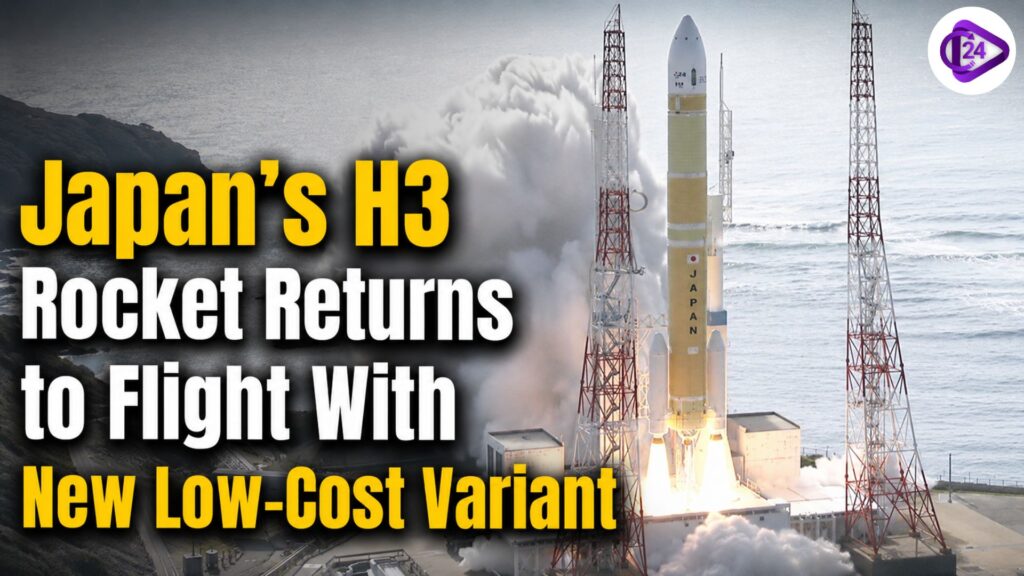
The country’s H3 rocket made her maiden flight with a new low-cost rocket variant as Japan moves a key initiative forward in its burgeoning space program. Developed by the Japan Aerospace Exploration Agency (JAXA) and Mitsubishi Heavy Industries, the H3 rocket is designed to provide reliable and cost-effective access to space. With the successful demonstration of the rocket’s capabilities at its latest mission, the team is introducing a new variant of the rocket, which promises to make the launch more competitive in the global market, while being less expensive.
The return to flight is especially significant as it boosts Japan’s presence in the commercial space industry. Additionally, the mission showcases the nation’s spirit of innovation, cost-effectiveness, and technological advancements in launching satellites.
Key Highlights of Japan’s H3 Rocket Returns to Flight
- Although the rocket H3 has suffered development challenges in previous attempts, it was successfully launched in Japan.
- The mission ushered in a new generation of the low-cost H3 launch vehicle.
- The rocket is made to achieve a dramatic cost savings in launch.
- To this end, the H3 program was developed by JAXA and Mitsubishi Heavy Industries.
- The launch will boost Japan’s competitiveness in the international space industry.
- The rocket will be used to put satellites and scientific equipment into orbit.
- The mission shows enhanced reliability and efficiency in operation.
Why Japan’s H3 Rocket Returns to Flight With New Low-Cost Variant?
The mission to test the success is significant in a number of ways. Certainly it makes Japan more confident of the next-generation launch capability. Secondly, it proves the practicability of competitive, less costly, launch services in space industry markets.
There are a number of nations and private firms striving to minimize the cost of ejections as well. In this regard, cost is increasingly the deciding factor to lure business consumers. The low-cost-type satellite will be used to secure a bigger market share in market for satellite launches globally.
Moreover, the mission highlights Japan’s engineering capability and its plans for the long-term development of space.
How the New Low-Cost Variant Improves Space Accessibility – H3 Rocket
- Lowens launch costs: The new low-cost H3 variant brings the satellite launch to the governments, private companies, and the research institutions much more accessible title to the launch, at the reduced cost. This cost saving opportunities allow more groups to utilize space technology and space access.
- Lower launch costs – Improved for startups and small satellite companies that are often budgeted for. Consequently, there are more satellites available in orbit for use in other applications, such as communication, navigation and observation of the Earth.
- Promotes Innovation: Provides universities, research centers, and technology companies with simple access to space for testing ideas and prototyping for new space technologies that could never have been realized without such access.
- Enhances competitiveness in global launch market: The low-cost variant will further strengthen the competitiveness of Japan in the global launch market by tapping into domestic and international market demand for reliable and cost-effective global launch solutions.
- Facilitates Scientific Research: Increases frequency of scientific payload launches and experimental space missions, providing scientific progress in areas such as astronomy, climate monitoring and space exploration.
- Facilitates Satellite Constellations: Lower launch costs support the deployment of satellite constellations in different services such as internet access, weather, disaster management, environment monitoring.
- Enhances the opportunities of developing countries and emerging space nations to access space programmes at economic costs.
- Enhances Mission Flexibility: The mission flexibility of the H3 rocket’s adaptable design makes space access more convenient for a diversity of mission requirements and payload sizes.
- Promotes Innovation and Competition in the Space Industry: Reduces barriers to entry, which fosters innovation and competition.Supports a global space industry: Opens the door for new industry players, thereby promoting innovation, competition, and global economic growth.
- H3 Low-cost variant: The H3 rocket’s low-cost option helps facilitate sustainable growth in commercial space activities and future exploration missions.
JAXA & Japan Technology PYQs
| Exam & Year | Question | Options | Answer |
| SSC CGL 2023 | JAXA is the space agency of which country? | (A) China (B) South Korea (C) Japan (D) Russia | (C) Japan |
| RRB NTPC 2021 | What is the full form of JAXA? | (A) Japan Aerospace Exploration Agency (B) Japan Aviation and Exploration Authority (C) Japanese Aeronautics Agency (D) Japan Advanced Exploration Association | (A) Japan Aerospace Exploration Agency |
| SSC CHSL 2022 | JAXA was formed in which year? | (A) 1998 (B) 2003 (C) 2008 (D) 2010 | (B) 2003 |
| UPSC CDS 2021 | The headquarters of JAXA is located in? | (A) Tokyo (B) Tsukuba (C) Kyoto (D) Osaka | (B) Tsukuba |
| SSC MTS 2023 | Which country successfully landed the SLIM Moon lander in 2024? | (A) India (B) China (C) Japan (D) UAE | (C) Japan |
| RRB Group D 2022 | Hayabusa missions are associated with which country? | (A) USA (B) Russia (C) Japan (D) France | (C) Japan |
| SSC CPO 2022 | Japan became the fifth country to achieve a soft landing on the Moon through which mission? | (A) Chandrayaan-3 (B) SLIM (C) Hayabusa-2 (D) Kaguya | (B) SLIM |
| CDS 2024 | Hayabusa2 mission collected samples from which asteroid? | (A) Bennu (B) Ryugu (C) Eros (D) Vesta | (B) Ryugu |
| SSC GD 2023 | Which Japanese mission successfully returned asteroid samples to Earth? | (A) Kaguya (B) Hayabusa2 (C) Akatsuki (D) SLIM | (B) Hayabusa2 |
| State PCS 2022 | JAXA was formed through the merger of how many organizations? | (A) Two (B) Three (C) Four (D) Five | (B) Three |
COP31 Hosts Propose 35% Global Electrification Target by 2035
Conclusion on H3 Rocket
Japan’s H3 Rocket Returns to Flight With New Low-Cost Variant” signifies a pivotal moment in Japan’s space program, as the mission was a demonstration of the rocket’s capability with the new variant. The H3 rocket’s affordability, flexibility, and reliability will help consolidate Japan’s position in the rapidly changing space industry on a global scale. Additionally, small costs result in a long-term opportunity to expand the accessible space for companies to branch out and open their doors for other companies to market their product. With these capabilities, H3’s “the new technology to be paid back in the future” – Low Cost Variant could be one of Japan’s most important space achievements and an innovation catalyst for the space industry of the future.