


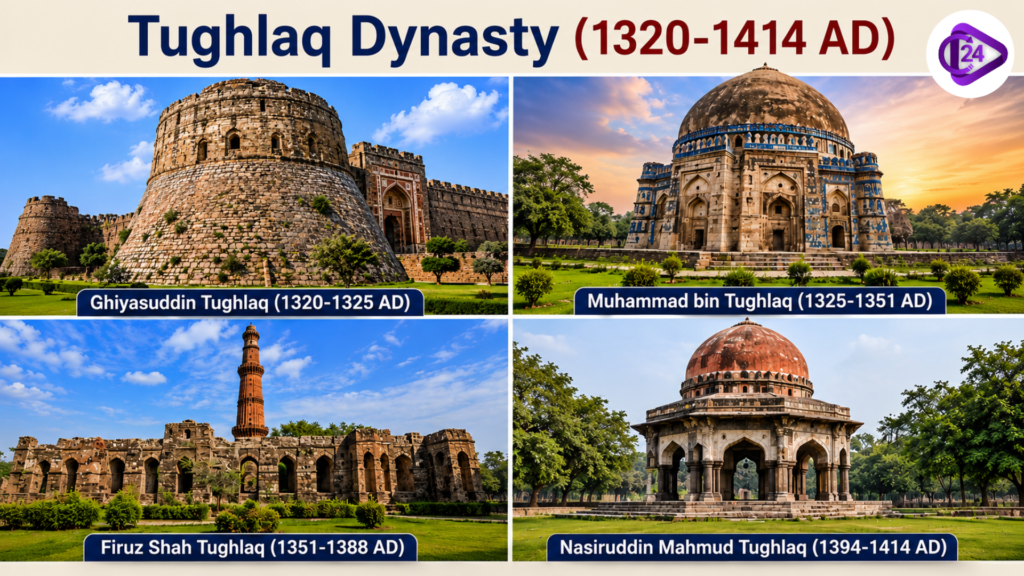
Tughlaq Dynasty: Also called the Tughluq or Tughluk dynasty It was an Indo-Turkic Muslim dynasty. Tughlaq Dynasty was one of the prominent dynasties that ruled the Delhi Sultanate. From 1320 AD to 1414, the dynasty ruled medieval India. They succeeded Mubarak Shah, the final Sultan of the Khilji Dynasty. Ghiyas-uddin Tughlaq was the founder of the Tughlaq Dynasty. Nasiruddin Mahmud Shah was the last ruler of the Tughlaq dynasty. The factories were called karkhanas, and this expedited economic growth, while the irrigated canals further boosted agriculture. As a result, the increasing of overland trade and maritime explosive that makes rapid urbanisation. Schools, mosques and public buildings multiplied as urban centres expanded during the Tughlaq Dynasty.
Ghiyasuddin Tughlaq (Ghazi Malik)
- Ghazi Malik ( Ghiyasuddin Tughlaq) was the founder of the Tughlaq dynasty, which he founded after ascending the throne in AD 1320.
- He ruled for a short period and died in 1325, after which Muhammad Tughlaq, his son, succeeded to the throne.
- The Delhi Sultanate was further consolidated under the Tughlaqs. This included the incorporation of many distant territories within direct Sultanate rule of the Tughlaq Dynasty.
He constructed Tughlaqabad, the capital and stronghold of his kingdom, meant for defence.
Muhammad Bin Tughlaq
- Some historians blame him for his father’s death; he became the Sultan of Delhi after his father’s death.
- The Sultan was a believer in the Divine Right theory of kingship. He followed a liberal policy and appointed officials without any concern for caste, creed or religion.
- Likewise, he was also not partial to Hindus among his subjects.
- He pursued a policy of conquest and dispatched expeditionary forces to Khurasan, Nagarkot, Qarajal, Mewar, and Telangana. Through the pursuit of training diplomatic relations with many Asian states.
- His empire was the largest of any of the medieval Sultans.
- He built the Royal Palace of Jahanpanah and the Begumpuri mosque.
Firoz Shah Tughlaq
Feroz (or Firuz) Shah Tughluq, who was the first cousin of Muhammad Tughlaq, became king in 1351 and ruled until 1388. The Sultan was not a great military commander like his predecessors, but a tremendous city, monument and public building builder.
The Sultan levied the four taxes permitted by Islamic law — including one on non-Muslims. In 1361, his campaign to Jajnagar (Odisha) devastated the renowned Puri Jagannatha temple.
THE ACHIEVEMENTS OF FIROZ SHAH:
- Firoz Shah Tughlaq largely focused on infrastructure development in his kingdom.
- Diwan-i-Khairat: Office for charity
- Diwan-i-Bundagan: Department of slaves
- Sarais (Rest House): For the convenience of merchants and other travellers
- Four New Towns: Firozabad, Fatehabad, Jaunpur And Hissar
He constructed canals from:
- Yamuna to the city of Hissar
- Sutlej to the Ghaggar
- Ghaggar to Firozabad
- Mandvi and Sirmour Hills to Haryana Hansi
Rate of taxes levied under Firoz Shah Tughlaq:
- Kharaj: Tax on the yield of land equal to 10% of one-tenth of produce
- Two and a half per cent tax on property realised from Muslims (Zakat)
- Kham: One out of five of the loot taken in (four out of five was kept for the soldiers)
- Other taxes are the irrigation tax, garden tax, octroi tax and the sales taxes
Muhammad bin Tughlaq and his Experiments
Transfer of Capital
- Muhammad bin Tughlaq (1324 – 1351), second only to Alauddin Khalji, will be part of history mainly remembered as a bold experimentalist who showed a great deal of interest in agriculture.
- Even right after coming to power, Muhammad Tughlaq took the most controversial step of transferring the capital from Delhi to Deogir (now Daulatabad).
- Not all were required to move; only the upper classes of polite society such as shaikhs, nobles and ulema, while a good majority stayed in Delhi.
- In time, however, discontent grew, and with the realisation that governing the north from the south was a near-impossible task, Muhammad bin Tughlaq withdrew Daulatabad as capital.
- It improved communications and pulled North and South India closer together. There settled after some time on the possibility of Daulatabad numerous individuals, including a few clergymen who had gone there. In the process, they became a method of disseminating in the Deccan the cultural, religious and social notions which had from time to time been imported by the Turks into northern India.
- Thus a novel pattern of cultural contact between North and South Indians evolved, as also within Southern India.
Token Currency
- One more debatable assignment resorted to by Muhammad bin Tughlaq was the integration of such a thing known as “Token currency”. Barani claims the Sultan introduced token currency since the treasury was empty from both the Sultan’s dreams of conquest and his unending kindness.
- The fourteen hundreds were a period of scarcity of silver in the world, and India had to cope with it. Thus, he was compelled to use copper coins in place of the silver.
- He brought in a copper coin (Jittal) instead of the silver coin (tanka) and ordered to accept it as equivalent to the tanka. The idea of token currency was new, and traders and villagers in India found it hard to accept.
- The State also lacked the discretion required to make sure that imitations of coins were not produced by mints. There was no way for the government to stop anyone from creating more, so new coins quickly found their way into circulation.
- The residents, according to Barani, started creating the token currency in their homes. But the common man could not tell the difference between copper coins stamped by the royal treasury and those made in a particular locality. Therefore, the Sultan was compelled to rescind the token currency.
Khurasan & Qarachil Expedition
- The Delhi Sultanate, at that time underMuhammad bin Tughluq ( 1325 – 1351 ), undertook several military campaigns to establish its frontiers and to settle boundary disputes.
- The Khurasan expedition sought to create stronger lines of defence in the west. Yet, this expedition did not come to pass.
- Second, the Qarachil expedition was an effort to settle a territorial dispute with neighbouring hill states that had become clients of China.
- But that expedition ended in vanquishment. However, there were diplomatic overtures from China to Delhi later.
- Agrarian Reforms & Changes in Nobility During the Reign of Muhammad Tughlaq
Agrarian Reforms:
- Agriculture was boosted by some of the measures adopted by Muhammad Tughlaq. Most of these were piloted in the Doab belt. Muhammad Tughlaq thought that Alauddin Khalji’s idea of reducing the khuts and muqaddams (headmen in the villages) to a position of mere cultivators could not be put into practice. But he wanted a fair share of state land revenue.
- The reforms he promoted should have lastingly changed things for the better, but they went awfully wrong during his time.
- As early as the beginning of Muhammad Tughlaq’s reign, there was a prominent agrarian uprising in the Gangetic doab area arising from over-assessment. Villagers fled, and Muhammad Tughlaq resorted to draconian measures to apprehend them and restore order.
- Compounding the problems was a drought that afflicted the region for some six years. Monuments at Parita, Panama, detailing the backs and fronts of those who settled their graves and layering their images.
- The relief measures, in the meantime, came too late — advances for cattle and seeds as well as digging wells. So many had perished in Delhi that it turned foul with pestilence.
- The sultan departed from Delhi and spent two and a half years in a camp called Swargadwari, 100 miles outside the capital along the Ganges just north of Kanauj.
- When he returned to Delhi, Muhammad Tughlaq started a project of expansion and development of cultivation in the doab. With him, he established a separate department- diwan-i-amir-i-kohi.
- It had been divided into development blocs, each headed by an official whose task was to extend cultivation onto new land by lending to cultivators while also incentivising a series of crop substitutions: wheat for barley; sugarcane for wheat; vines and dates for sugarcane.
- The scheme failed more than anything because the men selected for it turned out to be inept and corrupt, each keeping the money for themselves.
- Muhammad Tughlaq had perished in the meanwhile, and Firoz had registered off the debt. But the policy put forth by Muhammad Tughlaq to extend and enhance cultivation was not forgotten. Firoz took it up, but Akbar took it up with even greater passion later on.
Challenges of a Diverse Nobility:
- The second issue before Muhammad Tughlaq was of nobility. When the Chahalgani Turks fell, and the Khaljis rose to power, the aristocracy was recruited from Muslims of various races, even Indian converts.
- People who were not members of the nobility, people from the barber caste, cook caste/weaver or wine-maker castes, etc., were also entertained by Muhammad Tughlaq. He even assigned them big jobs.
- His nobility were descendants of Muslim converts (and some Hindus), or had been foreign appointees. The nobles of these diverse ethnic backgrounds did not form cohesive, loyal factions.
- The enormous space of the empire offered opportunities for both insurrection and creation of spheres of autonomy. This only intensified due to the cruel measures taken by Muhammad Tughlaq.
- Consequently, his reign represented a pinnacle of the Delhi Sultanate and its implosion.
Overview of How Firoz Shah Tughlaq Came to Power
- Muhammad Tughlaq faced continuous rebellions throughout his empire, especially in South India. Putschists and unrest, these were orchestrated by local governors, putting massive pressure on his armies.
- But the arrival of a plague soon afterwards at Delhi decimated Muhammad Tughlaq’s own forces, killing two-thirds of his soldiers. Following the fall of South India, another revolt from Harihara and Bukka established the Vijayanagara Empire, while foreign-born magnates in the Deccan set up the Bahmani Empire.
- Bengal also gained independence. Muhammad Tughlaq successfully crushed revolts in Awadh, Gujarat and Sind, but when he died in Sind, his cousin Firuz Tughlaq succeeded him.
- Muhammad Tughlaq) was surrounded by discontent from the nobility, military leaders, and Muslim theologians and Sufi saints of great influence.
- With a basis of scholars stepping into their new roles, on his rise to power, Firoz Tughlaq had to overcome the problem of not letting the Delhi Sultanate disintegrate. He followed an appeasement policy towards the nobles, army and theologians while exercising control over areas that were easily controlled.
Policies Undertaken by Firoz Shah Tughlaq:
- Firoz Tughlaq was not an impressive commander of the army, but he ruled for 37 years, which we can call a period of peace and incremental growth. He issued an edict permitting the posts and iqta (land grants) of dead nobles to pass on to sons, sons-in-law, and slaves.
- He ended the practice of torturing or mutilating nobles and officials during accounts and audits. Such actions satisfied the barons and curtailed revolt.
- This practice of hereditary offices and iqta (regional governorships held by an individual) had detrimental long-term effects. This kept competent outsiders at arms distance, but also made the sultan beholden to a narrow oligarchy.
- A – Inheritable armies: He carried the idea of heredity over to the army, where old soldiers were replaced by sons, sons-in-law, or slaves. Professional soldiers had ceased to receive their income in cash and were given land revenue assignments from villages.
- As such, soldiers did not reap the long-term rewards, and the military management grew sloppy, and corruption flourished.
- He tried to please the theologians by declaring himself a real Muslim monarch and stressing that his country was indeed Islamic. The orthodox theologians had fought a battle with the sultans over the kind of state and treatment of non-Muslims from the time of Iltutmish (1220–1236).
- In order to placate the theologians, some were given high office; however, the judiciary and educational system remained firmly in their hands.
- He distanced himself from the practices in the Kingdom, which scholars believed were impermissible. He is the one who introduced Jaziya.
- Firuz Tughlaq was the first king to attempt systematic translation of Hindu religious works from Sanskrit into Persian to promote better understanding of Hindu thought and practice.
Conclusion on Tughlaq Dynasty
The Tughlaq dynasty was one of the largest dynasties of the Delhi Sultanate; it ruled a large part of India between 1320 and 1414 AD. Ghazi Malik founded the Tughlaq dynasty and later became king by name Ghiyasuddin Tughlaq, during which he ruled militarily as well as effectively administratively. After him, his successor Muhammad-bin-Tughlaq became the most well-known ruler of this dynasty after he made sweeping policies like moving the Capital of India and introducing token currency. Tughlaq Dynasty Tughlaqs also lent a hand to architecture, making forts and cities. Nevertheless, internal administrative problems led to, over the decades, an erosion and final collapse of the dynasty.