


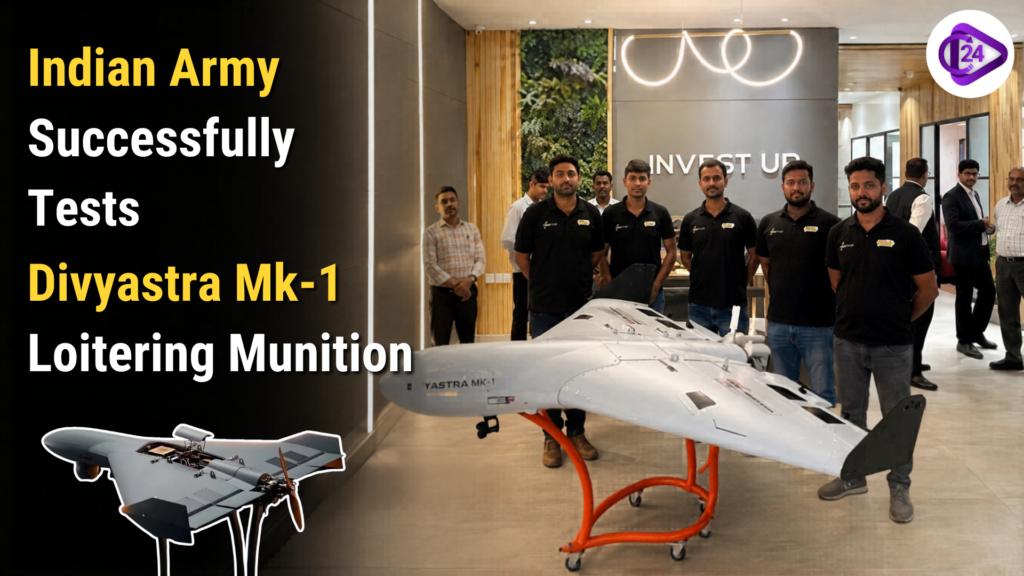
A successful operational demonstration of Divyastra Mk-1 indigenous Loitering Munition (LoMa) was observed by the Indian Army in Jodhpur, marking a major step towards achieving India’s ambitious target of becoming ‘Aatmanirbharta’ in the defense sector. Hoverit, an Indian startup company, is developing the ‘Make in India’ Divyastra Mk-1 for Intelligence, surveillance and reconnaissance (ISR) & Precision strike missions. The fully automated and sophisticated navigation, AI-based target recognition and swarming features make this a force multiplier for modern battlefield operations. The successful test underscores India’s emerging proficiency in unmanned combat systems (UCS) and bolsters its domestic defense manufacturing ecosystem.
Divyastra Mk-1 Loitering Munition: Key Features and Significance
- Successfully performed in front of senior Indian Army officers at the ex-Echo Tide Office auditorium in Jodhpur.
- The technology has been developed by the Indian defence technology startup – ‘Hoverit’.
- Indigenous loitering munition for precision strike & ISR missions.
- Supports independent navigation with the use of AI.
- Adopts target detection/recognition.
- Swarm drone (SWAD) operation capability.
- Can maintain definition of a target area before engaging that area.
- The report for flight endurance is up to 5 hours.
- Max range of 500 km.
- Estimated Attack speed was between 300–400 km/h.
- Can be quickly deployed by vehicle-mounted launch systems.
- Proven manoeuvrability and launch from the field.
- Cost-effective alternative to imported systems.
- Inspires India to become Self-reliant with Atmanirbhar Bharat and Make in India
- It is expected to boost India’s short-range and medium-range striking capabilities in the fight for the nation.
Previous Year Questions (PYQs)
| Exam | Year | Question | Options | Answer |
| CDS | 2024 | What is a loitering munition commonly called? | (A) Cruise Missile (B) Kamikaze Drone (C) Ballistic Missile (D) SAM | (B) Kamikaze Drone |
| NDA | 2023 | ISR in defence terminology stands for? | (A) Intelligence, Surveillance & Reconnaissance (B) Internal Security Response (C) Integrated Strike Radar (D) Information Surveillance Radar | (A) |
| AFCAT | 2024 | Which initiative promotes indigenous defence manufacturing in India? | (A) Startup India (B) Skill India (C) Make in India (D) Digital India | (C) |
| CAPF | 2022 | Which technology enables autonomous target recognition in modern drones? | (A) AI (B) GPS (C) Sonar (D) Radar Reflector | (A) |
| CDS | 2021 | Loitering munitions combine features of which two systems? | (A) Tank and Artillery (B) UAV and Missile (C) Fighter and Helicopter (D) Radar and Missile | (B) |

World’s First Pig Liver and Kidney Transplant
Conclusion: Why Divyastra Mk-1 Matters for India’s Defence Future
The successful test of Divyastra Mk-1 is yet another sign of India’s fast development of indigenous drone and precision-strike capabilities. Loitering munitions combine the capabilities of surveillance, target acquisition and precision engagement that is the hallmark of modern warfare and weaponry, particularly in the use of unmanned systems. Driven by Artificial Intelligence, with long endurance, swarm capability and indigenous design, Divyastra Mk-1 is a valuable asset for the Indian Army. The platform further supports India’s overall initiative of minimising defence imports and boosting the indigenous manufacturing sector. As these systems continue to evolve and be adopted in India, the nation is making strides toward becoming a global power in advanced defence technologies and solutions for independent warfare.
FAQ’s – Indian Army Successfully Tests Divyastra Mk-1
Divyastra Mk-1 is an indigenous loitering munition developed by Hoverit for surveillance and precision-strike missions
It was developed by the Indian defence startup Hoverit.
A loitering munition is a drone-like weapon that can hover over a target area and strike when required.
The operational demonstration was conducted in Jodhpur, Rajasthan.
It reportedly has an operational range of up to 500 km.