



A significant breakthrough in the early development of xenotransplantation in China has been a successful simultaneous graft of a genetically modified pig liver and two pig kidneys in a human patient. The researchers from Xijing Hospital in Xi’an at Air Force Medical University conducted the procedure. Nothing immediately came up about rejection of the organs since they were transplanted into a 53-year-old brain-dead patient. Equipped with the power of gene editing, the breakthrough could be a game-changer for transplant medicine and address the global shortage of human donor organs.
China’s First Pig Liver and Kidney Transplant: Key Highlights
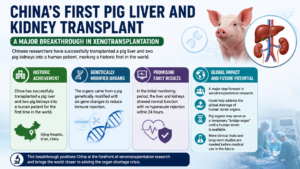
- China has successfully transplanted into a single patient a pig liver and two pig kidneys for the first time around the world.
- This surgery was done at Xijing Hospital.
- The recipient was a 53-year-old brain-dead person whose family had permitted the experimental procedure.
- The transplanted organs were from a pig that had been genetically modified to have six gene changes to help decrease transgenic immune rejection.
- In the first monitoring period, researchers were able to demonstrate normal function of the organs.
- There was no hyperacute rejection within 24 hours of transplantation.
- The achievement is the latest in a series of breakthroughs in the field of xenotransplantation, also known as the transplanting between species.
- The adoption of pig organs is thought to be suitable owing to their similarity with human organs in size and physiology.
- China has become a leader in xenotransplantation research experiments by transplanting organs from pigs for the first time.
- This breakthrough can aid in donating less limited organs worldwide.
- Scientists hope to find a pig organ as a temporary “bridge organ” for a patient to buy time until a human donor is found.
- Medical use may still be some time off in the future before further clinical trials and long-term studies can take place.
Previous Year Questions (PYQs)
| Exam | Year | Question | Options | Answer |
| UPSC Prelims | 2021 | Xenotransplantation refers to: | A. Organ transplant between species B. Gene therapy C. Stem cell therapy D. Blood transfusion | A. Organ transplant between species |
| SSC CGL | 2022 | Which animal is most commonly used in xenotransplantation research? | A. Dog B. Pig C. Sheep D. Horse | B. Pig |
| NEET | 2020 | The immune rejection of transplanted organs is mainly caused by: | A. Hormones B. Antibodies and immune cells C. Enzymes D. Vitamins | B. Antibodies and immune cells |
| UPSC Prelims | 2019 | CRISPR technology is mainly associated with: | A. Gene Editing B. Satellite Imaging C. Nuclear Energy D. Robotics | A. Gene Editing |
| AIIMS Nursing | 2023 | Which organ shortage has encouraged xenotransplantation research? | A. Eyes B. Human donor organs C. Bones D. Skin | B. Human donor organs |
112 Emergency Response Support System
Conclusion: Significance of China’s Xenotransplantation Breakthrough
The successful pig liver and kidney transplant in China is a breakthrough in medical science and organ transplantation. The researchers’ work has shown that genetically modified pig organs are able to work within a human body, which is a significant development towards the plight of a shortage of donor organs. While it is still experimental and needs to be thoroughly validated in further clinical trials, this technique could potentially be of enormous benefit to millions of patients and save lives waiting to receive a transplant. As more organs become available in the future thanks to further advancements in xenotransplantation and gene-editing, this could revolutionise the way transplant recipients receive medical care and make a huge difference in the number of patients waiting for new organs in the world.