


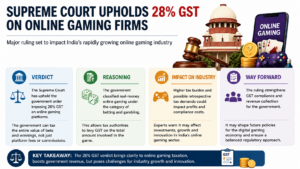
The Supreme Court of India has upheld the government order to impose a 28 % Good and Services Tax (GST) for online gaming firms from now on. The decision is said to be a significant move for online gaming and betting, as many gaming companies had filed writ petitions challenging the GST notices which had been issued to them, having a value of thousands of crores. The government said online real-money gaming sites could be considered as actionable claims in a similar fashion to betting/gambling activities. The findings serve as a win for the tax authority and could have a considerable ramification on the gaming industry’s income and compliance expenses. According to industry experts, the decision has the potential to have a profound impact on the Indian online gaming sector, which is witnessing rapid growth, and could impact future government policies on online taxation.
Supreme Court Verdict on Online Gaming GST: Key Highlights and Impact
- The Supreme Court has confirmed the 28% tax on online gaming platforms imposed by the government.
- The decision is seen as an endorsement of a retrospective assessment by gaming companies of taxes on past deals.
- The real-money online gaming industry was placed by the government in the betting and gambling category.
- GST authorities had issued several thousand crores worth of notices to gaming companies.
- The decision is likely to hit online gaming companies with higher taxes.
- The online gaming companies said GST should only be charged for the platform fees/commission.
- The government argued that per-bet taxation levied on the total amount of winnings is to be considered as GST.
- The ruling further enhances the legal powers of GST departments in taxation of digital products.
- There could be some potential retro taxes on several gaming companies.
- Experts in the industry say that increased taxation could have an impact on investments in India’s gaming business.
- The ruling could affect fantasy sports and skill-based gambling websites.
- Previously, the GST Council committee had recommended uniform tax rates of 28% on online games.
- The decision is expected to bring better tax compliance and better revenue collections, according to tax authorities.
- With a surge in smartphone and internet use, the online gaming sector has drastically progressed.
- Proponents of, say, the crypto-currency ban say that this high tax will hinder innovation and drive users toward illicit platforms.
- The ruling is clarifying to legal minds the difference between gaming and gambling taxes, say legal experts.
- The judgement might pave the way for policy deliberations around the digital gaming economy of India.
- Online gaming is one of the most significant digital entertainment and start-up sectors of India.
- The decision may have ramifications for the tax regime of the emerging virtual and digital platforms as well.
- Now regulators can look at balancing out regulation, tax, and development of the industry in the sector.
PYQs on GST
| Exam Name | Year | Question | Options | Answer |
| UPSC Prelims | 2017 | The Goods and Services Tax (GST) in India was introduced through which Constitutional Amendment? | A. 99th Amendment B. 101st Amendment C. 102nd Amendment D. 103rd Amendment | B. 101st Amendment |
| SSC CGL | 2022 | GST in India was implemented on which date? | A. 1 January 2016 B. 1 July 2017 C. 15 August 2017 D. 26 January 2018 | B. 1 July 2017 |
| RRB NTPC | 2021 | Which body recommends GST tax rates in India? | A. RBI B. Finance Commission C. GST Council D. NITI Aayog | C. GST Council |
| UPSC Mains | 2020 | Discuss the impact of GST on India’s digital economy and services sector. | A. Reduced taxation B. Uniform indirect taxation system C. Increase in direct taxes D. Decline in e-commerce | B. Uniform indirect taxation system |
| SSC CHSL | 2023 | Online gaming taxation in India primarily falls under which category? | A. Direct Tax B. Customs Duty C. GST D. Income Tax | C. GST |
Historic Book on India’s First Olympic Gold Released
Conclusion: Supreme Court Verdict Reshapes India’s Online Gaming Industry
This landmark ruling by the Supreme Court will shape the future of online gaming tax policy in India, particularly as it upheld the retrospective 28% GST levy on online gaming companies. The decision further bolsters the government’s power to control and tax online gaming, akin to betting and gambling businesses. This is likely to raise game company and startup operational costs, but also generate added revenue and enhance compliance rules. High taxes may impact innovation and investment in a growing gaming industry by industry participants. In the future, policymakers will have to find a balance between effective regulation, revenue generation and sustainable growth of the Indian digital entertainment economy.