


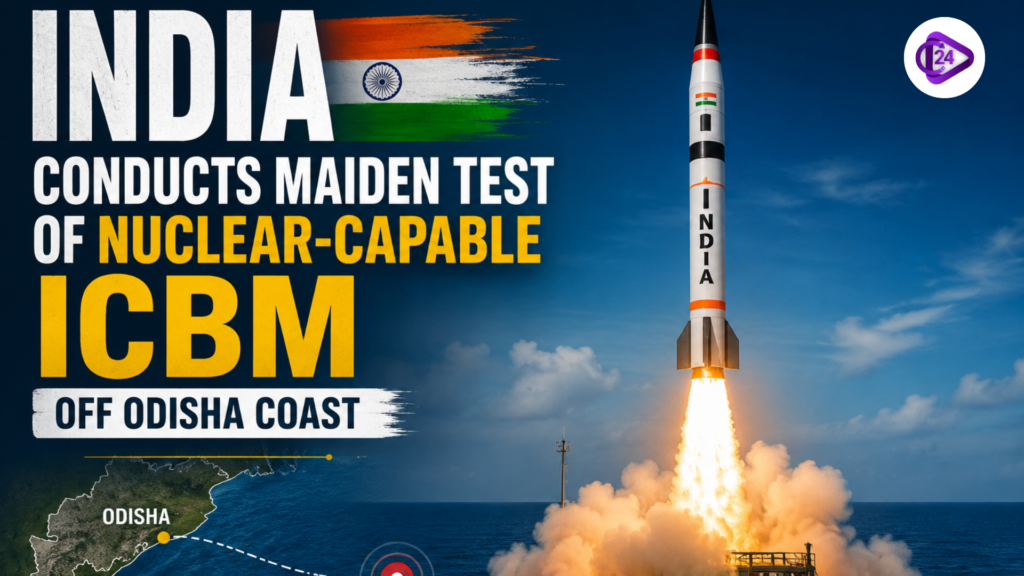
India has made a giant stride towards nuclear-capable Intercontinental Ballistic Missile (ICBM) development with the successful testing off the Odisha coast of the first test flight of such a missile. The test was conducted by the DRDO team at the Integrated Test Range (ITR), which enhances India’s strategic deterrence capability in the long range. The missile will be armed with nuclear warheads and have a range of thousands of kilometres. This successful trial depicts the development of India’s indigenous missile technology and marked Indian Missile Power’s progress in the advanced class of ICBMs and strategic defence system countries, say defence experts
Significance of India’s Maiden Nuclear-Capable ICBM Test
- Under the supervision of the Defence Research and Development Organisation (DRDO), India successfully carried out the test of an Odisha-made nuclear-capable intercontinental ballistic missile (ICBM) off the Odisha coast for the first time.
- The missile was launched from the habitat of one of the most prominent indigenously established missile test centres of India, the Integrated Test Range (ITR) near Chandipur and Dr APJ Abdul Kalam Island, Odisha.
- The successful test is a major step towards bolstering India’s strategic defence preparedness and long-range strike capabilities.
- Intercontinental Ballistic Missiles (ICBMs) can reach a distance of over 5,500 kilometres and can carry conventional or nuclear warheads to long-term targets.
- The test was compared to the country’s Agnividya missile programme and, in particular, its progress on the Agni-6 missile system programme being developed by DRDO.
- The missile trial underscored India’s ability to enhance its nuclear deterrence and strategic capabilities in the Indo-Pacific region.
- This test confirms key operational and technical parameters that are essential for a missile’s deployment for long-distance missions, a report reads.
- India became part of a club of other technologically advanced countries, which have developed advanced long-range ballistic missile technology and similar technologies in MIRVs.
- Recently, DRDO has carried out several advanced missile tests off the Odisha coast, such as glider weapon systems, naval missile systems, and hypersonic anti-ship missiles.
- The successful testing of the ICBM highlights India’s shift towards indigenous defence production, self-sufficiency in military technologies and strategic modernisation of security.
About Intercontinental Ballistic Missile (ICBM)
A Long-range Ballistic Missile (LRBM) or Intercontinental Ballistic Missile (ICBM) is a missile that is capable of flying longer than 5,500 km and carrying a nuclear or conventional warhead to a distant target that is more than 2,000 km across continents. The trajectory of the ICBM is ballistic: a ballistic missile starts powered and continues through space before descending back to the Earth towards its target. The missiles are referred to as a big part of the country’s strategic defence and nuclear deterrence system. The modern ICBMs are capable of carrying several warheads by MIRV (Multiple Independently Targeted Reentry Vehicle) and can be launched from land-based silos, mobile launchers, or submarines.

Shashi Shekhar Vempati Appointed New CBFC Chairman
Conclusion – India Successfully Tests Nuclear-Capable ICBM
It is a notable achievement for the Indian defence and strategic capabilities to have successfully tested an Indian nuclear-capable ICBM. The missile test reflects India’s enhanced capabilities in indigenisation of missile technology and bolsters its long-range deterrence matrix. The test is part of DRDO’s effort to promote self-reliance and stringent military modernisation in line with the country’s emphasis. This success further bolsters India’s status as a leading world power with advanced ballistic missile capabilities and strengthens its strategic posture and national security measures.