

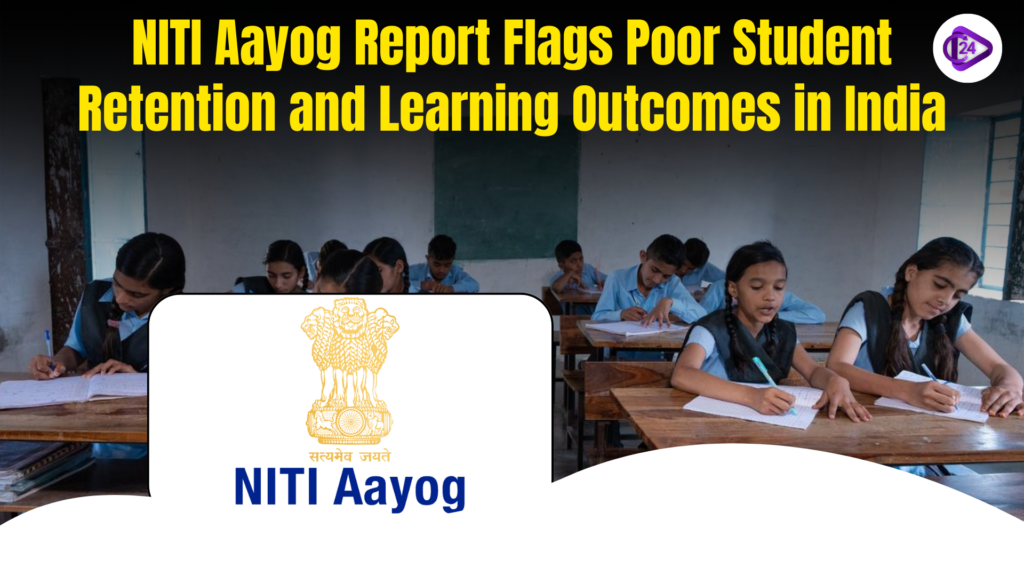
The study recently conducted by the NITI Aayog indicates that pupil retention in school education and student performance in learning continue to be critical issues in the Indian school education system. The report highlights issues stemming from low enrolment rates at government schools and learning gaps, a shortage of teachers, and low foundational literacy and numeracy skills of learners. It also highlights the fact that many children are making good progress in classes, but that they are not fully achieving nationally expected standards. Based on the UDISE+, ASER, NAS, and PARAKH surveys, the report vividly points to the need for better policy reforms, management of teachers, integration of digital learning, and improved monitoring mechanisms in order to bolster the overall quality of education in India.
Highlights of NITI Aayog Report on India’s Education Crisis
- Nearly 71% of students were enrolled in government schools in 2005, which came down to around 49.24% during the 2024-25 school year, NITI Aayog noted. The above shows that parents are increasingly expressing a higher preference for private schools.
- The lack of retention of students was one of the major concerns noted in the report, particularly when they were making the primary-secondary school and secondary – higher secondary school transitions. Students drop out of school for a variety of reasons – economic, social, and infrastructural.
- While some states have expanded school access and enrolment, learning outcomes remain inadequate in several states. ASER or NAS surveys found that many students found difficulty in basic reading comprehension skills and arithmetic skills.
- Shortages and delays in teachers at the school level continue to have an impact on the quality of classroom learning, especially in rural and remote schools. The report pointed out that the single-teacher schools and the disintegration of the school structures abound.
- The policy highlighted the significance of Eklavya and brought up the importance of foundational literacy and numeracy as per the goals of the National Education Policy (NEP) 2020.
- NITI Aayog advocated for the increased implementation of AI in school education, digital learning resources, and an improvement in governance in the education field.
- The report further recommended fortifying the monitoring systems, conducting more frequent evaluations with students, providing quality teacher training, and ensuring that evidence-based policymaking leads to better educational results nationally.
Recently Asked Questions on New Education Policy (NEP)
| Exam & Year | Question | Options | Correct Answer |
| CTET 2024 | According to NEP 2020, foundational literacy and numeracy is considered essential for all future learning. What does this refer to? | A. Vocational Education B. Foundational Literacy and Numeracy C. Digital Learning D. Experiential Learning | B. Foundational Literacy and Numeracy |
| UGC NET 2023 | According to NEP 2020, which platform is recommended for hosting virtual labs and online learning resources? | A. YouTube B. Google Classroom C. SWAYAM D. Zoom | C. SWAYAM |
| UGC NET 2024 | NEP 2020 proposes replacing the old education structure with which new curricular structure? | A. 8+4 B. 10+2 C. 5+3+3+4 D. 6+3+3+2 | C. 5+3+3+4 |
| CTET 2023 | What is the primary objective of PARAKH under NEP 2020? | A. Conduct board exams B. Regulate universities C. Set norms and standards for assessment D. Provide online classes | C. Set norms and standards for assessment |
| UPTET 2022 | According to NEP 2020, every teacher should complete at least how many hours of Continuous Professional Development (CPD) annually? | A. 20 Hours B. 30 Hours C. 40 Hours D. 50 Hours | D. 50 Hours |
| UPSC Prelims 2021 | National Education Policy 2020 aims to achieve what percentage of Gross Enrolment Ratio in higher education by 2035? | A. 25% B. 35% C. 50% D. 75% | C. 50% |
| REET 2023 | NEP 2020 emphasizes which type of learning approach? | A. Rote Learning B. Experiential Learning C. Lecture Method D. Memorization-Based Learning | B. Experiential Learning |
| DSSSB 2022 | The National Research Foundation (NRF) proposed in NEP 2020 aims to: | A. Conduct School Exams B. Promote Coaching Institutes C. Develop Research Culture in Universities D. Recruit Teachers | C. Develop Research Culture in Universities |
| CTET 2024 | According to NEP 2020, vocational education exposure should be provided to at least what percentage of learners by 2025? | A. 25% B. 40% C. 50% D. 75% | C. 50% |
| KVS PRT 2023 | Which policy first described education as a “forceful tool for cultivation of social and moral values”? | A. NCF 2005 B. National Policy on Education 1986 C. RTE Act 2009 D. NEP 2020 | B. National Policy on Education 1986 |

Bengaluru Records Highest Number of Cybercrime Cases in India
Conclusion – NITI Aayog Raises Concern Over Student Retention
The drop in retention rates and failure to achieve strong learning outcomes are critical issues in the Indian education system, according to the NITI Aayog report. Despite the agricultural gains of increased access to education and school enrolment, learning gaps, teacher shortages, and dropout rates are among the difficulties that affect educational quality. The report identifies the areas that require the most focus to better implement NEP 2020, improve foundational literacy, support digital learning, and ensure frequent monitoring. Policy changes and improved governance can play a key role in improving the school education system and promoting better learning outcomes across the country.