

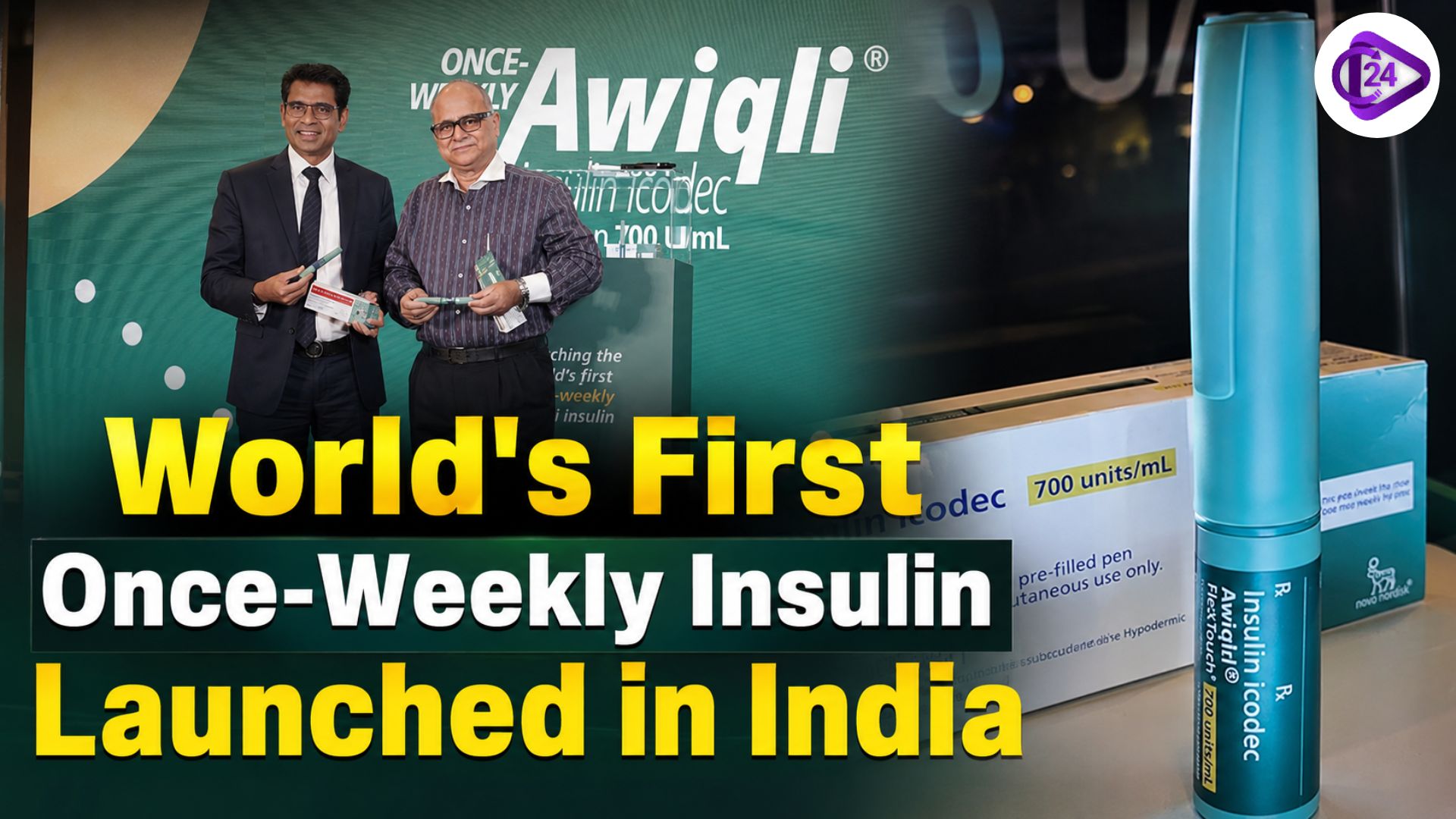
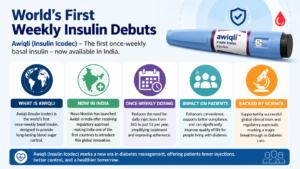
World’s First Weekly Insulin Debuts: Novo Nordisk has introduced a new long-acting agent in diabetes management, Awiqli (Insulin Icodec)- The first once-weekly basal insulin globally- and is now available in India. The groundbreaking treatment could revolutionise diabetes care by reducing the need for insulin injections on a daily basis and increasing patient compliance.
The innovation is set to cater for millions of patients and bolster India’s healthcare ecosystem, as India boasts one of the largest diabetic populations around the world. The launch is based on successful global clinical trials and regulatory approvals, making this an important development in medical science and current affairs.
Why in News?
Novo Nordisk expanded the availability of Awiqli (Insulin Icodec) in India, where it was approved, becoming one of the first country -located to launch globally for eligible adults with diabetes. The launch intends to simplify insulin therapy and improve treatment adherence by minimising the injection frequency from 365 injections yearly to only 52 per year.
Key Highlights of Once-Weekly Insulin
| Particular | Details |
| News | World’s First Once-Weekly Insulin Launched in India |
| Medicine | Awiqli |
| Generic Name | Insulin Icodec |
| Developed By | Novo Nordisk |
| Type | Once-Weekly Basal Insulin |
| Launch | July 2026 |
| Injection Frequency | Once Every Week |
| Major Benefit | Replaces Daily Basal Insulin |
| Clinical Programme | ONWARDS Phase III Trials |
| Significance | First Weekly Insulin Therapy in the World |
What is Awiqli (Insulin Icodec)?
Awiqli is a long-acting ‘ultra’ basal insulin that aims to manage glycaemic control for an entire week with just one shot. It is an insulin analogue, Insulin Icodec, that was developed to release itself over a week.
Awiqli has the benefit of decreasing the injection frequency, unlike conventional basal insulin, which is given daily, whilst maintaining glycaemic control. The drug is meant for long-term management of the condition under medical supervision and is seen as one of the great new advances in insulin therapy over the last several decades.
Why is Once-Weekly Insulin a Major Breakthrough?
The Awiqli (Insulin Icodec) is a major step forward as it completely transforms basal insulin delivery. Legacy requires daily injections for patients with diabetes needing basal insulin, which results in treatment fatigue, including missed doses and poor compliance. A once-weekly insulin reduces injection burden by up to almost 86%, simplifies diabetes management while achieving effective blood glucose control.
Novo Nordisk stated that the ONWARDS Phase III clinical trial programme for the medicine showed efficacy and safety in eligible patients, with glycaemic control similar to daily basal insulin. This breakthrough may encourage better patient compliance, improve quality of life and lead to a reduction in diabetes-associated complications due to non-compliance, the issue of which is especially relevant in countries facing an increasing burden of diabetes like India, thereby improving long-term health outcomes.
How Does Insulin Icodec Work?
- Novo Nordisk has developed insulin Icodec, a once-weekly basal insulin analogue.
- Its single injection is designed for a week of sustained glucose-lowering effects.
- Insulin binds tightly, but reversibly, to circulating serum albumin, resulting in slow release over seven days.
- It keeps basal insulin levels constant, regulating blood glucose levels in between meals and while you sleep.
- Patients self-inject once every 7 days on the same day of the week as instructed by a healthcare provider.
- This long-lasting effect is presumably due to the design of its molecules, as it has a half-life of about one week.
- Its efficacy and safety compared to daily basal insulin were proven in the ONWARDS Phase III clinical trial programme.
- Novo Nordisk has developed Insulin Icodec with the aim of reducing treatment burden and improving adherence to insulin therapy whilst maintaining effective glycaemic control.
Previous Year Questions (PYQs) on Insulin & Diabetes
| Exam | Year | Question | Options | Correct Answer |
| UPSC Prelims | 2023 | Diabetes mellitus is primarily caused by the deficiency or improper utilisation of which hormone? | (A) Thyroxine (B) Insulin (C) Adrenaline (D) Cortisol | (B) Insulin |
| SSC CGL | 2022 | Which organ of the human body produces insulin? | (A) Liver (B) Kidney (C) Pancreas (D) Spleen | (C) Pancreas |
| SSC CHSL | 2021 | Insulin is secreted by which cells of the pancreas? | (A) Alpha Cells (B) Beta Cells (C) Delta Cells (D) Acinar Cells | (B) Beta Cells |
| CDS | 2020 | Which hormone is responsible for lowering blood glucose levels in the human body? | (A) Glucagon (B) Thyroxine (C) Insulin (D) Adrenaline | (C) Insulin |
| NDA | 2019 | The Islets of Langerhans are present in which organ? | (A) Liver (B) Pancreas (C) Kidney (D) Gall Bladder | (B) Pancreas |
| RRB NTPC | 2021 | Diabetes mellitus occurs mainly due to insufficient secretion of which hormone? | (A) Estrogen (B) Testosterone (C) Insulin (D) Progesterone | (C) Insulin |
| SSC GD | 2023 | Which hormone regulates the level of glucose in the blood? | (A) Growth Hormone (B) Thyroxine (C) Insulin (D) Melatonin | (C) Insulin |
| State PCS | 2022 | Which cells of the pancreas produce insulin? | (A) Alpha Cells (B) Gamma Cells (C) Beta Cells (D) PP Cells | (C) Beta Cells |
| UPSC CAPF | 2021 | Which disease is commonly treated using insulin therapy? | (A) Hypertension (B) Asthma (C) Diabetes Mellitus (D) Tuberculosis | (C) Diabetes Mellitus |
| SSC MTS | 2020 | Insulin was discovered by which scientists? | (A) Watson & Crick (B) Frederick Banting & Charles Best (C) Louis Pasteur (D) Edward Jenner | (B) Frederick Banting & Charles Best |
World Bank Income Classification 2026
Conclusion on World’s First Once-Weekly Basal Insulin
Awiqli (Insulin Icodec) is the world’s first once-weekly basal insulin, launched in India as a revolutionary step towards diabetes treatment. As diabetes rapidly rises, these innovations could improve medication adherence, simplify insulin therapy and ultimately lead to better patient outcomes. Awiqli confirms worldwide clinical evidence supporting the expanding role of medical innovation in treating chronic diseases.