
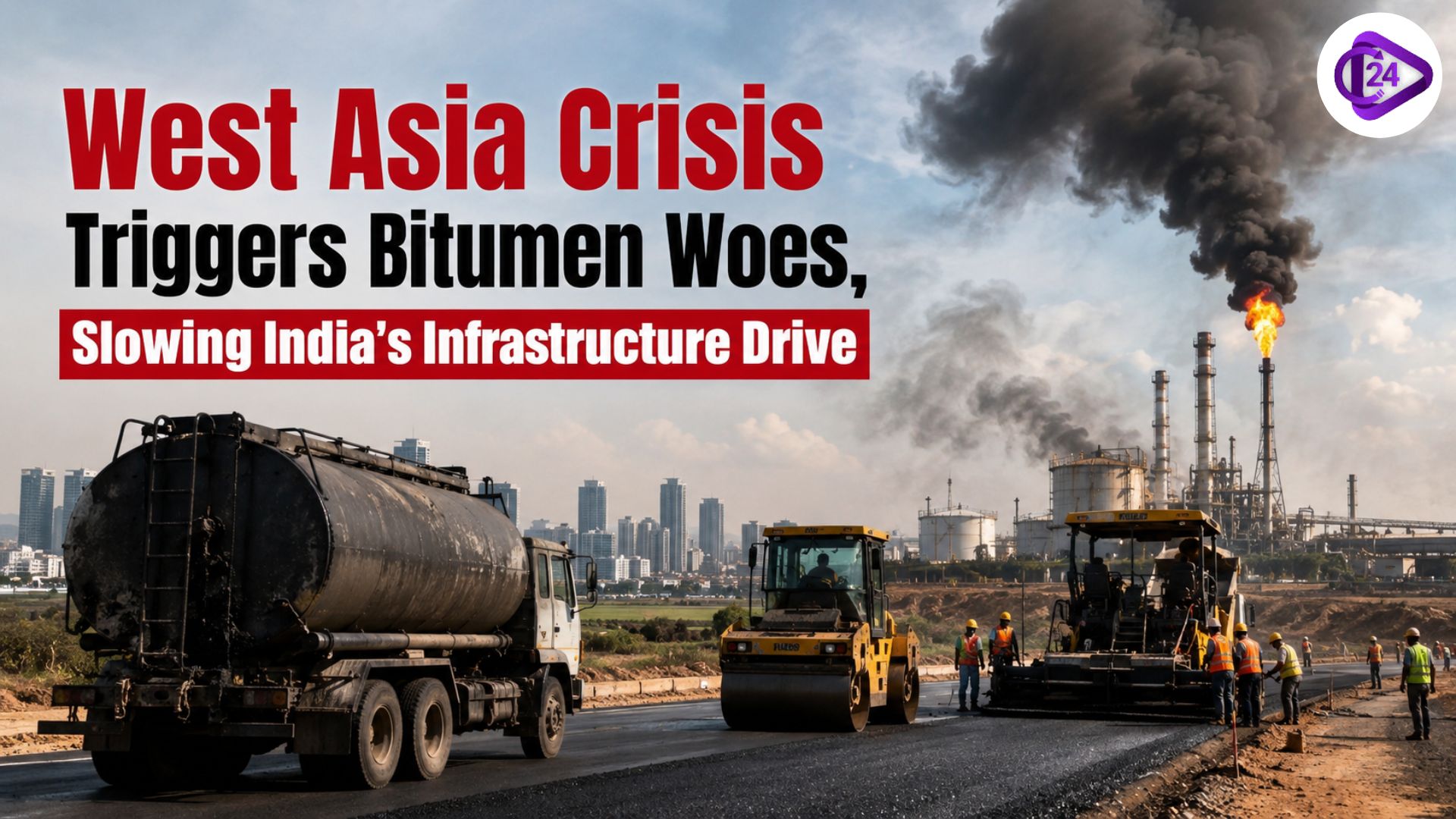
The West Asia crisis is not merely creating challenges for India’s energy sector as it is tainting global energy supply chains but is also impacting the infrastructure industry by upsetting the cost of essential construction materials in India. One of the major issues arising out of the current geopolitical crisis is the dwindling supply of bitumen, a key component in road construction works, and its increasing cost.
The overall construction cost if the West Asia crisis slows down highway projects or logistics corridors in India, which has been focusing its investments in the area heavily, would also rise. India has a high dependence on imports of crude oil, and as global energy markets are volatile, the price and availability of petroleum-based products like bitumen are themselves volatile.
Understanding Bitumen and Its Role in Infrastructure – West Asia
Bitumen is a petroleum-derived material primarily used in road construction, waterproofing, airport runways, and urban infrastructure projects. It acts as a binding agent that holds aggregates together to create durable road surfaces.
India’s ambitious infrastructure programmes, including national highways, economic corridors, smart cities, and rural road networks, depend significantly on a stable supply of bitumen.
Major Uses of Bitumen in India
| Sector | Application |
| Highways | Road surfacing and maintenance |
| Urban Infrastructure | Streets, flyovers, and bridges |
| Airports | Runways and taxiways |
| Housing | Waterproofing and insulation |
| Industrial Projects | Protective coatings and paving |
How the West Asia Crisis Is Affecting Bitumen Supply – West Asia
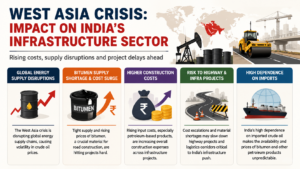
- Uncertainty started rising in already uncertain global energy markets due to West Asia crisis, driving up the crude oil prices.
- Bitumen is a petroleum-based material; as crude oil costs of raw materials rise, so does bitumen.
- International geopolitical tensions have caused problems in the transport of crude oil and refined products on important shipping corridors.
- Supply costs are overall up due to freight rates, insurance and security.
- Transit times have become longer and delays are impacting major ports to ensure timely delivery of bitumen.
- Due to supply chain disruptions a lot of the market, especially through procurement, has become hard to come by for infrastructure companies.
- The fluctuations in prices have created a difficult situation for road construction agencies and contractors to plan and estimate costs.
Previous Year Questions (PYQs) on Bitumen
| Year | Exam | Question | Correct Answer |
| 2020 | UPSC CSE (Prelims) | In road construction, bitumen is primarily used as:(a) Filler material(b) Reinforcement material(c) Binding material(d) Insulating material | (c) Binding material |
| 2018 | SSC JE (Civil) | Bitumen is mainly obtained from:(a) Coal tar distillation(b) Petroleum refining(c) Natural gas processing(d) Limestone deposits | (b) Petroleum refining |
| 2017 | State PSC (Civil Engineering) | Which property determines the hardness or softness of bitumen? (a) Ductility value(b) Penetration value(c) Flash point(d) Specific gravity | (b) Penetration value |
| 2016 | GATE (Civil Engineering) | The viscosity of bitumen mainly affects:(a) Colour of pavement(b) Workability and coating of aggregates(c) Aggregate size(d) Pavement width | (b) Workability and coating of aggregates |
| 2015 | SSC JE (Civil) | Which test is commonly used to determine the consistency of bitumen? (a) Los Angeles abrasion test(b) Impact test(c) Penetration test(d) Crushing value test | (c) Penetration test |
| 2014 | State Engineering Services | The softening point of bitumen is determined by the:(a) Marshall method(b) Ring and Ball method(c) CBR test(d) Vicat apparatus | (b) Ring and Ball method |
| 2013 | GATE (Civil Engineering) | Bitumen used in flexible pavements is generally classified based on:(a) Colour and texture(b) Aggregate size(c) Penetration grade or viscosity grade(d) Density only | (c) Penetration grade or viscosity grade |
| 2012 | SSC JE (Civil) | Bitumen is primarily used in the construction of:(a) Rigid pavements(b) Flexible pavements(c) Masonry structures(d) Steel bridges | (b) Flexible pavements |
Conclusion: West Asia Crisis Triggers Bitumen Woes
The need to expand its bitumen supply and other infrastructure-related expenses have put the West Asia crisis on the table for India in connection with its infrastructure plans. As bitumen is essential for roads, highways, airports and urban infrastructure, we could be facing a sluggish start for project realisation and financial commitments due to prolonged geopolitical tensions. Further, India’s dependence on crude oil imports is huge and the oil is prone to price changes from outside.
Diversification of sources, further development of domestic refining capabilities, use of recycled materials and strengthening energy supply chains will become the key factors for continued infrastructure expansion and energy security in the future.