

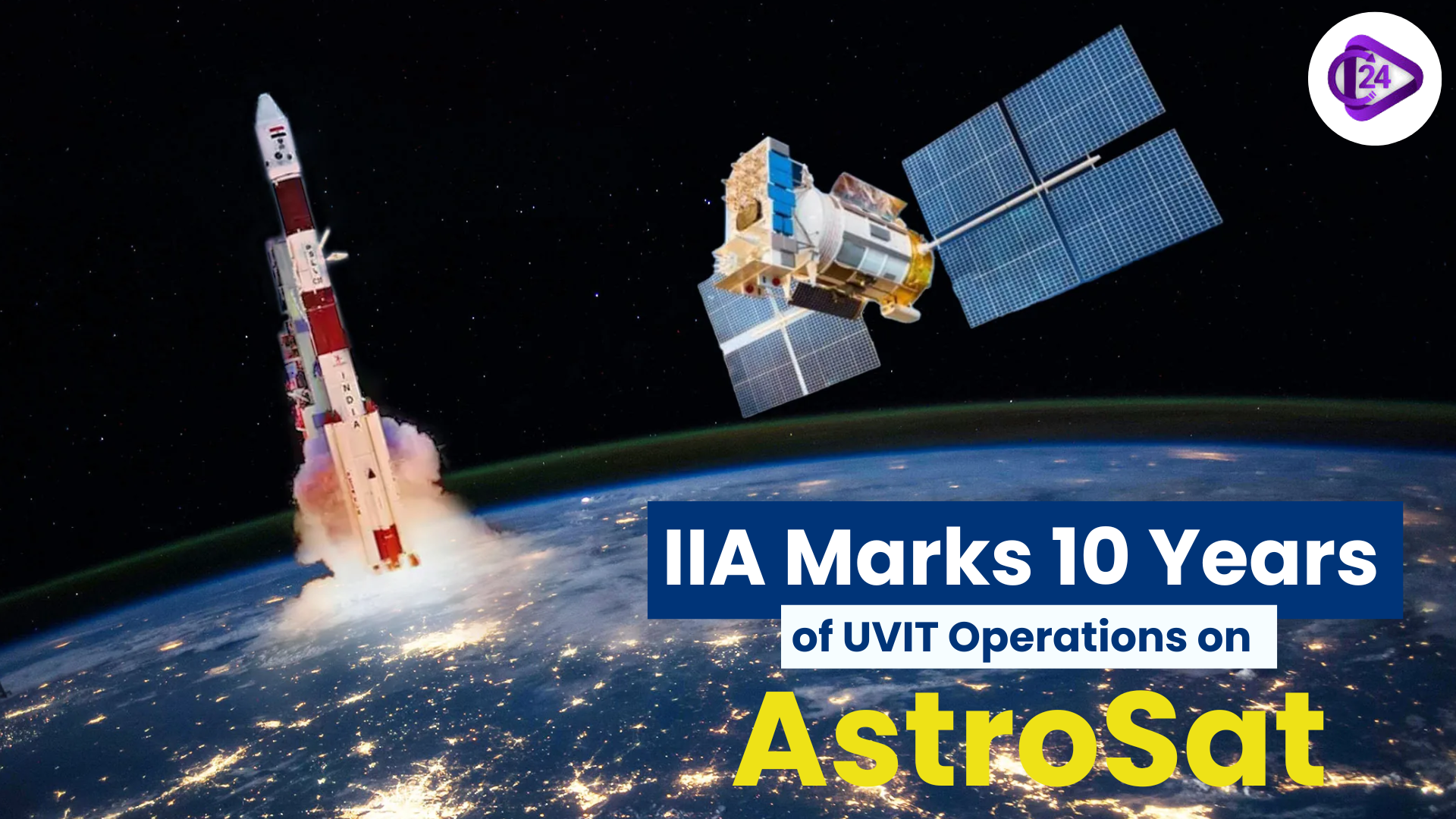
The IIA is marking a historic milestone with UVIT – its ultraviolet telescope on board AstroSat – entering its 10th year of successful operation. Introduced in 2015 as one of the four instruments of the first multi-wavelength space observatory in India, UVIT opened its eyes on the universe, 30 November 2015, and has since measured ultraviolet and the light in the visible bands of the stars, galaxies, and other phenomena in the universe that are too distant. It has also monitored more than 1,451 heavenly objects over a decade, generating close to 300 scientific papers and 19 dissertations. This anniversary confirms the increasing popularity of India in the field of space astronomy and indicates the importance of UVIT in the research of world astrophysics.
Significance of UVIT Operations on AstroSat
-
UVIT on AstroSat offers a high-resolution ultraviolet imaging system that allows astronomers to study cosmic phenomena as well as stars and galaxies in an unexpectedly detailed way.
-
It works on three channels, Far-UV, Near-UV, and visible, which means that the multi-wavelength observations can be made through the application of one platform.
-
In the last 10 years, UVIT has helped in almost 300 research papers and 19 PhD theses, which resulted in the improved presence of India in space astronomy.
-
Its extended data is useful in monitoring stellar evolution, star formation and dynamics of galaxies and assists both national and international astrophysical research projects.
-
UVIT enhances the scientific dominance of India in space-based ultraviolet astronomy.
Previous Year Question Asked About AstroSat
| Exam Name | Year | Question | Options | Answer |
|---|---|---|---|---|
| UPSC CSE Prelims | 2023 | What is the primary purpose of AstroSat? | A) Weather forecasting B) Earth observation C) Multi-wavelength space astronomy D) Communication satellite | C |
| SSC CGL | 2022 | AstroSat was launched in which year? | A) 2014 B) 2015 C) 2016 D) 2017 | B |
| CDS | 2021 | Which Indian telescope on AstroSat observes in ultraviolet light? | A) LAXPC B) SXT C) UVIT D) CZTI | C |
| RRB NTPC | 2020 | UVIT on AstroSat helps study? | A) Ocean currents B) Star formation and galaxies C) Climate change D) Solar panels' efficiency | B |
| SSC CPO | 2019 | AstroSat is associated with which Indian organisation? | A) ISRO B) DRDO C) IIA D) BARC | A |
| UPSC CSE Mains | 2018 | How many telescopes are onboard AstroSat? | A) 3 B) 4 C) 5 D) 6 | C |
| State PSC Exam | 2021 | UVIT observes in which wavelengths? | A) Infrared only B) Visible only C) Ultraviolet and visible D) X-ray only | C |
Conclusion
The anniversary of UVIT is a 10-year landmark on the AstroSat, which is a testament to the success of space astronomy in India. The ultraviolet measurements made by UVIT have made new insights into stars, galaxies and cosmic phenomena. The success of this decade of operation is an indication of the increased knowledge, dominance of the scientific community, and contribution of India to the world in the field of astrophysical study and space astronomy.