

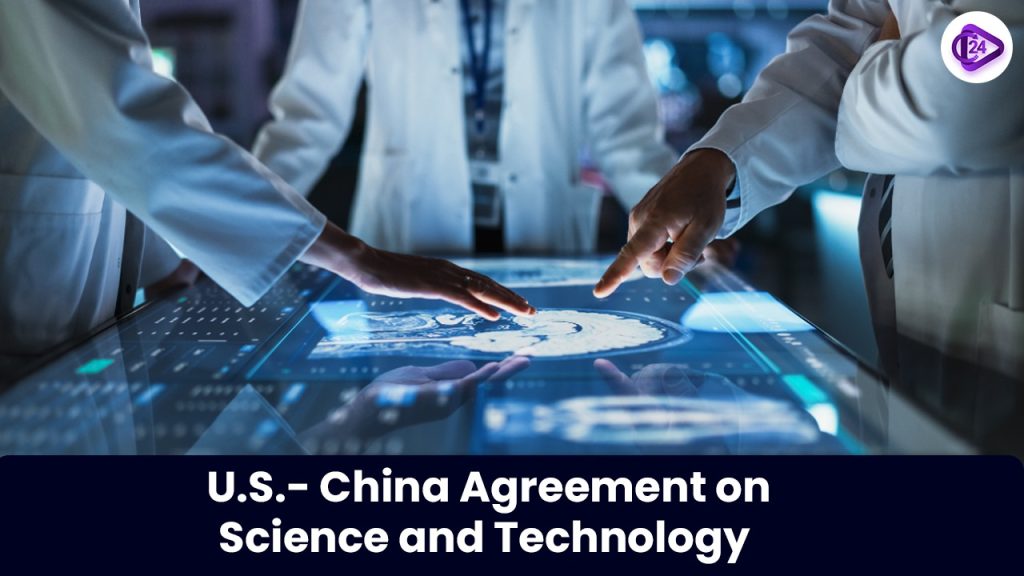
The United States and China have agreed to extend their bilateral Agreement on Cooperation in Science and Technology (S&T) for another five years. This partnership aims to strengthen collaboration in areas such as agriculture, nuclear fusion, and research safety, despite ongoing technological rivalry and geopolitical tensions between the two nations.
The United States of America and the People’s Republic of China have agreed to roll over, for five additional years, the bilateral Agreement on Cooperation in Science and Technology (S&T).
The relationship between the United States and China is an important feature of the structure of the interstate system of the twenty-first century, characterized by entanglement, technological contest, and geopolitical confrontation. Australia and the US are significant trading partners, but trade friction and disruption of supply chains reveal risks. In technology, they are cutthroat rivals, especially in sectors such as artificial intelligence, fifth-generation technology, and quantum computing and more importantly, the U.S. has denied China core technologies. In politics, the USA plays a balancing role against China’s power primarily in Indo-Pacific through such groups as the Quad and China’s support, its presence notably in the South China Sea and Taiwan.
However, they work together to address International concerns like climate change, and other health emergencies. Nevertheless, ideological divides further tensions, even with issues democratic support for the U.S. opposed to China’s autocratic model of governance; and human rights violation in Xinjiang and Hong Kong. This complicated interaction defines global policies, and manages competition and cooperation, while ensuring world order, needs to be managed.
About the Agreement
Inception: Originally adopted in 1979, and has been revised every five years since then.
Structure: Co-chairs from each country with the implementation of the executive agencies therein.
Scope: Comprises 40 annexes and appendices which focuses on issues such as farming and controlled nuclear fusion.
New Provisions: These measures were increased researcher safety; data sharing reciprocation; and limitation of research to simple projects and cooperation between governments.
The general importance of Bilateral S&T Agreements
-
Expand collaboration by stakeholders to other non-state institutions.
-
Support research collaboration, scholarships and exchange, and other forms of relationships between institutions.
-
Achieve the creation of bilateral research centers.
-
India today similarly signed trade-related agreements with 83 countries.
Essential Differences in the Renewed Agreement
-
Allowed only for studies deemed to be of fundamental importance and for topics of interest that are of similar concern to all parties involved.
-
Have excluded work on critical and emerging technologies.
-
Provides measures to ensure the safety of the respective researcher and to avoid skewed benefit to china.
-
Implications for India
Implications for India
-
Global Competition: China’s endeavors in the field of AI, 5G, and quantum computing enhance competitiveness for India.
-
Strategic Collaboration: To build up the S&T cooperation from India further, its electric S&T partnerships with the US, Japan, and Europe are required in space, IT as well as pharmaceuticals sectors.
-
Geopolitical Opportunities: The intensification of Sino-American relations gives India a chance to strengthen its position at the quad formation.
-
Economic Risks: On the Indian side, wagering on the fact that if the U.S. and China get into some sort of a trade war, India and thus its economy will suffer is quite a valid proposition.
-
Security Concerns: In general, rising military tensions across the Indo-Pacific region have the potential to up the security threats adjacent to India.
Conclusion and Way Forward
Based on the established trends of worldwide S&T production, the U.S.-China S&T Agreement mirrors the increasing rivalry in technology. For India, this is a critical juncture to:
-
One particular suggested strength that need to be bolstered is in R&D.
-
To retain competitiveness, there is a need to increase and ‘internationalization of S&T cooperation’.
-
There has to be a balance of the security alliances given to the U.S. and the economic relations being fostered with China.
-
Focus on the policy of strategic independence and use the confrontation between countries to strengthen its positions in the sphere of science and technology in the international community.
Conclusion
The extended U.S.-China S&T Agreement highlights the growing technological rivalry between the two powers, with key provisions aimed at enhancing cooperation in fundamental research. For India, this presents both opportunities and challenges, particularly in the areas of global competition, strategic collaborations, and security concerns. India must bolster its R&D efforts and navigate its strategic alliances to stay competitive in this increasingly complex geopolitical landscape.