


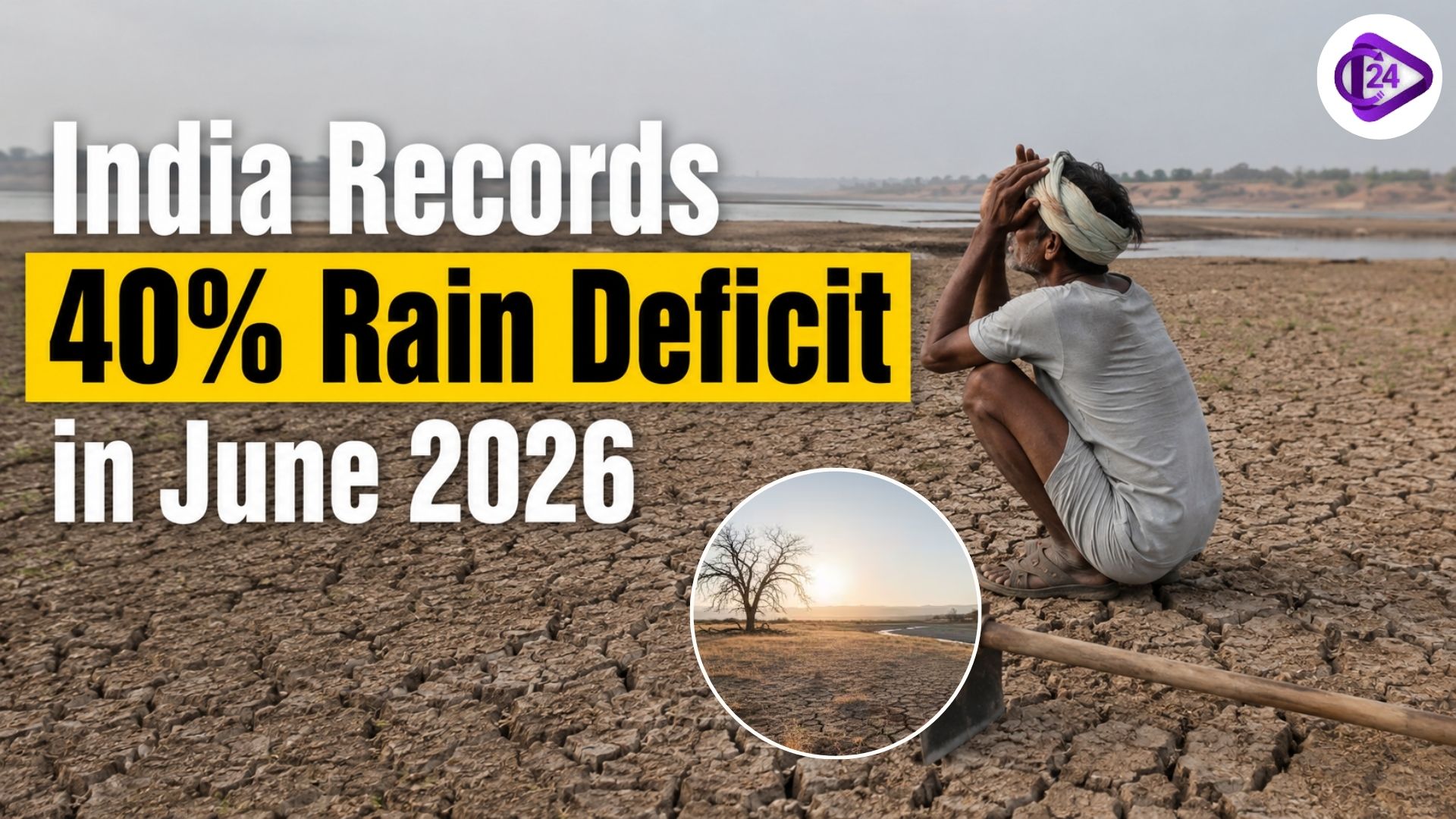
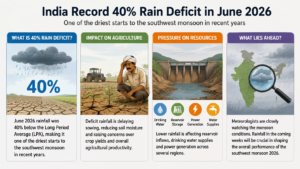
Rain Deficit: The latest RAIN data indicates that, as well as other parts of the world, India experienced a rainfall deficit of 40% during June 2026, making it one of the driest starts to the southwest monsoon for the past few years. The rainfall deficit has been more or less significant in central India, where the month’s rainfall was almost 25% deficient. The deficit has created concerns with agriculture harvests, reservoir storage, drinking water supplies and power generation. Besides, the meteorologists are closely watching the monsoon conditions as the rainfall in the coming weeks would shape the overall performance of the southwest monsoon 2026.
What is the 40% Rain Deficit?
The India Record 40% Rain Deficit in June 2026 means the country experienced way less rainfall than the long-period average (LPA) for the month of June. The term rainfall deficit can be defined as the difference between precipitation and historical average values over a standard climatological period.
The 40% deficiency is considered “deficient rainfall” and is indicative of a below-normal southwest monsoon. Any such significant deficit can have an impact on farming operations, soil moisture, reservoir inflows and late sowing of crops. Additionally, if the negative balances continue to roll over into July, the economic and environmental repercussions may increase.
Previous Year Questions (PYQs) on Indian Monsoon
| Exam & Year | Question (with Options) | Correct Answer |
| UPSC Prelims 2023 | With reference to the Indian Monsoon, consider the following statements:(A) El Niño generally weakens the southwest monsoon.(B) La Niña generally strengthens the southwest monsoon.(C) Both (A) and (B)(D) Neither (A) nor (B) | (C) Both (A) and (B) |
| UPSC Prelims 2022 | Which of the following is the primary cause of the southwest monsoon in India?(A) Differential heating of land and sea(B) Earth’s rotation alone(C) Ocean tides(D) Polar winds | (A) Differential heating of land and sea |
| UPSC Prelims 2021 | The withdrawal of the southwest monsoon from India generally begins from:(A) Kerala(B) Punjab and Rajasthan(C) Tamil Nadu(D) Odisha | (B) Punjab and Rajasthan |
| UPSC Prelims 2018 | Which one of the following phenomena is most closely associated with deficient monsoon rainfall in India?(A) La Niña(B) El Niño(C) Polar Vortex(D) Western Disturbances | (B) El Niño |
| UPSC Prelims 2015 | The southwest monsoon first reaches which Indian State?(A) Tamil Nadu(B) Karnataka(C) Kerala(D) Goa | (C) Kerala |
| UPSC Prelims 2014 | The southwest monsoon normally covers the entire country by:(A) Mid-June(B) End of June(C) Early July(D) Mid-August | (C) Early July |
| CDS 2022 | The Indian monsoon is primarily driven by:(A) Pressure differences between land and sea(B) Ocean tides(C) Earth’s magnetic field(D) Volcanic activity | (A) Pressure differences between land and sea |
| NDA 2021 | The retreating monsoon brings significant rainfall to:(A) Gujarat(B) Punjab(C) Tamil Nadu(D) Jammu & Kashmir | (C) Tamil Nadu |
| State PSC (Various) | Which branch of the southwest monsoon gives rainfall to the Western Ghats?(A) Bay of Bengal Branch(B) Arabian Sea Branch(C) Northeast Monsoon(D) Western Disturbance | (B) Arabian Sea Branch |
| State PSC (Various) | The normal onset date of the southwest monsoon over Kerala is:(A) 15 May(B) 1 June(C) 15 June(D) 1 July | (B) 1 June |
GPS-Tagged White-rumped Vulture Dies
Why Is Central India the Worst Hit? Rain Deficit
- The arrival of good rainfall in Central India was delayed due to the advancement of the monsoon, keeping the region comparatively drier.
- The absence of low-pressure systems over the Bay of Bengal led to fewer rain-bearing weather systems proceeding inland.
- With the establishment of El Niño, southwest monsoon circulation weakened, which contributed to less rainfall in the core monsoon belt.
- Negative Madden–Julian Oscillation (MJO) inhibited cloud development and convection, thereby depressing rainfall activity.
- The India Meteorological Department (IMD) said Central India received 84.4 mm of rain against the normal 170.3 mm, resulting in a rainfall deficit of 50%.
- Lower soil moisture has delayed kharif sowing and elevated water stress on reservoirs and sources.
Conclusion on India’s June Monsoon Rain Deficit Reaches 40%
India Records 40% Rain Deficit In June 2026: Report Weak Start Presents Challenges as 2023 Rain Deficit duels monsoon season. Central India is particularly hard-hit, with a nearly 50% shortfall in rainfall leading to more worry over agriculture, water resources and the rural economy. But July and August rainfall will be critical in whether or not the gap season closes. The IMD will have to keep a continuous track till the monsoon subsides, forcing fairly prompt policy response with a view to mitigating the adverse effects of less rainfall.