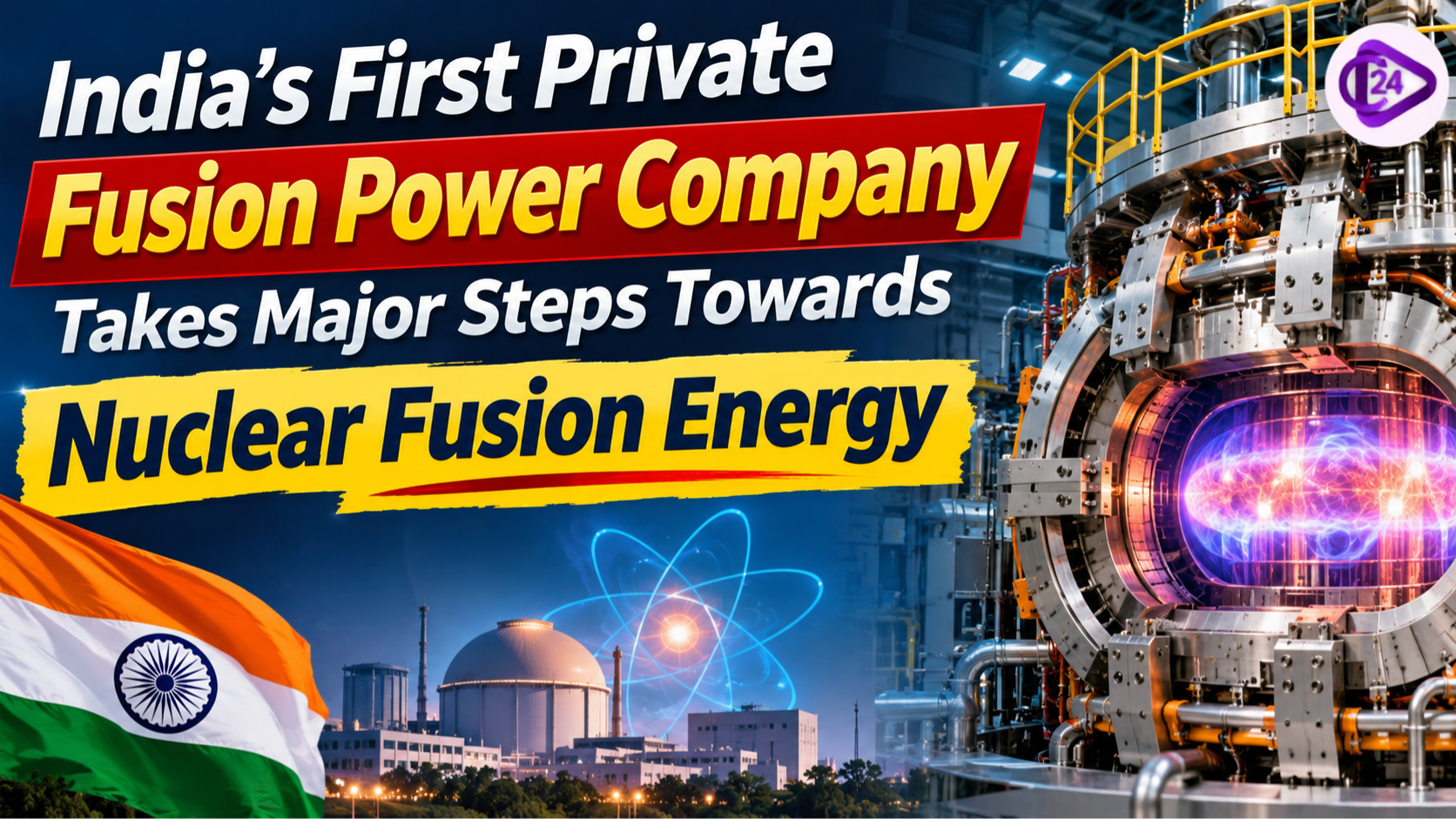


Pranos Fusion: India is moving forward in advanced nuclear fusion research with the entry of private companies into next-generation energy technology. Bengaluru-based Pranos Fusion is developing experimental fusion systems to build India’s domestic capabilities in plasma physics, superconducting magnets, and reactor engineering. Its work is an important development in India’s efforts to explore clean energy technologies and strengthen long-term energy security.
Why in News?
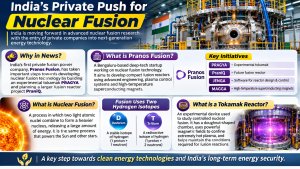
India’s first private fusion power company, Pranos Fusion, has taken important steps towards developing nuclear fusion technology. The company is developing an experimental tokamak called PRAGYA and planning a larger fusion reactor project named PraniQ.
These initiatives aim to advance India’s capabilities in fusion reactor design and related technologies.
What is Pranos Fusion?
Pranos Fusion is a Bengaluru-based deep-tech startup working on nuclear fusion technology. It aims to develop compact fusion reactors using advanced engineering, plasma control systems and high-temperature superconducting magnets.
Its major technology initiatives include:
- PRAGYA: An experimental tokamak designed to study plasma behaviour and test fusion technologies.
- PraniQ: A proposed future fusion reactor targeting net scientific energy gain.
- JENGA: A software platform for reactor simulation, design and control.
- MAGGA: A technology programme focused on high-temperature superconducting magnets.
The company’s efforts aim to develop indigenous technologies and encourage private-sector participation in India’s advanced energy research.
What is Nuclear Fusion?
Nuclear fusion is a process in which two light atomic nuclei combine to form a heavier nucleus, releasing a large amount of energy.
It is the same process that powers the Sun and other stars.
Most experimental fusion reactors use two isotopes of hydrogen:
- Deuterium: A stable isotope of hydrogen containing one proton and one neutron.
- Tritium: A radioactive isotope of hydrogen containing one proton and two neutrons.
These isotopes combine under extremely high temperatures to produce helium, a neutron and energy. Fusion experiments generally require temperatures of around 100 million degrees Celsius or higher.
What is a Tokamak Reactor?
A tokamak is an experimental device used to study controlled nuclear fusion.
Its important features include:
- It has a doughnut-shaped chamber.
- It uses powerful magnetic fields to confine extremely hot plasma.
- It helps maintain the conditions required for fusion reactions.
- It is one of the leading technologies being researched for future fusion energy.
PRAGYA will help Pranos Fusion test technologies required for developing larger fusion machines.
India’s Progress in Nuclear Fusion Research
India has been involved in fusion research through government-supported scientific institutions and international collaborations.
- Institute for Plasma Research (IPR)
The Institute for Plasma Research is located in Gandhinagar, Gujarat. It conducts research in plasma physics and controlled thermonuclear fusion.
Its major experimental tokamak facilities include:
- ADITYA-U
- Steady State Superconducting Tokamak-1 (SST-1)
- International Thermonuclear Experimental Reactor (ITER)
India is a partner in the International Thermonuclear Experimental Reactor (ITER), a major international project focused on demonstrating the feasibility of fusion energy.
ITER is being constructed in southern France. Its participating members include India, the European Union, the United States, Russia, China, Japan and South Korea.
Difference Between Nuclear Fusion and Nuclear Fission
| Nuclear Fusion | Nuclear Fission |
| Combines light atomic nuclei | Splits heavy atomic nuclei |
| Uses hydrogen isotopes | Uses uranium or plutonium |
| Produces helium in deuterium-tritium reactions | Produces smaller nuclei |
| Generally produces less long-lived radioactive waste | Produces radioactive nuclear waste |
| Powers the Sun | Used in conventional nuclear power plants |
Importance of Nuclear Fusion for India
- Clean Energy: Fusion has the potential to generate electricity with very low greenhouse gas emissions during operation.
- Energy Security: It could diversify India’s future energy sources.
- Technological Innovation: Research encourages development of superconducting magnets, advanced materials and plasma-control systems.
- Private Investment: Startups can bring additional funding and innovation into advanced scientific research.
- Skilled Workforce: Fusion research can create opportunities for Indian scientists and engineers.
Challenges in Nuclear Fusion
Despite its potential, commercial fusion energy faces several challenges:
- Maintaining plasma at extremely high temperatures.
- Controlling plasma instability inside the reactor.
- Developing materials that can withstand extreme heat and neutron radiation.
- Managing high research and infrastructure costs.
- Achieving more usable energy output than the overall energy required to operate the system.
Commercial fusion electricity is not yet an established source of power.
Conclusion – Pranos Fusion
Pranos Fusion’s development of PRAGYA represents an important step towards private-sector participation in India’s nuclear fusion research. Its proposed PraniQ reactor could further advance indigenous fusion technology. Although commercial electricity generation remains a long-term challenge, these developments can strengthen India’s scientific capabilities and future energy security.