

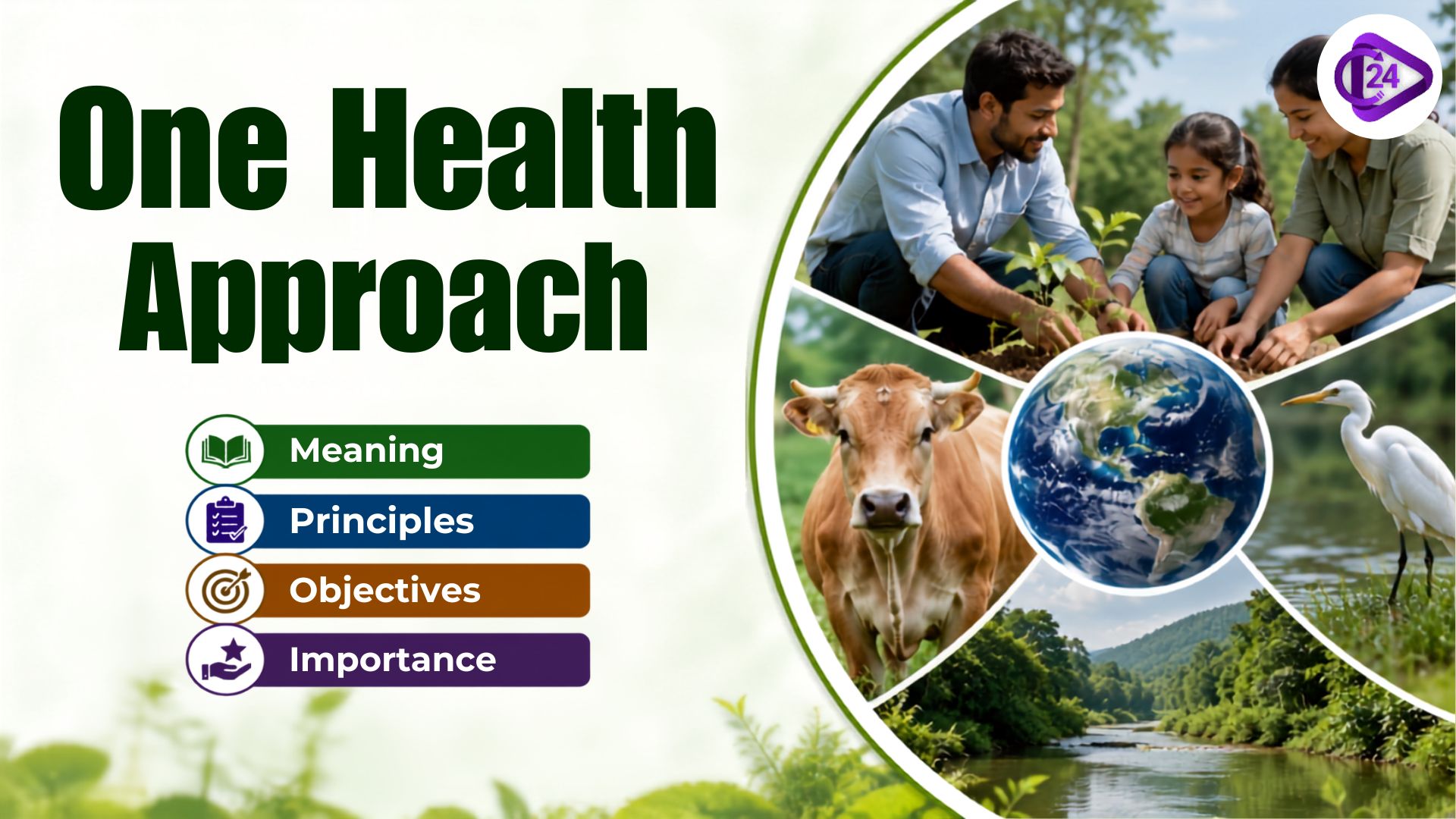
Emerging infectious diseases, antimicrobial resistance, climate change, and biodiversity loss- the One Health Approach: Meaning, Principles, Objectives and Importance has gained greater importance than ever. The One Health approach acknowledges that the health of humans, animals, plants and the environment are closely linked. Thus, a multi-sector approach to effective disease prevention and public health management is needed.
One Health Approach: meaning, principles, objectives and importance encourages coordination between people, animals and the environment – among medical professionals, veterinarians, environmental scientists, researchers and policy makers to help improve health care. It can also play a protective role in sustainable development by addressing health risks and challenges at the human-animal-environment interface.
What is the One Health Approach?
- One Health is an integrated and coordinated strategy which acknowledges the interdependency of the health of people, animals, plants and the environment.
- It encourages collaboration and integration of various sectors including public health, veterinary science, agriculture, wildlife and environment management in response to common health issues.
- The strategy focuses on combating disease transmission between animals and humans (zoonotic diseases) to prevent them, identify them and make decisions to respond.
- It also prioritises addressing antimicrobial resistance (AMR), food safety and monitoring and protecting ecosystem health.
- One Health promotes multisectoral surveillance, research, data sharing and policy harmonisation between stakeholders.
- The One Health Approach safeguards human health by tackling the problem where it happens, enhances public health, protects biodiversity, and contributes to sustainable development at all levels – local, national, and global.
Why is the One Health Approach Important?
- The One Health Approach is significant because human, animal, plant and environmental health are intricately interconnected.
- It helps to prevent and control zoonotic diseases, such as COVID-19, avian influenza and rabies, that can be transmitted from animal to human and vice versa.
- The strategy enhances disease surveillance in the early period, which helps in early investigation and response to disease outbreaks.
- It helps to fight antimicrobial resistance (AMR) by encouraging the responsible use of antibiotics in the treatment of people and animals.
- One Health enhances food safety and food security by decreasing the risk of diseases transmitted by livestock and agriculture.
- It helps protect the environment, biodiversity, and the sustainable management of our ecosystems; health risks from climate change, pollution and habitat loss are minimised.
- In conclusion, the One Health Approach optimises preparedness for pandemic outbreaks, public health resilience, and sustainable development by pursuing a multi-sectoral collaborative approach.
PYQs Related to One Health, Diseases and Health Programmes
| Year | Exam | Question | Options | Answer |
| 2024 | SSC CGL | Which of the following is a zoonotic disease? | (A) Rabies (B) Typhoid (C) Cholera (D) Scurvy | (A) Rabies |
| 2024 | RRB NTPC | Which mosquito is the primary vector of Dengue? | (A) Anopheles (B) Aedes aegypti (C) Culex (D) Housefly | (B) Aedes aegypti |
| 2023 | SSC CHSL | The National Tuberculosis Elimination Programme (NTEP) aims to eliminate TB in India by: | (A) 2028 (B) 2025 (C) 2030 (D) 2035 | (B) 2025 |
| 2023 | RRB Group D | Which of the following diseases is transmitted through the bite of an infected dog? | (A) Rabies (B) Dengue (C) Malaria (D) Cholera | (A) Rabies |
| 2022 | SSC CGL | Which Government programme strengthens disease surveillance across India? | (A) National Health Mission (B) Integrated Disease Surveillance Programme (IDSP) (C) PM-JAY (D) Ayushman Bharat Digital Mission | (B) IDSP |
| 2022 | RRB NTPC | Which of the following diseases is caused by a virus? | (A) Tuberculosis (B) Cholera (C) Dengue (D) Typhoid | (C) Dengue |
| 2021 | SSC GD | Mission Indradhanush is associated with: | (A) Vaccination (B) Nutrition (C) Sanitation (D) Education | (A) Vaccination |
| 2021 | RRB Group D | Which disease is spread by the Aedes mosquito? | (A) Malaria (B) Dengue (C) Kala-azar (D) Plague | (B) Dengue |
| 2020 | SSC CGL | Which of the following diseases is caused by a bacterium? | (A) Malaria (B) Tuberculosis (C) Dengue (D) AIDS | (B) Tuberculosis |
| 2020 | RRB NTPC | Which mosquito spreads Malaria? | (A) Culex (B) Female Anopheles (C) Aedes (D) Tsetse Fly | (B) Female Anopheles |
| 2019 | SSC CHSL | Which disease is known as Hydrophobia? | (A) Rabies (B) Cholera (C) Typhoid (D) Measles | (A) Rabies |
| 2019 | RRB JE | Which Government programme aims to provide free vaccination to children and pregnant women? | (A) Mission Indradhanush (B) PM Poshan (C) Poshan Abhiyaan (D) Ayushman Bharat | (A) Mission Indradhanush |
Vikram-1, India’s First Privately Developed Orbital-Class Rocket
Conclusion on One Health Approach
Understanding One Health Approach: Definition, Principle, Aim & Importance is a comprehensive and interlinked approach that acknowledges the intricate connections between human health, animal health, plant and environmental health. The One Health approach is gaining increasing importance and recognition as the world grapples with emerging infectious diseases, antimicrobial resistance (AMR), climate change and biodiversity loss. It provides for early disease detection, rapid outbreak response and contributes to food safety and sustainable ecosystem management by promoting collaboration among health, veterinary, agriculture, wildlife and environmental fields.