


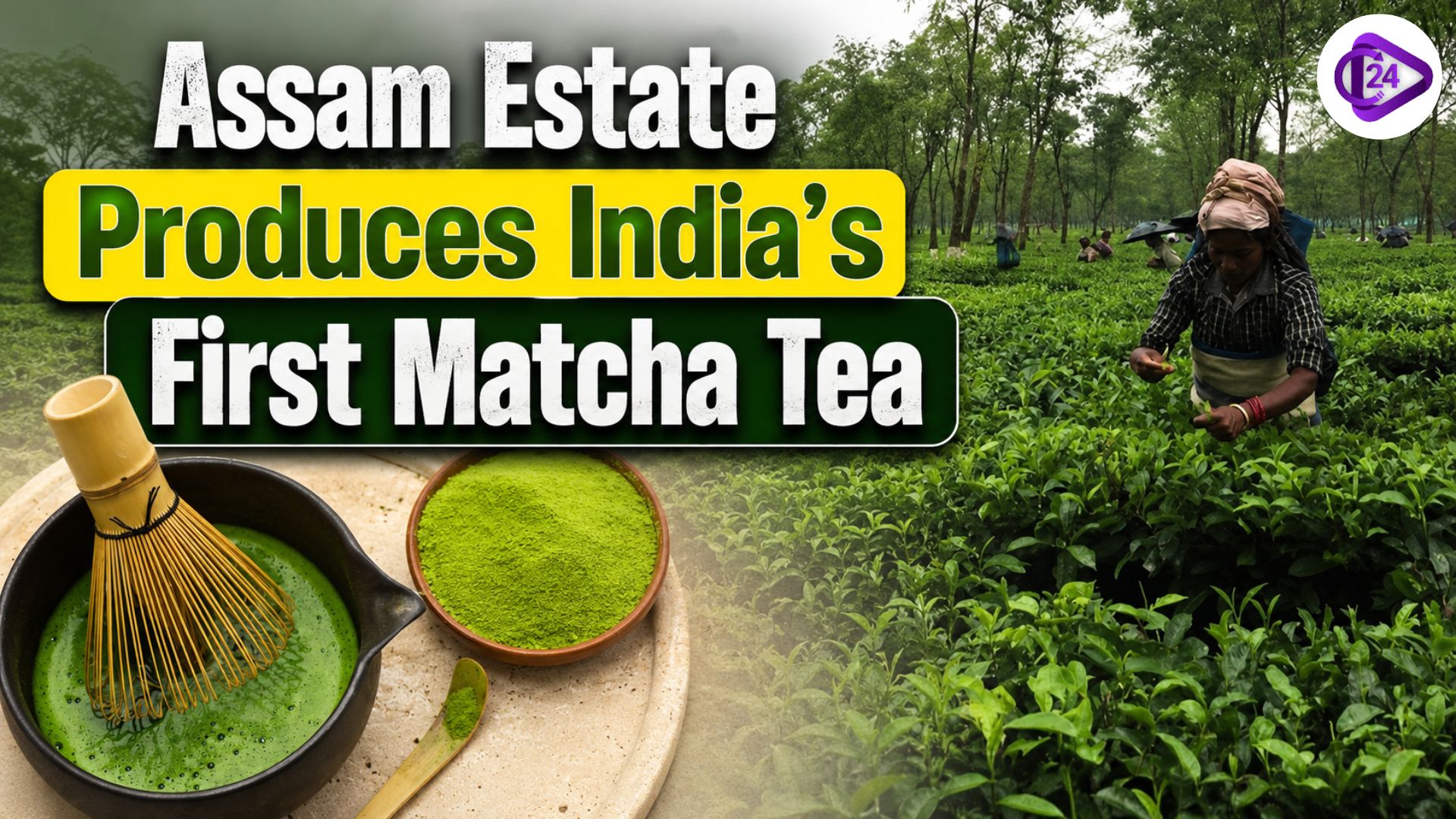
Matcha Tea: Assam Estate produces India’s first Matcha tea, a significant breakthrough in the country’s premium tea segment! Matcha is a traditional Japanese tea that has been cultivated and processed in Japan for centuries. But in Assam, an innovative tea estate has managed to produce India’s first genuine matcha tea using the locally grown tea leaves and special processing methods. The success would further boost India’s position in the global speciality tea market as Grows, exporters, and Consumers initiate new business ventures in the tea market. The upfront promotion of Assam Estate’s product as India’s first matcha tea has the potential to promote India’s higher-quality tea exports and could diversify the exportable tea products in India.
Assam Estate Produces India’s First Matcha Tea: Overview
| Particular | Details |
| Development | Assam Estate Produces India’s First Matcha Tea |
| State | Assam |
| Tea Type | Premium Green Tea Powder (Matcha) |
| Processing | Shade-grown leaves, steamed, dried, stone-ground |
| Main Benefit | Rich in antioxidants and nutrients |
| Global Significance | Expands India’s speciality tea market |
| Target Market | Domestic and international consumers |
What is Matcha Tea?
Matcha is finely ground green tea powder that is specifically grown. Select the powdered tea leaves, or “matcha”, and drink the tea ready-made by consuming the whole powdered leaf. Consequently, it contains higher levels of antioxidants, vitamins, minerals and amino acids.
The first of Assam Estate, produced with the golden name of Matcha tea, has been announced in India, making the country capable of producing world-quality speciality tea with a golden name.
How is Matcha Tea Produced?
- Tea plants are cultivated in the shade for approximately 20–30 days before picking, using special shading covers. This enhances the chlorophyll and amounts of amino acids (particularly L-theanine) and brings the bright green hue to matcha.
- For the first harvest, only the youngest and tender tea leaves are hand-picked to ensure high quality.
- Leaves are steamed immediately after harvest to halt oxidation and retain the freshness, flavour, nutrients and green colour.
- The leaves are then steamed, followed by drying without rolling, affording a raw material termed tencha.
- Stems, veins and other coarse tissues are removed, leaving only the soft leaf tissue.
- Lastly, the tencha leaves are gently divided by a stone mill into an ultra-fine powder, creating authentic matcha with its smooth and creamy texture, excellent umami flavour and nutritional value.
Assam PYQs (Art & Culture, Temples & GI Tags)
| Year | Exam | Question | Options | Answer |
| 2024 | UPSC Prelims | Which of the following is the traditional dance of Assam performed during Bohag Bihu? | (A) Garba (B) Bihu Dance (C) Ghoomar (D) Lavani | (B) Bihu Dance |
| 2023 | UPSC/State PSC | The Vaishnavite monasteries known as Satras were established by whom? | (A) Guru Nanak (B) Srimanta Sankardeva (C) Ramanujacharya (D) Kabir | (B) Srimanta Sankardeva |
| 2022 | UPSC/State PSC | Majuli, famous for its Satras, is located in which state? | (A) Odisha (B) Assam (C) West Bengal (D) Tripura | (B) Assam |
| 2021 | State PSC | The famous Kamakhya Temple is situated on which hill? | (A) Parasnath Hill (B) Nilachal Hill (C) Nandi Hills (D) Rajgir Hill | (B) Nilachal Hill |
| 2020 | State PSC | Kamakhya Temple is dedicated to which deity? | (A) Lord Shiva (B) Goddess Kamakhya (C) Lord Vishnu (D) Lord Ganesha | (B) Goddess Kamakhya |
| 2019 | State PSC | Ambubachi Mela is celebrated at which temple? | (A) Jagannath Temple (B) Kamakhya Temple (C) Konark Temple (D) Meenakshi Temple | (B) Kamakhya Temple |
| 2018 | State PSC | Which is the world’s largest inhabited river island? | (A) Diu (B) Majuli (C) Elephanta (D) Sagar Island | (B) Majuli |
| 2017 | UPSC Prelims | Which classical dance form originated in Assam? | (A) Kathak (B) Sattriya (C) Manipuri (D) Mohiniyattam | (B) Sattriya |
| 2016 | State PSC | Which of the following is a GI-tagged silk of Assam? | (A) Banarasi Silk (B) Muga Silk (C) Chanderi Silk (D) Kanchipuram Silk | (B) Muga Silk |
| 2015 | State PSC | Assam is internationally famous for which GI-tagged agricultural product? | (A) Darjeeling Tea (B) Assam Tea (C) Nilgiri Tea (D) Kangra Tea | (B) Assam Tea |
| 2014 | State PSC | Mekhela Chador is the traditional dress of which state? | (A) Manipur (B) Assam (C) Meghalaya (D) Nagaland | (B) Assam |
| 2013 | UPSC/State PSC | Who led the Neo-Vaishnavite movement in Assam? | (A) Chaitanya Mahaprabhu (B) Srimanta Sankardeva (C) Basavanna (D) Vallabhacharya | (B) Srimanta Sankardeva |
| 2012 | State PSC | Which is the most celebrated harvest festival of Assam? | (A) Onam (B) Bohag Bihu (C) Pongal (D) Baisakhi | (B) Bohag Bihu |
| 2011 | State PSC | Which GI-tagged tea is produced exclusively in Assam? | (A) Kangra Tea (B) Assam Orthodox Tea (C) Nilgiri Tea (D) Darjeeling Tea | (B) Assam Orthodox Tea |
| 2010 | State PSC | Kamakhya Temple is considered one of the _____. | (A) Char Dham (B) Jyotirlingas (C) Shakti Peethas (D) Pancha Bhootas | (C) Shakti Peethas |

MANAS, India’s AI-Powered Digital Shield Against Drug Abuse
Conclusion on Assam Estate Pioneers India’s First Matcha Tea
The achievement that Assam Estate produces India’s First Matcha Tea marks an important milestone for India’s tea sector. This exemplifies innovation, quality agriculture and the nation’s capacity to compete in the international speciality tea market. As demand for healthy beverages and premium green tea products grows, the development can be advantageous for the tea growers, exporters and consumers. For Assam Estate, producing the inaugural tea formulation of Matcha Tea of India is a major step towards gaining international recognition as a star producer of premium matcha tea, if the quality doesn’t drop.