

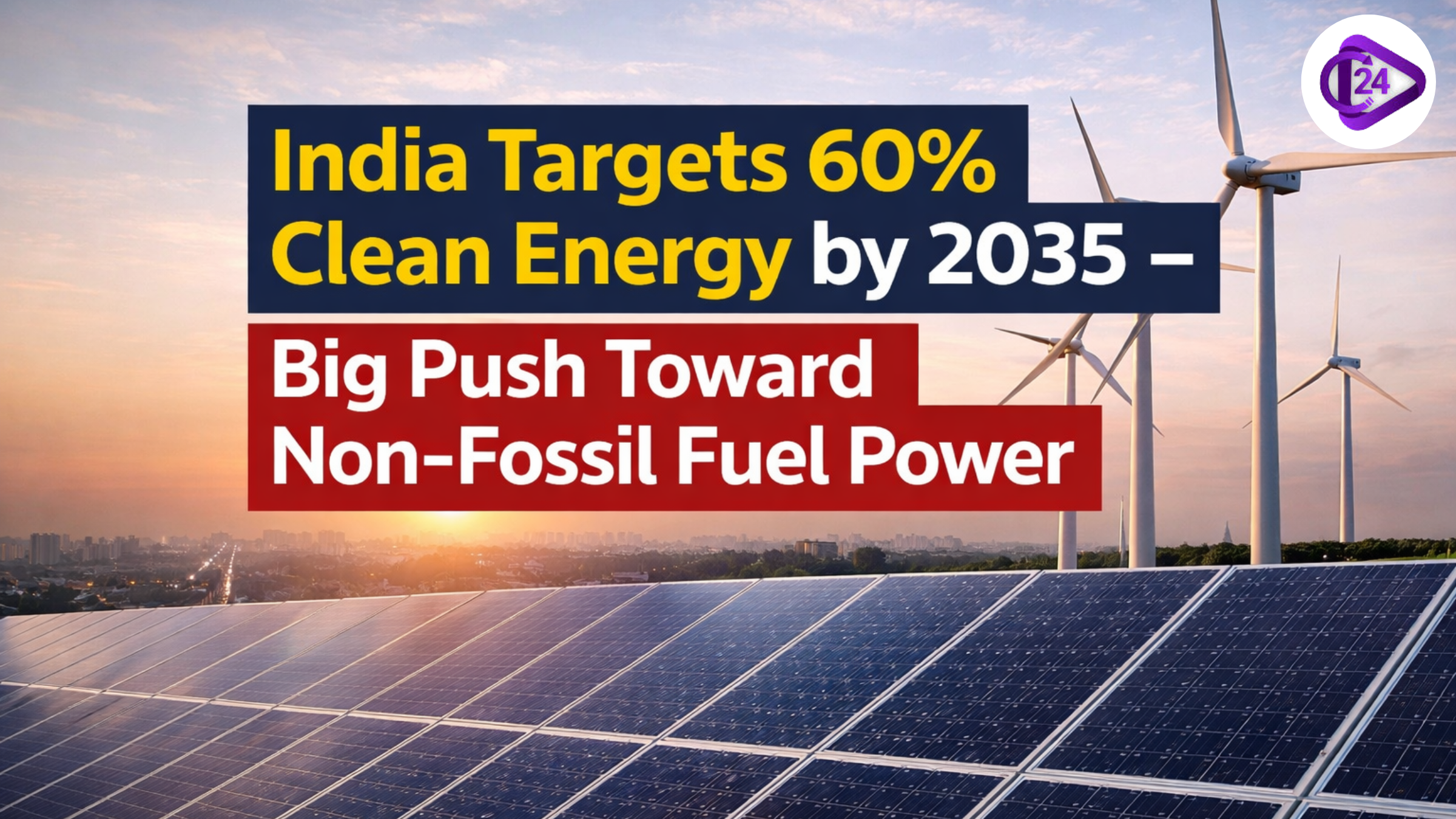
India is speedily pushing its clean energy shift with an ambitious goal of switching 60 per cent of the entire power generation to non-fossil fuels by 2035. The move will show that the country is highly committed to climate action, energy security, and sustainable development. As time goes on and more and more investments are made in solar, wind, and hydro energy, as well as nuclear energy, India expects to no longer rely heavily on coal and other fossil fuels. The project also resonates with the international climate objectives and helps increase the economy by creating green employment, innovation, and infrastructure in the energy sector.
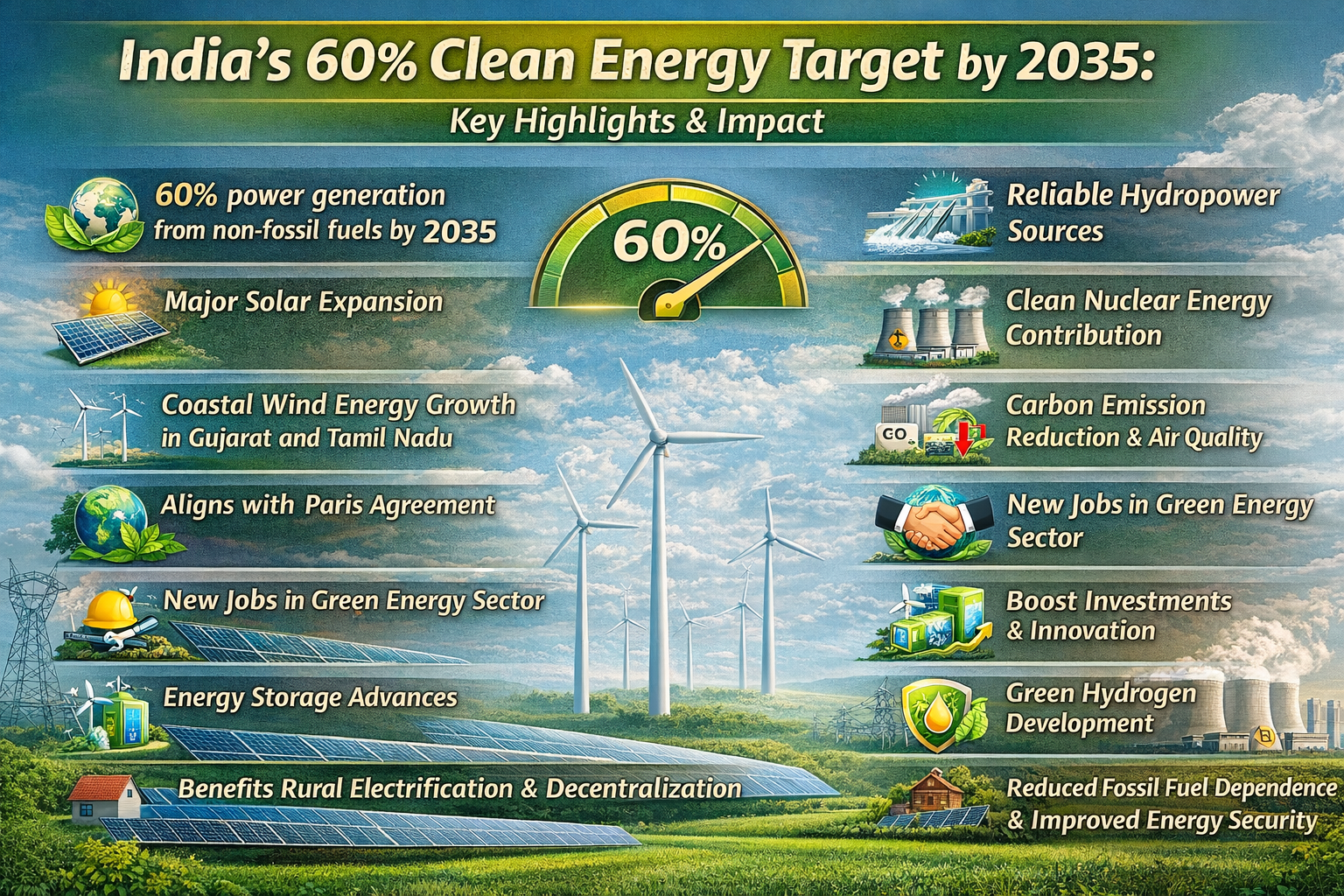
India’s 60% Clean Energy Target by 2035: Key Highlights & Impact
- The government intends to derive 60 per cent of power-generating capacity by 2035 based on non-fossil fuels, which will reinforce India’s climate obligations in the long run.
- Solar energy will have a significant contribution; the number of big solar parks and rooftop installations of solar energy grows quickly in the United States.
- The capacity of wind energy will also increase, particularly in some coastal areas such as Gujarat and Tamil Nadu.
- Hydropower is also a good source of constant and renewable energy, which maintains the stability of the grid.
- The sources of nuclear energy will help as a clean and efficient base-load power source.
- The conversion will make a huge impact by cutting down the amount of carbon emissions as well as improving the quality of the air in the country.
- The project is in line with the provisions of the country of India on international climate, such as the Paris Agreement.
- The increased renewable energy will create jobs in the manufacturing, installation, and maintenance industries.
- The policy will promote investments in green technologies by the private sector and increase innovation in the area.
- Storage of energy that is renewable, like batteries, will also be important to the task.
- Green hydrogen is a future fuel that will help to decarbonise industries, as well as transport.
- The government is emphasizing enhancing the energy distribution infrastructure.
- Renewable growth will help rural towns and countries to get electricity and decentralised energy.
- The transformation will minimise reliance on imported fossil fuels, which will enhance energy security.
- Monetary rewards and policy changes will enhance the uptake of clean energy.
- The clean energy ecosystem will be supplemented by electric vehicle growth.
- Efficiency and losses will reduce with the introduction of smart grids and digital monitoring systems.
- The project helps to facilitate more sustainable city growth and urban cleanliness.
- Cooperation with international business partners will promote technology transfer and investment.
- On balance, the 2035 clean energy goal is a significant move towards a more sustainable and green India.
PYQs on Energy & Fossil Fuels
| Exam | Year | Question | Options | Answer |
|---|---|---|---|---|
| UPSC Prelims | 2015 | Which of the following are non-renewable energy sources? | (A) Coal (B) Natural Gas (C) Wind Energy (D) Both A & B | D) Both A & B |
| UPSC Prelims | 2018 | What is the main source of energy in India? | (A) Solar (B) Coal (C) Wind (D) Hydro | B) Coal |
| UPSC Prelims | 2019 | Which is the cleanest fossil fuel? | (A) Coal (B) Petroleum (C) Natural Gas (D) Diesel | C) Natural Gas |
| UPSC Prelims | 2020 | Which of the following are renewable sources? | (A) Coal (B) Biomass (C) Solar (D) Both B & C | D) Both B & C |
| UPSC Prelims | 2021 | Which one is a renewable energy source? | (A) Coal (B) Wind Energy (C) Petroleum (D) Natural Gas | B) Wind Energy |
| SSC CGL | 2018 | Which fuel has the highest calorific value? | (A) Coal (B) Petrol (C) Hydrogen (D) Diesel | C) Hydrogen |
| SSC CGL | 2019 | Which of the following is a fossil fuel? | (A) Solar Energy (B) Wind Energy (C) Petroleum (D) Biomass | C) Petroleum |
| SSC CHSL | 2020 | Which gas is mainly responsible for global warming due to fossil fuels? | (A) Oxygen (B) Nitrogen (C) Carbon Dioxide (D) Hydrogen | C) Carbon Dioxide |
| SSC CHSL | 2021 | LPG mainly consists of which gases? | (A) Methane & Ethane (B) Propane & Butane (C) Hydrogen & Oxygen (D) Nitrogen & Oxygen | B) Propane & Butane |
| RPSC RAS Prelims | 2016 | Which mineral is used for nuclear energy? | (A) Coal (B) Uranium (C) Iron (D) Bauxite | B) Uranium |
| RPSC RAS Prelims | 2018 | Which state is the largest producer of solar energy in India? | (A) Gujarat (B) Rajasthan (C) Maharashtra (D) Tamil Nadu | B) Rajasthan |
| RPSC RAS Prelims | 2021 | Which is a non-conventional energy source? | (A) Coal (B) Petroleum (C) Solar Energy (D) Natural Gas | C) Solar Energy |
| UPSC Prelims | 2022 | Green Hydrogen is produced using which source? | (A) Coal (B) Natural Gas (C) Renewable Energy (D) Diesel | C) Renewable Energy |
| SSC CGL | 2022 | Which fossil fuel is widely used in thermal power plants? | (A) Coal (B) Wind (C) Solar (D) Hydro | A) Coal |
Conclusion – India Targets 60% Clean Energy by 2035
India has set a goal of achieving 60 per cent power generation by 2035 through non-fossil fuel generation, which is a rocket step towards the future, a sustainable energy generation that is strong and resilient. Not only does this ambitious goal make commitments in climate stronger, but it also saves energy and decreases the reliance on imports. As renewable energy, green hydrogen, and new infrastructure grow rapidly, India will be a leader in the clean-energy transition on an international scale. Although it will be vital to success in terms of effective implementation, investment, and policy support. On the whole, this project opens the doors to economic growth, the preservation of the environment, and a greener and cleaner future for future generations.