
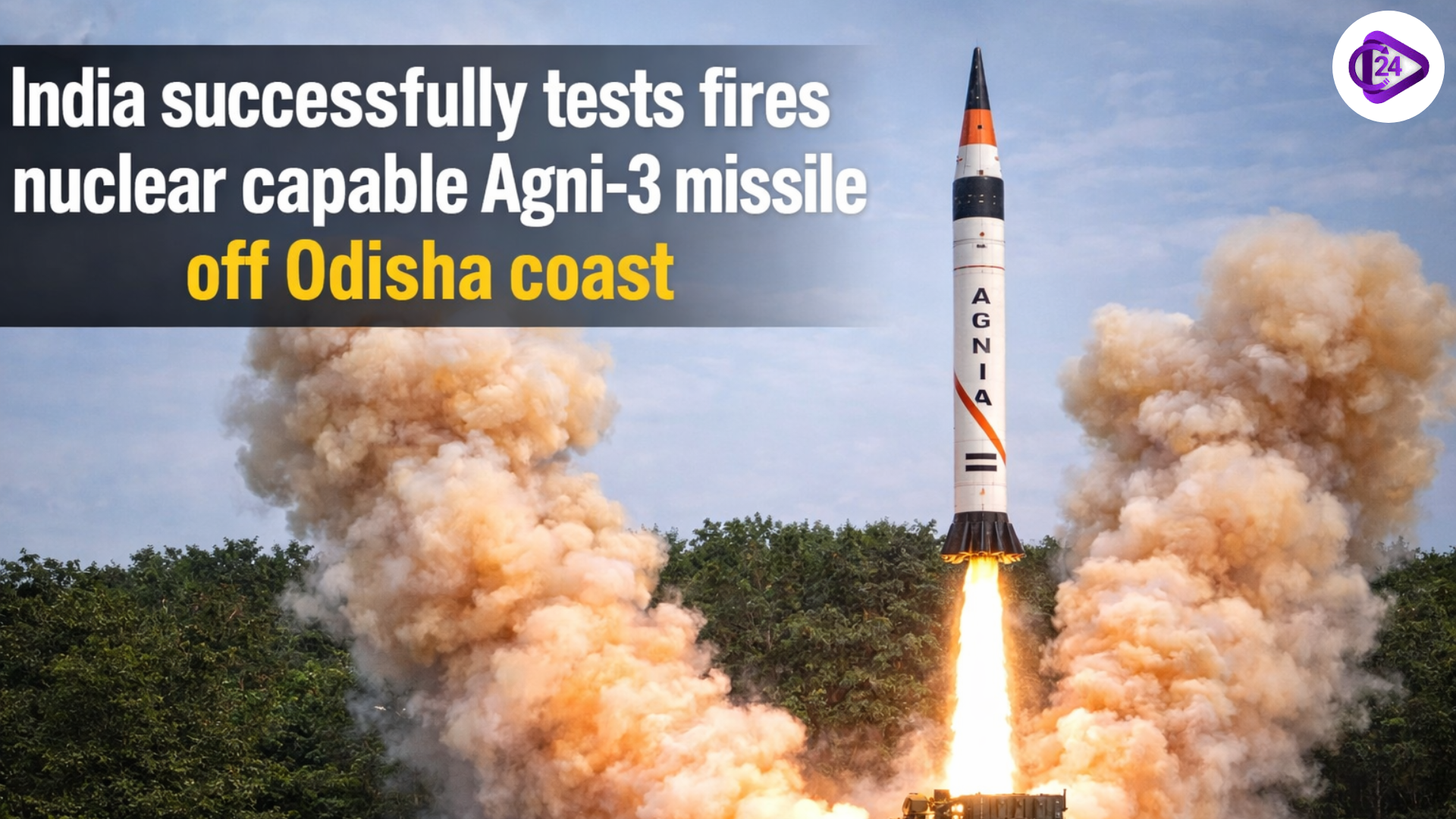
In an official statement, defence officials confirmed that India managed to test-launch its nuclear-capable Agni-3 intermediate-range ballistic missile from the Integrated Test Range at Chandipur in Odisha. The launch on February 6 confirmed all the operational and technical parameters under the control of the Strategic Forces Command that regulates the strategic missile arsenal of the country. The two-stage, solid-fuelled missile used in the announcement has taken a planned path and shows reliability and preparedness, according to the announcement of the press release as part of India’s credible minimum deterrence posture. The successful test underscores the continued emphasis on building strategic deterrence and operational readiness.
Significance of Agni-3 Missile
-
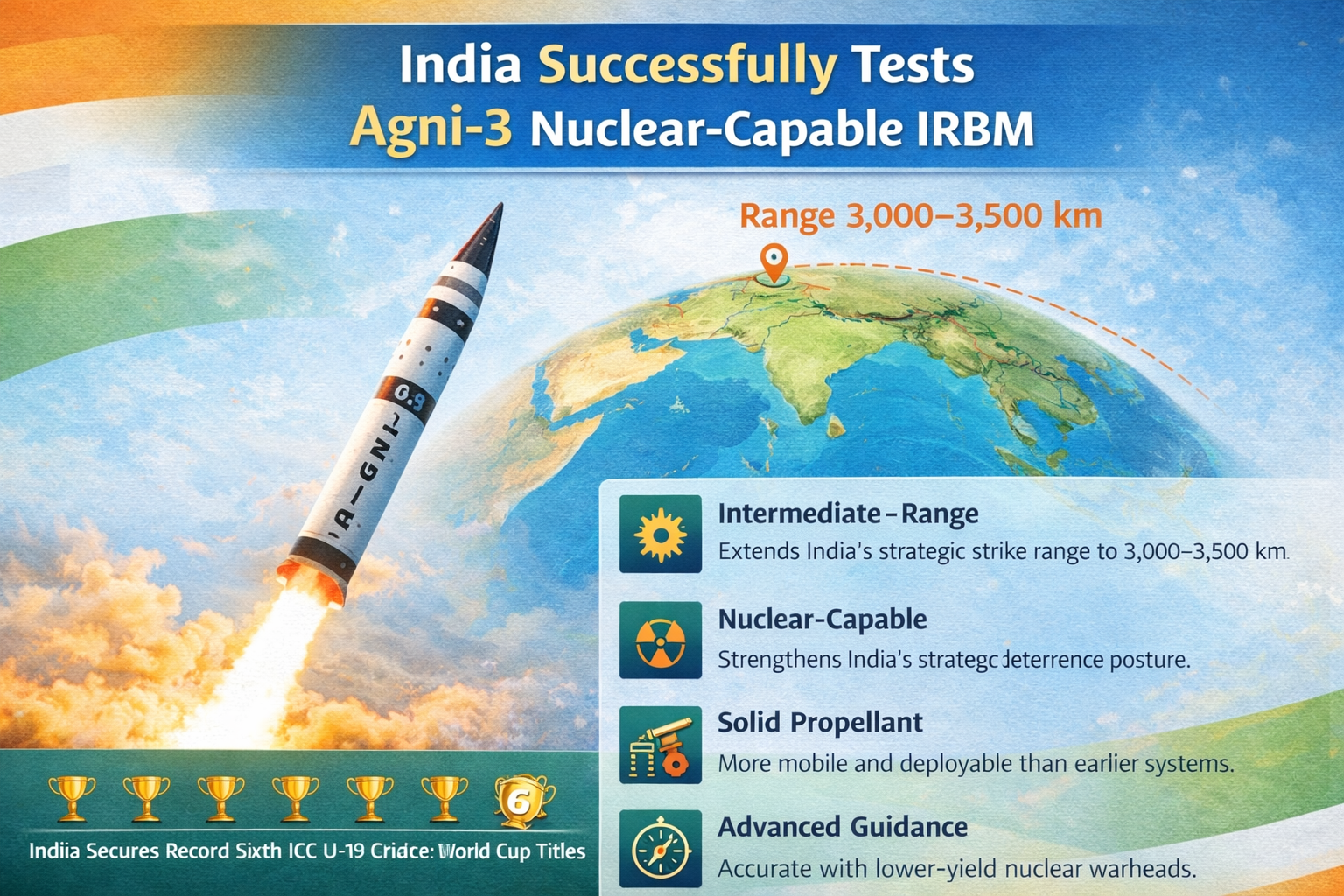
It extends India’s strategic strike range to about 3,000–3,500 km, covering deep-lying targets in potential adversary territories.
-
Agni-3 is a nuclear-capable, intermediate-range ballistic missile that strengthens India’s strategic deterrence posture.
-
The successful validations of operational and technical parameters demonstrate the missile’s readiness and reliability.
-
Its range places critical strategic locations within reach, reinforcing credible minimum deterrence.
-
Featuring solid propellant and advanced guidance systems, Agni-3 is more mobile and deployable than earlier systems.
-
The missile enhances India’s second-strike capability by being road and rail-mobile, improving survivability.
-
Integration under the Strategic Forces Command ensures it is part of the country’s structured nuclear command and control.
-
Its deployment helps balance regional security dynamics, especially with nuclear-armed neighbours.
-
Agni-3’s accuracy increases its effectiveness with lower-yield warheads, allowing efficient deterrence.
-
It forms a crucial link between shorter-range systems like Agni-2 and longer-range platforms such as Agni-5 in India’s strategic arsenal.
Recently Asked PYQs: Agni Missile
| Exam | Year | Question (MCQ) | Options | Correct Answer |
|---|---|---|---|---|
| UPSC Prelims (GS-I) | 2013 | Which of the following is a surface-to-surface ballistic missile developed by India? | (A) Akash (B) Trishul (C) Agni-I (D) Nag | (C) Agni-I |
| CDS (I) | 2018 | Agni-II missile is classified as which type of missile? | (A) Short-range ballistic (B) Medium-range ballistic (C) Cruise missile (D) Anti-aircraft missile | (B) Medium-range ballistic |
| NDA & NA | 2020 | The Agni-I missile uses which type of fuel? | (A) Liquid (B) Cryogenic (C) Solid (D) Hybrid | (C) Solid |
| UPSC CAPF (AC) | 2022 | Consider the following missiles: Agni-I, BrahMos, and Dhanush. Which of the above are ballistic missiles? | (A) 1 only (B) 1 and 3 only (C) 2 and 3 only (D) 1, 2 and 3 | (B) 1 and 3 only |
| SSC CGL | 2019 | The Agni-II missile has been developed by which organisation? | (A) ISRO (B) HAL (C) DRDO (D) BARC | (C) DRDO |
| SSC GD | 2021 | Which Agni missile has a longer range? | (A) Agni-I (B) Agni-II (C) Same range (D) Depends on payload | (B) Agni-II |
| State PSC (BPSC) | 2019 | Agni-II missile was first successfully tested in which year? | (A) 1995 (B) 1997 (C) 1999 (D) 2001 | (C) 1999 |
| Air Force Group-X | 2022 | Agni-I belongs to which category of missiles? | (A) Air-to-air (B) Surface-to-surface ballistic (C) Cruise missile (D) Anti-tank | (B) Surface-to-surface ballistic |
Conclusion (India Successfully Tests Agni-3 Missile)
Agni-3 recently is an indication that its local defence technology has matured and its reliability is not doubtful. The launch, which was conducted in accordance with well-established work rules and protocols, indicates reaffirming of a credible minimum deterrence stance by India and is likely to have been an expression of continued attention to the expansion of strategic preparedness and national security potential.