
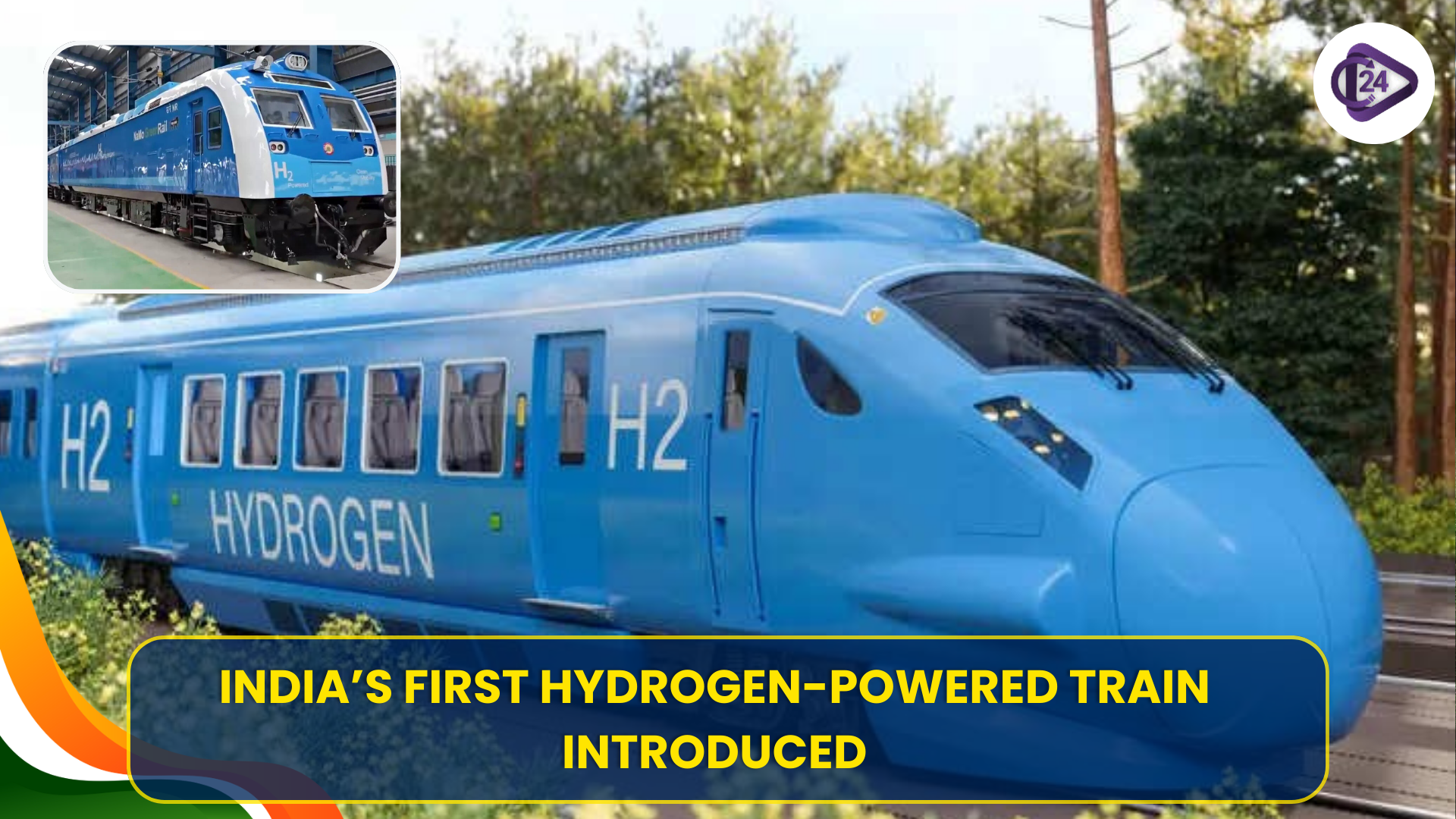
India has accomplished a historical record when it comes to sustainable transport, as its first hydrogen-powered train coach was successfully tested by Integral Coach Factory (ICF) at Chennai. The new coach – a "Driving Power Car" – runs on hydrogen fuel-cell technology, giving it no emissions of the type released by diesel or normal electric trains. The trial, announced by Ashwini Vaishnaw, represents a huge step towards greener and future-ready railways in India.
India’s First Hydrogen-Powered Train: Overview
-
The Indian Railways has successfully tested the first hydrogen-powered train coach in India (Driving Power Car) at Integral Coach Factory (ICF) in Chennai.
-
The coach utilises hydrogen fuel cell technology: Hydrogen gas reacts with oxygen in fuel cells to generate electricity, producing water vapour—making the coach a zero-emission alternative to diesel.
-
The design of the planned hydrogen-powered train will include 2 power cars and 8 passenger coaches in total (10 coaches overall). It has a capacity for 2,600 passengers and can operate at speeds of up to approximately 110 km/h.
-
Each power car will contain around 220 kg of hydrogen in HP cylinders. Hydrogen refuelling and storage facilities (with a capacity of 3,000 kg) are planned at a separate site in Jind, Haryana.
-
The project aims to develop a hydrogen-powered train with a power output of 1,200 horsepower, making it one of the most powerful hydrogen trains in the world—part of the movement towards clean, sustainable rail travel.
Important PYQs Based Questions
| Exam Name | Year | Question | Answer |
|---|---|---|---|
| UPSC CSE Prelims | 2022 | When and where did the first passenger train in India run? | 16 April 1853, Bori Bunder (Mumbai) to Thane |
| SSC CGL | 2023 | How many carriages did India’s first passenger train have? | 14 carriages with around 400 passengers |
| UPSC CSE Prelims | 2023 | Names of the locomotives that hauled India’s first passenger train? | Sindh, Sultan, Sahib |
| SSC CHSL | 2022 | First passenger train in Eastern India, and the year? | Howrah to Hooghly, 15 August 1854 |
| RRB JE | 2023 | Which is India’s first hydrogen-powered train coach? | Integral Coach Factory (ICF), Chennai |
| UPSC Prelims | 2023 | What technology was used in India’s first hydrogen train? | Hydrogen fuel-cell technology |
| SSC CGL | 2023 | First high-speed bullet train project in India? | Mumbai–Ahmedabad High Speed Rail Corridor |
| UPSC CSE Mains | 2023 | Expected operational speed of India’s first bullet train? | Around 320 km/h |
| RRB NTPC | 2024 | Planned passenger capacity of India’s first hydrogen-powered train? | Over 2,600 passengers |
| UPSC CSE Prelims | 2024 | Year of the first passenger train in India? | 1853 |
Expected Questions for Upcoming Exams Based on Hydrogen-Powered Train
When and where was India’s first hydrogen-powered train coach successfully tested?
Options:
A) 16 April 1853, Mumbai
B) 25 July 2025, ICF Chennai
C) 15 August 2024, Howrah
D) 1 Jan 2025, Delhi
Answer: B) 25 July 2025, ICF Chennai
Explanation: The train was tested at Integral Coach Factory, Chennai, marking India’s first hydrogen-powered train trial.
Q2: What type of fuel technology does the train use?
Options:
A) Diesel
B) Electric only
C) Hydrogen fuel-cell
D) CNG
Answer: C) Hydrogen fuel-cell
Explanation: The train uses hydrogen fuel-cell technology, generating electricity through a reaction between hydrogen and oxygen, producing only water vapor.
Q3: How much hydrogen does each power-car approximately carry?
Options:
A) 100 kg
B) 220 kg
C) 500 kg
D) 50 kg
Answer: B) 220 kg
Explanation: Each power car stores around 220 kg of hydrogen at high pressure (~350 bar) for propulsion.
Q4: What is the expected operational speed of the hydrogen-powered train?
Options:
A) 90 km/h
B) 110 km/h
C) 150 km/h
D) 200 km/h
Answer: B) 110 km/h
Explanation: The train is designed to operate at around 110 km/h, suitable for heritage and non-electrified routes.
Q5: What is the environmental benefit of the hydrogen train?
Options:
A) Emits CO₂
B) Emits only water vapor
C) Uses fossil fuels
D) Produces smoke
Answer: B) Emits only water vapor
Explanation: Hydrogen fuel-cell trains produce only water vapor, making them a zero-emission alternative to diesel trains.
Q6: Which organization developed this hydrogen-powered train coach?
Options:
A) BHEL
B) ICF Chennai
C) DRDO
D) Indian Railways Headquarters
Answer: B) ICF Chennai
Explanation: Integral Coach Factory, Chennai, developed and tested India’s first hydrogen-powered train coach.
Q7: On which type of routes is the hydrogen train expected to be first deployed?
Options:
A) Metro routes
B) Heritage and hill routes
C) Freight routes only
D) High-speed express routes
Answer: B) Heritage and hill routes
Explanation: Hydrogen trains are planned first for heritage and hill routes, where electrification is difficult.
Q8: What is the planned passenger capacity of the hydrogen-powered train?
Options:
A) 1,500
B) 2,600+
C) 3,500
D) 500
Answer: B) 2,600+
Explanation: The train rake (2 power cars + 8 passenger coaches) can accommodate over 2,600 passengers.
Q9: What is the expected power rating of the hydrogen train?
Options:
A) 600 HP
B) 1,200 HP
C) 2,000 HP
D) 800 HP
Answer: B) 1,200 HP
Explanation: The hydrogen-powered train is being developed with 1,200 horsepower, making it one of the most powerful hydrogen trains globally.
Q10: What kind of infrastructure is planned for hydrogen refuelling?
Options:
A) No infrastructure needed
B) 500 kg storage facility
C) 3,000 kg hydrogen storage facility
D) Only electric charging
Answer: C) 3,000 kg hydrogen storage facility
Explanation: Dedicated hydrogen refuelling and storage facilities (~3,000 kg capacity) will support train operations initially.
Conclusion
India's first hydrogen-powered train coach by ICF Chennai tests successfully is a major milestone in sustainable rail transport in India. Using the hydrogen fuel-cell technology, the train promises no emissions, lesser reliance on fossil fuels and is a model for future eco-friendly trains. It paves a way for greener novel railway solutions for India.