



Herbal Cigarettes: A new study by the Indian Institute of Technology Gandhinagar (IIT-GN) is debunking popular misconceptions about the safety of herbal cigarettes compared to tobacco cigarettes. By examining the study, the author concluded that emissions from herbal cigarettes are as harmful, or even more harmful, than emissions from conventional, tobacco-based cigarettes. In fact, some products used as herbal cigarettes showed increased concentrations of fine particulate matter and oxidative potential, which has raised concerns about the health impact on the respiratory and cardiovascular systems. The results reveal that in a similarly curious fashion, even “natural” and “tobacco-free” labels don’t imply safety to eat.
Herbal Cigarettes Found as Harmful as Tobacco Cigarettes – Key Findings
- The researchers at the Indian Institute of Technology Gandhinagar have carried out the study along with international researchers.
- The results of the study are published in a scientific journal, Journal of Hazardous Materials.
- As natural and tobacco free and safer alternatives, herbal cigarettes are widely advertised.
- Scientists determine embroilment of herbal tobacco cigarettes can be as high or higher as the ones created from tobacco cigarettes.
- The study was a comparison of the herbal and Tobacco cigarette brands that are available in India.
- Custom Air has restored about 20% of the levels of sub-500 nanometer particles produced by the herbal cigarette smoke.
- Fine particulate matter may enter deep into the lungs and bloodstream.
- Exposure to such particles is associated with respiratory and cardiovascular diseases.
- The oxidative potential (OP) – a measure of smoke’s capacity to produce harmful reactive oxygen species – was measured.
- The emissions from the herbal cigarettes had an extremely high level of oxidative potential compared to tobacco cigarettes.
- In some tendu-wrapped herbal cigarettes, the oxidative potential increased by up to almost 49% compared to paper-wrapped cigarettes.
- For the study, harmful metals and carbon-containing compounds were identified in the smoke emissions.
- A particular herbal product contained a very high level of lead despite its claim of being chemical-free.
- The expression natural does not equal safe,” researchers said.
- Herbal cigarettes may not be subject to conventional tobacco control policies.
- The study recommends that herbal smoking products be better regulated.
- People are not well-versed in the health hazards associated with smoking with herbs.
- Properly, scientists point out that smoke from any burning substance can affect one’s health.
- The results can help dispel any misinformation about “herbal smoking products.
- The research adds to the need for evidence-based Public health policies.
(PYQs) on Tobacco Control and Public Health – Herbal Cigarettes
| Exam | Year | Question | Options | Answer |
| UPSC Prelims | 2022 | Tobacco consumption is a major risk factor for which disease? | (A) Malaria (B) Lung Cancer (C) Dengue (D) Cholera | (B) Lung Cancer |
| SSC CGL | 2021 | Which organization leads global tobacco control efforts? | (A) WHO (B) UNESCO (C) FAO (D) IMF | (A) WHO |
| UPSC Prelims | 2020 | WHO Framework Convention on Tobacco Control (FCTC) is related to: | (A) Trade (B) Climate Change (C) Public Health (D) Biodiversity | (C) Public Health |
| CDS | 2022 | Passive smoking refers to: | (A) Occasional smoking (B) Exposure to second-hand smoke (C) Herbal smoking (D) Vaping | (B) Exposure to second-hand smoke |
| CAPF | 2023 | Which organ is most directly affected by smoking? | (A) Liver (B) Kidney (C) Lungs (D) Pancreas | (C) Lungs |
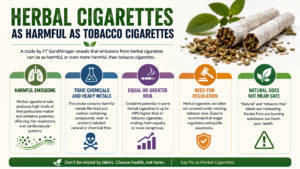
Why the Study on Herbal Cigarettes is Important
The study is significant because it challenges a widespread misconception that herbal cigarettes are harmless due to their tobacco-free composition. Scientific evidence shows that the process of burning herbal ingredients generates harmful particles and toxic compounds capable of affecting lung and heart health. As herbal smoking products gain popularity among young adults and health-conscious consumers, the findings emphasise the need for stronger regulation, accurate labelling, and public awareness campaigns. The research also highlights the importance of relying on scientific evidence rather than marketing claims when assessing health risks associated with smoking products.
Conclusion – Herbal Cigarettes
The IIT Gandhinagar study provides strong evidence that herbal cigarettes are not a safe alternative to tobacco cigarettes. Despite being marketed as natural and tobacco-free, these products can generate harmful emissions that may pose serious risks to respiratory and cardiovascular health. The findings demonstrate that smoke from any combustible material can be dangerous and that consumers should not assume safety based on “herbal” labelling alone. The study also underscores the need for stronger regulatory oversight and greater public awareness to prevent misconceptions about herbal smoking products and protect public health.