
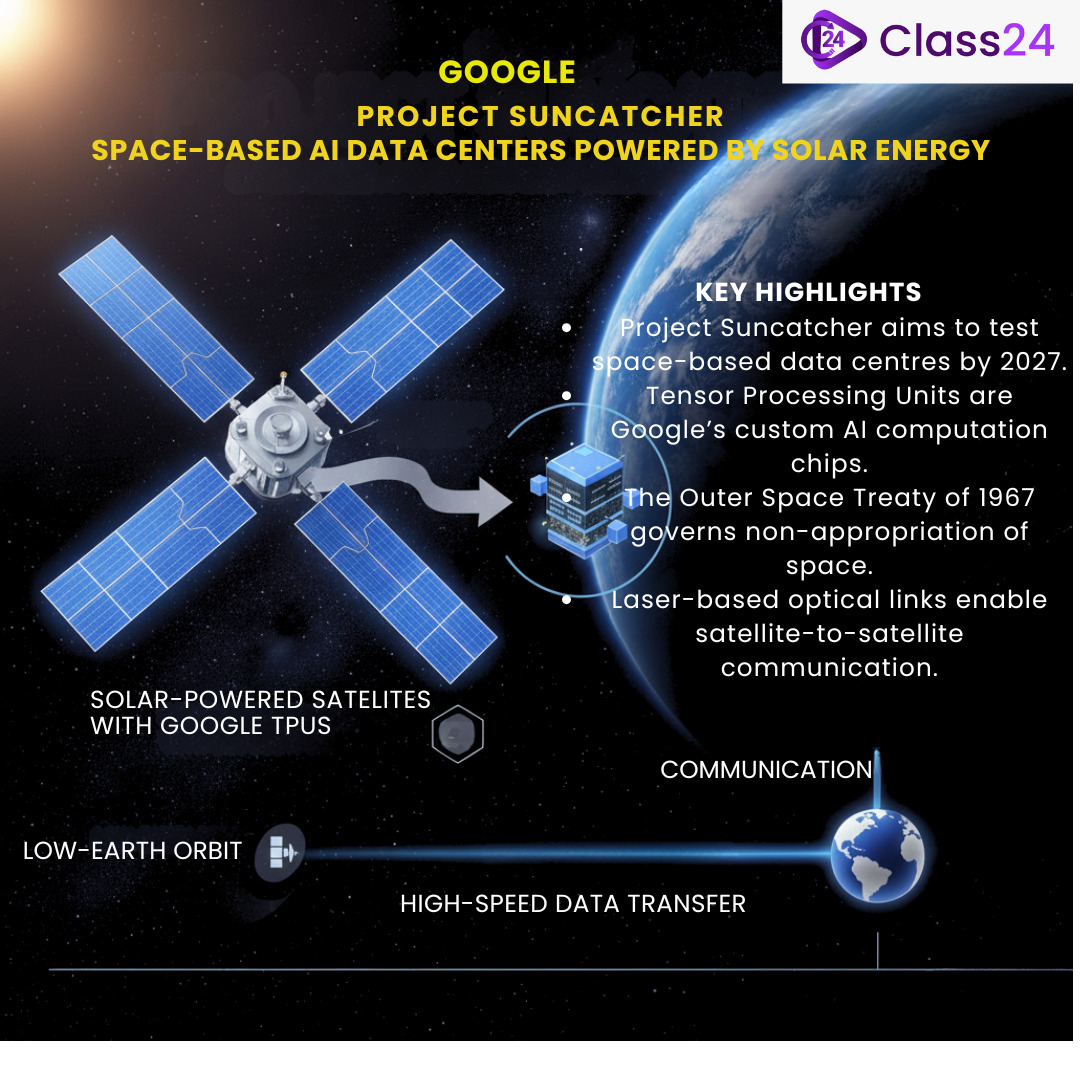
Google has launched the Project Suncatcher, a long-range research project that seeks to investigate the possibilities of AI data centers located in space, which are provided with an ample supply of solar energy. The project involves deploying solar-powered satellites equipped with Google-designed Tensor Processing Units (TPUs) into low-Earth orbit to determine whether AI computing can be sustainably performed outside of Earth's infrastructure. In a major advancement towards future space-based, scalable AI computational systems, Google aims to launch two prototype satellites by early 2027 in collaboration with Planet Labs, which could tap into continuous sunshine and eliminate the dependence on the power grid.
Key Highlights: Points of Google’s Project Suncatcher
The Project Suncatcher is an experimental project of Google to test AI data centres in space.
It is concerned with the solar-powered satellite implementation to sustainably execute AI workloads.
The intended project will involve the deployment of satellites that have Google-designed Tensor Processing Units (TPUs).
Low-Earth, sun-synchronous satellites will be used to provide near-contemporary solar energy.
The high-speed data transfer between space and the Earth will be made possible with the help of optical communication links.
The prototype satellites are proposed to be launched in early 2027 and will be used to test the feasibility.
PYQs had been Asked So Far
| Question | Answer | Exam | Year |
|---|---|---|---|
| Who is the co-founder of Google? | Larry Page and Sergey Brin | SSC CGL | 2019 |
| Google was founded in which year? | 1998 | SSC CHSL | 2020 |
| Google’s parent company is called | Alphabet Inc. | SSC CPO | 2021 |
| Who is the CEO of Google (Google LLC)? | Sundar Pichai | SSC GD | 2022 |
| Google's headquarters is located at | Mountain View, California | RRB NTPC | 2021 |
| Alphabet Inc. was formed in which year? | 2015 | SSC MTS | 2022 |
| Google Chrome is a | Web browser | Banking PO | 2020 |
| The Android operating system was developed by | SSC CHSL | 2023 |
Expected MCQs About Google’s Project Suncatcher
Consider the following statements:
-
Project Suncatcher is part of Google’s long-term AI infrastructure research.
-
The project aims to completely replace Earth-based data centres by 2025.
Which of the statements is correct?
A. 1 only
B. 2 only
C. Both 1 and 2
D. Neither 1 nor 2
Answer: A. 1 only
The initiative is experimental and does not aim for the immediate replacement of ground data centres.
The main advantage of space-based AI data centres, as explored in Project Suncatcher, is:
A. Zero maintenance cost
B. Unlimited internet speed
C. Continuous access to solar power
D. Absence of hardware failures
Answer: C. Continuous access to solar power
Sun-synchronous orbits allow satellites to receive near-constant sunlight.
Which technology is planned to be used for AI computing in Project Suncatcher satellites?
A. GPUs from NVIDIA
B. Quantum processors
C. Google’s Tensor Processing Units (TPUs)
D. ARM processors
Answer: C. Google’s Tensor Processing Units (TPUs)
TPUs are Google’s custom chips designed specifically for AI and machine learning tasks.
Project Suncatcher aims to address which major challenge of Earth-based data centres?
A. Software licensing
B. Data privacy
C. Power and energy constraints
D. Internet bandwidth
Answer: C. Power and energy constraints
Space offers near-continuous solar energy, reducing dependence on terrestrial power grids.
Conclusion
Project Suncatcher by Google is an ambitious move to an environmentally-friendly AI infrastructure, as it investigates the use of space-based data centres. The project will use the power of constant sun rays and satellite computing in an attempt to alleviate the energy strain on the planet and re-conceptualize the way that large-scale AI workloads can be energized in the future.