


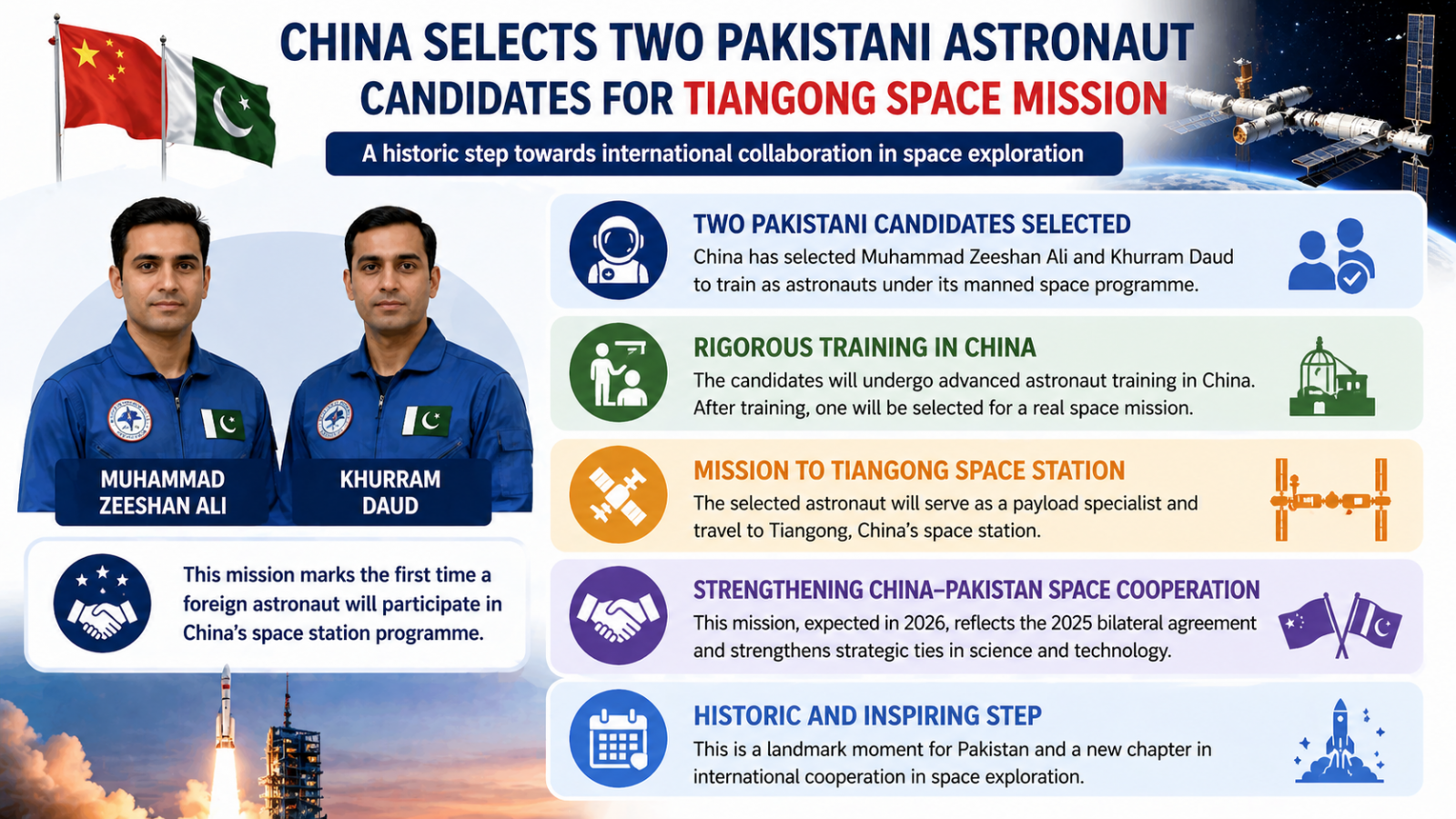
China choose two Pakistani candidates as part of its human spaceflight programme in relation to the Tiangong space station has been a historic step towards international collaboration in space exploration. The selection of a foreign astronaut for a Chinese space mission is the first time in a foreign space mission undertaken by the China Manned Space Agency. The two candidates, Muhammad Zeeshan Ali and Khurram Daud, will undergo rigorous training in China; one of them will be selected as a payload specialist for a future mission. The trend indicates increasing cooperation between China and Pakistan in space and shows that China is open to allowing more international partners in its space exploration programmes.
Key Highlights of Tiangong Astronaut Mission
-
As part of its manned space programme, China has officially recruited two Pakistanis who are set to train as astronauts: Muhammad Zeeshan Ali and Khurram Daud.
-
The choice was affirmed by the China Manned Space Agency (CMSA) and was a key step to global space collaboration.
-
These two candidates have already passed through various screening and analysis tools before being selected.
-
They will soon go to China to start advanced astronaut training in special facilities.
-
One of the two chosen candidates will be picked after undergoing training, and a real spaceflight mission will be allocated to them.
-
The chosen astronaut will work as a payload specialist, who will cooperate with the Chinese members of the crew on the mission.
-
The mission will turn out to be the first occasion where a foreign astronaut will be involved in the space station programme in China.
-
The astronaut will go to the Tiangong space station, a permanently occupied Chinese satellite lab.
-
The programme is a result of a bilateral space cooperation agreement between China and Pakistan in 2025.
-
This mission is also anticipated to be launched in 2026, possibly as an extension of a Shenzhou mission in future.
-
The duration of the mission into space by the selected astronaut will likely be a short time compared to the regular crew missions.
-
This will enhance the strategic relationships between China and Pakistan at the level of development of science and technology.
-
It also indicates a larger ambition of China to open up its space station to other countries.
-
To Pakistan, this will be the first venture into human spaceflight and a huge scientific milestone.
-
In general, the mission is being regarded as the first milestone in international space cooperation and diplomacy.
Odisha to Set Up India’s First Advanced 3D Chip Packaging
Conclusion – China Selects Two Pakistanis for Foreign Astronaut Mission
The two Pakistani astronauts’ first foreign mission to the Tiangong space station by China signals a major milestone in global space collaboration. This project is pioneered by the China Manned Space Agency, and it is an indication of the increased transparency that China has embraced towards the international involvement in its space programme. To Pakistan, it is the historic landing in human space and a life-giving boost to its science. This partnership is presumed to lead to greater bilateral relations and widen partnerships in future space exploration, as one of the candidates to the mission is trained and the process is implemented.