

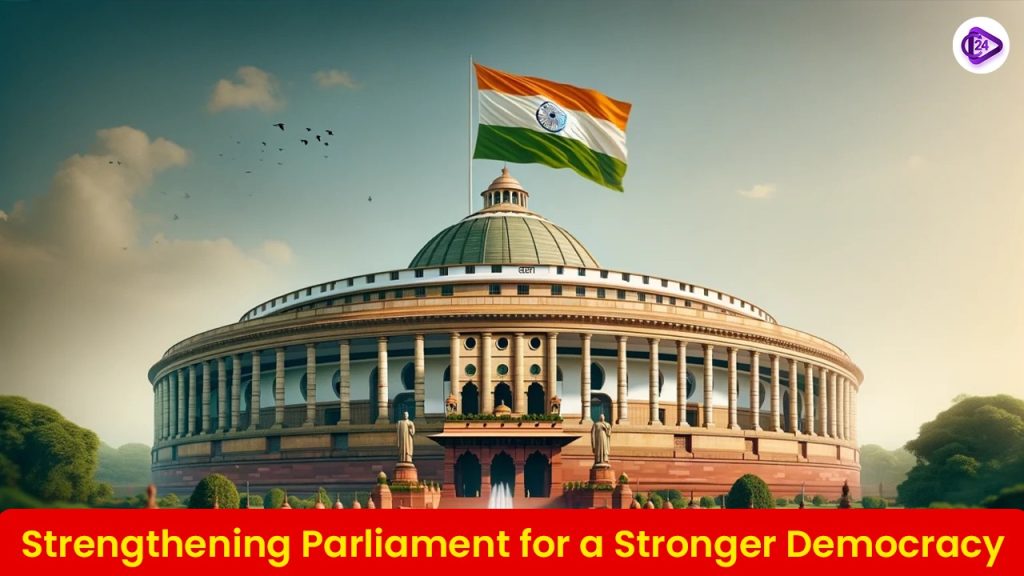
India’s parliamentary democracy has been witnessing a decline in decorum and productivity, with disruptions becoming a regular feature. The Winter Session 2024 saw 32% of scheduled time lost to disruptions, affecting the quality of debates and legislative output. This chaotic conduct undermines the credibility of the institution, reducing public trust. To restore order, strengthening parliamentary rules, improving transparency, and encouraging dialogue between the government and opposition are key solutions.
Context
Political brawls, disorders, and commotion have become part and parcel of parliamentary performances, and the frequent displays of such irrational behavior have led to a fall in the standards of parliamentary democracy in recent years.
Background
-
India, which is often called “the world’s largest democracy,” has been witnessing the significant deterioration of the standards of its parliamentary democracy in recent years.
-
This is more of a manifesting issue in poor quality of debates, legislative productivity, and overall decorum within the Parliament.
-
In the Winter Session 2024, 32% of the scheduled time was lost because of disruptions.
-
Lok Sabha did flat 45% of its allocated time in Budget Session 2024, while Rajya Sabha squandered no more but 31%.
-
Decreased productivity and walkouts are among the major incidents that took place in the House of democracy.
Major Causes of Disruptions
-
Opposition’ s Political Strategy: Disruptions are often the tools of politicians in the opposition and they resort to these methods purposely to get the necessary attention of people and demand the fulfillment of their interests.
-
Lack of Consensus: In United Progressive Alliance and the Bharatiya Janata Party, for instance, the parties may be disagreeing with each other over the question of the agenda and priorities causally leading to standoffs.
-
Contentious Legislation: Absence of pre-legislative consultations results in resistance to, and disagreements over, the template legislation.
-
Demand for Debates: Oftentimes, the insistence for the debates of big issues such as economic policies and foreign relations is the root cause for the government’s decision to disrupt.
Key Issues & Impacts
-
Erosion of Parliamentary Decorum: This socialization has led to constant interruptions, boycotts and chaotic conduct among other members of parliaments (MPs).
-
All of these disruptions not only consume the parliamentary time meant for legislation, but also demean and diminish the value of the institution of parliament.
-
Decline in Quality of Debates: This is mostly because those debates end up being trials of personalities rather than policy processes or policy content.
-
Instead of the serious consideration of issues facing the country, the Parliament has regressed to being a stage for propaganda battles.
-
Legislative Productivity: Output as reflected by the number of bills ensacted and the quality of legislation has also been affected. The general civil liberties have been infringed on due to the change in the cycling of passing bills without debates.
-
This erodes the legislative process while at the same time raises quality and effectiveness of the enacted laws into question.
-
Underutilising Parliamentary Committees: This has resulted in a dwindling importance in these committees and diminishing checks and balances which are so vital for any democracy.
-
The anti- committee has just allowed laws to be passed with less scrutiny which means the laws coming up are half baked and poorly worded.
-
Impact on Public Trust: A dysfunctional parliament not only harms the image of India to the outside world but also reduces it ability to lead in the international forum.
-
The time has come to restore respect and order to the process, to restore order.
Impact on Policy Making: The views and issues highlighted by various stakeholders must be carried out effectively and to ensure that policies’ solutions meet everyone’s needs, specified Health and safety engagement for them include constructive debates and discussions.
-
When interruptions arise they suppress these discussions and this leads to poor decisions with inadequate ability to address the people’s needs.
Possible Solutions
-
Strengthening Parliamentary Rules: A method of keeping order is to tighten up the codes of conduct and the sanctions that are available for breach.
-
It encompasses the codification of a Code of Conduct applicable to legislators; amendment of Anti-Defection law Act
-
Promoting Dialogue: Many conflicts can be minimized by encouraging proper dialogue and embraces the consensus-sharing between the government and the opposition.
Public Accountability: Introducing higher rates of MPs’ transparency and public accountability can prevent disruptive MPs’ actions.
-
It comprises supporting Public Interest Legislation that will allow MPs to listen to the affected persons and take suitable measures.
Role of the Opposition
-
The Opposition in any democracy bears essential functions of oversighting the actions and policies of the government, presenting its own policy agenda and parroting the views and sentiments of important sections of society.
-
Here in India it has a constitutional role assigned by the parliamentary system in which Opposition is supposed to act as an alternative to government and bring forward the sentiments and opinions of the masses.
-
Nevertheless, this role cause many conflicts and disturbances, for instance when Opposition feels themselves ignored or when crucial problem is not solved appropriately.
Proposed Measures
-
Reforming the Agenda-Setting Process: Now, the Business Advisory Committee (BAC) determines by voting and consensus what should be accomplished on that day, and every member has a vote of no.
-
It can be taken to a majority decision so that none of the parties can frustrate the discussions.
-
Mandatory Discussions on Notices: A new rule is proposed wherein any motion or discussion that is to be raised be tabled if a given number of MPs put in writing.
-
For instance, admission of a no-confidence motion only needs 50 MPs.
Strengthening Parliamentary Committees: The extent to which the governing bodies of a country can entrust committees to provide critical analyses of bills and policies could in a way minimize incidences of disruption on the main floor.
-
Committees can present elaborate reports and suggestions and that means most of the matters would receive careful consideration.
Improving Transparency and Communication: Getting better coverage for the proceedings in the parliament and making the communication between government and opposition side more effective could eventually lead to reducing the complaints that later turn into interruptions.
-
Penalizing Unwarranted Disruptions: Possible measures include suspending those MPs who are habitually running down the rules without adequate cause and imposing fines to them.
-
It could be in form of suspension or reduction in allowances being offered to the students.
-
Increasing the Number of Working Days: Making sure that Parliament sits long enough in a year offers enough time for debates hence decreasing the chance of having to interrupt sittings to have matters fixed.
-
Conclusion and Way Forward
-
The slide in Indian parliamentary democracy constitutes a real threat to the very character of democratic potential in India.
-
Generally, there is the need to eliminating unprecedented poor quality of debates, low legislation output and refusal to observe parliaments dignity.
-
Parliamentary committees should be empowered and made more representative for development of a vibrant democracy as a part of India’s parliamentary democracy.
Conclusion
India’s parliamentary democracy faces challenges due to disruptions, declining debate quality, and legislative inefficiency. Strengthening rules, empowering committees, and fostering dialogue between the government and opposition can help restore decorum and enhance productivity. A collaborative and transparent approach is essential to rebuild public trust and uphold the institution’s dignity.