

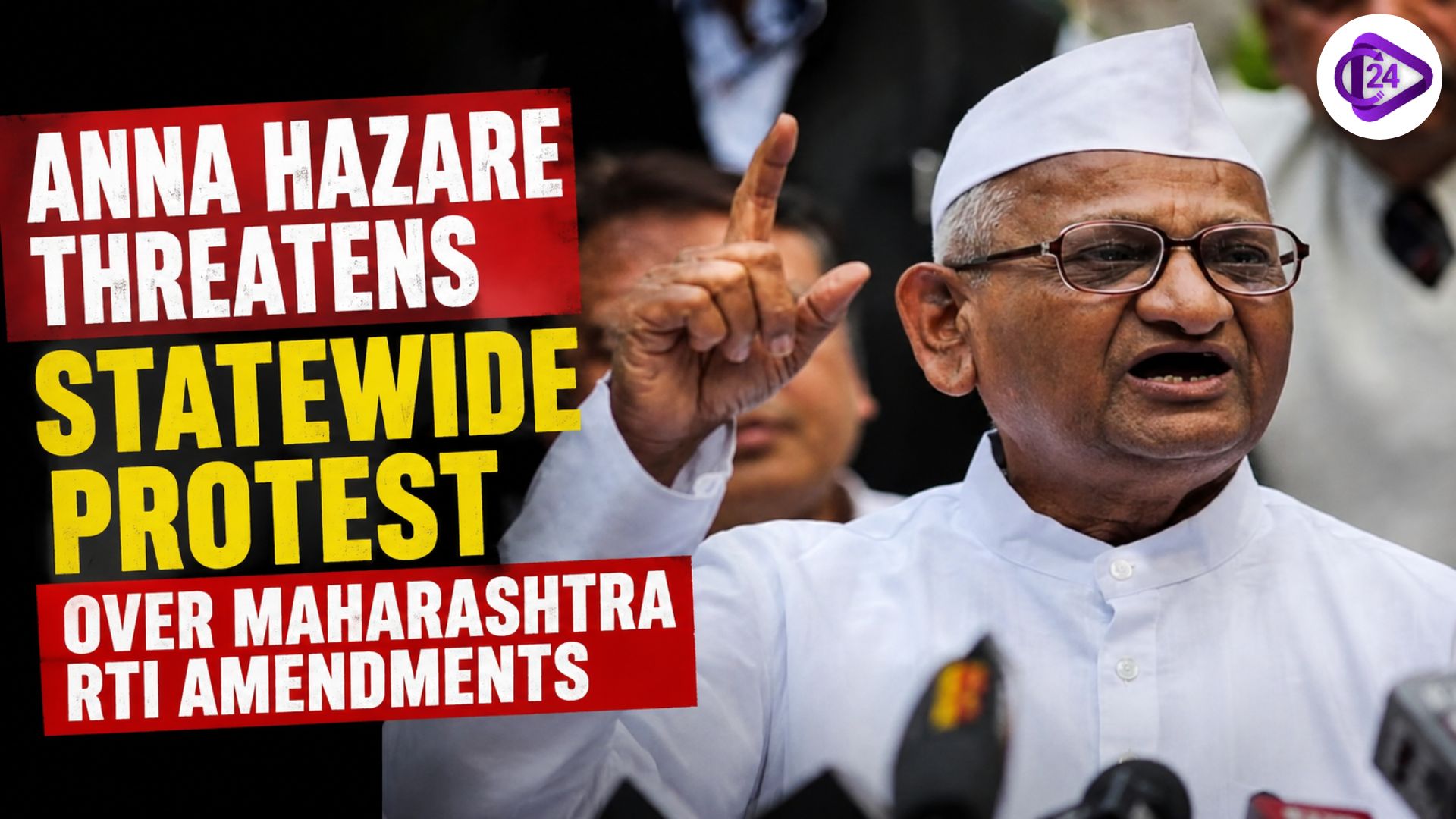
Veteran social activist Anna Hazare has expressed ‘serious concerns’ that he could call off a statewide protest if the state government does not remove the controversial amendments to the Right to Information (RTI) Act in Maharashtra. The proposed amendments could also diminish the spirit of the Right to Information (RTI) Act and do in-fact hamper transparency in governance, Hazare said. The Maharashtra RTI Amendments have sparked a nationwide debate due to the RTI Act’s role in advocating accountability and transparency within the government. Hence, increasingly, civil society organisations, civil rights activists and citizens have begun paying close attention to the developments.
Key Highlights of Maharashtra RTI Amendments Anna Hazare
- Anna Hazare has threatened a nationwide protest against the proposed changes.
- The amendments are with regard to the implementation of the RTI system in Maharashtra.
- RTI activists are saying that the moves could erode transparency mechanisms.
- The Maharashtra government says the changes are aimed at enhancing administrative efficiency.
- Civil society organisations have raised concerns about the possibility of restrictions on access to information.
- This outlined issue has received attention from many areas of discussion for the sense of responsibility and people’s rights.
What are the Maharashtra RTI Amendments?
The proposed Maharashtra RTI Amendments attempt to change a few aspects of the procedure of the Maharashtra RTI. The government said that the changes were of an administrative nature, while others pointed out that it may impact the effectiveness of the RTI system.
The RTI Act gives citizens the right to information from government authorities and transparency in government. Any change to the implementation of RTI is thus subjected to much public debate.
Why is Anna Hazare against the Maharashtra RTI Amendments?
Anna Hazare feels the Maharashtra RTI Amendments are curbing the citizens’ right to information from the public authorities. He said transparency is vital to tackle corruption and good governance. Hazare has said that the movement of RTI was the result of years of struggle by people. This means that any measure that activists see as hampering access to information poses grave concerns.
RTI Act, Previous Year Questions (PYQs)
| Year | Exam | Question | Options | Answer |
| 2024 | UPSC Prelims | The RTI Act, 2005, primarily promotes which principle? | (a) Judicial Review (b) Transparency and Accountability (c) Federalism (d) Directive Principles | (b) Transparency and Accountability |
| 2023 | SSC CGL | Under the RTI Act, information can be sought from: | (a) Private Companies only (b) Public Authorities (c) NGOs only (d) Political Parties only | (b) Public Authorities |
| 2022 | State PCS | The RTI Act strengthens which constitutional principle? | (a) Transparency in Governance (b) Emergency Powers (c) Judicial Activism (d) Federal Supremacy | (a) Transparency in Governance |
| 2021 | UPSC Prelims | Which legislation empowers citizens to seek information from public authorities? | (a) Lokpal Act (b) RTI Act, 2005 (c) Consumer Protection Act (d) RPA, 1951 | (b) RTI Act, 2005 |
| 2020 | SSC CHSL | In which year was the Right to Information Act enacted? | (a) 2002 (b) 2003 (c) 2005 (d) 2007 | (c) 2005 |
| 2019 | RRB NTPC | Which body hears second appeals under the RTI Act at the Central level? | (a) UPSC (b) CVC (c) CIC (d) NITI Aayog | (c) CIC |
| 2018 | UPSC Prelims | RTI is closely linked to which Fundamental Right? | (a) Article 14 (b) Article 19(1)(a) (c) Article 21A (d) Article 32 | (b) Article 19(1)(a) |
| 2017 | SSC CGL | What is the normal time limit for providing information under RTI? | (a) 15 Days (b) 30 Days (c) 45 Days (d) 60 Days | (b) 30 Days |
| 2016 | State PSC | Who can file an RTI application? | (a) Any Indian Citizen (b) Only Government Employees (c) Only Lawyers (d) MPs and MLAs only | (a) Any Indian Citizen |
| 2015 | UPSC Prelims | The RTI Act aims to improve: | (a) Transparency (b) Tax Collection (c) Judicial Appointments (d) Defence Management | (a) Transparency |
Bimal N. Patel Elected to Prestigious ITLOS Judicial Panel
Conclusion on Anna Hazare Opposes Maharashtra RTI Changes
The Maharashtra RTI Amendments have raised yet another pertinent issue on transparency, accountability and citizens’ rights. Anna Hazare’s warning of a statewide protest paints a grim picture of the seriousness with which many activists take the proposed changes. The amendments are supposed to boost administrative efficiency, but critics believe they could undermine access to information. The future of the Maharashtra RTI Amendments will depend on whether a balance can be struck between the principles of transparency and public accountability and governance reforms.