

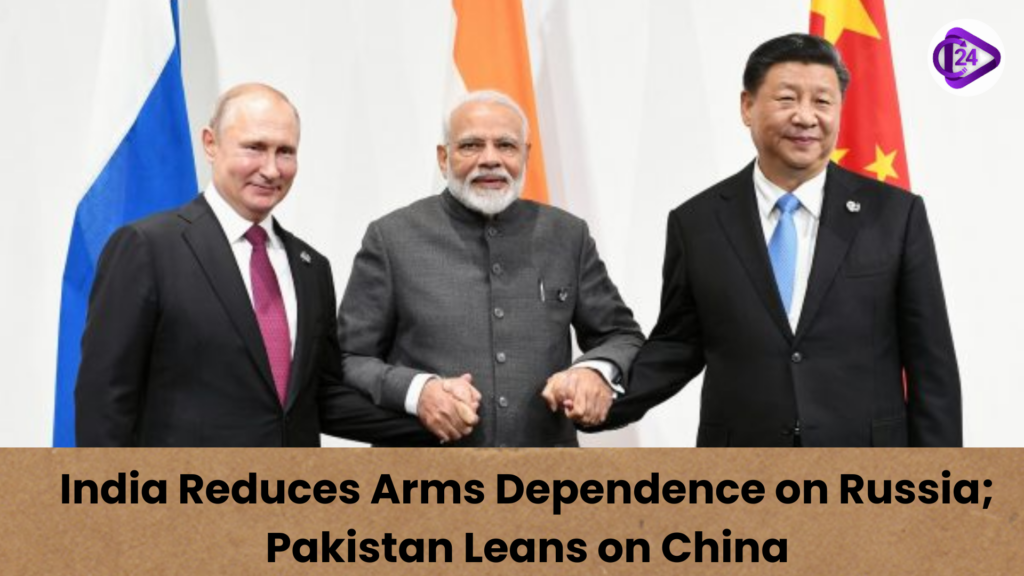
During the past decade, India and Pakistan have changed how they acquire weapons systems. India is now buying weapons from the West and Israel, lessening its age-old reliance on Russia. At the same time, Pakistan has turned more to China, dramatically lessening its reliance on buying arms from the United States. The new trend is a result of changes in geopolitics and the formation of partnerships in the region.
Context:
-
India is broadening its source of military equipment from Russia to France, the U.K., Israel, and the U.S., while Pakistan is turning more to China for weapons.
-
They mark a changing defence and diplomatic priorities for both countries.

Key Points
Who Supplies India’s Arms
-
Back in the 1990s, the biggest source of India’s defence imports was Russia which represented a mammoth 96.5% of all defence imports.
-
In the 2020s, Russia remained the main producer, but imports grew from France (accounting for 9%), the U.K. (5.5%), Israel (5%) and the U.S. (3%).
-
Advanced air power capabilities are being supplied to Arab countries by Western countries and Israel.

Pakistan’s dependence on China
-
The share of China’s weapons sold to Pakistan grew from 19% in the 2000s to almost all (95%) of its total arms imports in the 2020s.
-
In the last 20 years, the share of arms purchased by Pakistan from the U.S. dropped from more than 60% to just under 1%.
-
For more than three decades, China has been responsible for 50%-85% of Pakistan’s imported air power.
Effects of Operations and Today’s Battles
-
Both local systems and weapons obtained from Israel and Russia were used with success in Operation Sindoor.
-
The way the Indian Air Force controls the skies and carries out precise attacks on terror infrastructure demonstrates why a variety of imports is valuable.
-
Using Chinese PL-15 missiles and Turkish UAV signals changes in Pakistan’s arms purchases.
Worldwide Shifts in Arms Export
-
In the 2020s, the U.S. sold over 65% of all arms the world.
-
The decline in Russia’s stakes to 5% is a result, in large part, of political events like the Ukraine war.
-
China sells only 1.8% of the world’s arms, but a third of those go to Pakistan.

Strategic Implications
-
Becoming less dependent on Russia and supporting ‘Make in India’ is achieved through India’s diversification.
-
Pakistan’s support for China advances their partnership, though it makes the country more dependent on only one country for resources.
-
Such trends affect area security and show new changes in world powers joining forces.
Conclusion:
India and Pakistan’s changing weapons purchases are linked to wider changes happening in the region and the world. Buying from Western countries and Israel increases India’s defense, matching its self-made abilities. China and Pakistan are growing closer, yet there is a concern about how much one nation will depend on the other. Noticing these shifts helps us predict South Asia’s future in defence and diplomacy.