

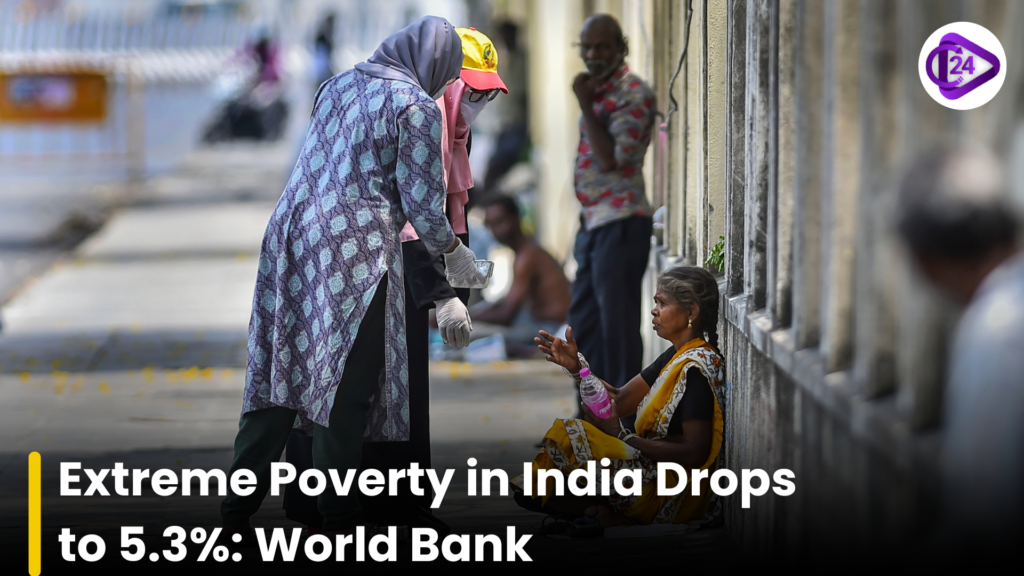
It has been noted by the World Bank that India’s rate of extreme poverty reduced from 27.1% in 2011–12 to 5.3% in 2022-23. At the same time, the poverty line for the entire world was increased 15%, going from the previous $2.15 daily to $3. The reduction demonstrates how India’s economy and social welfare system have developed during the last ten years. Regardless, more than 54 million Indians remained poor in 2024 even after all the growth. This proves that poverty among lower middle-income people is decreasing.
Context
-
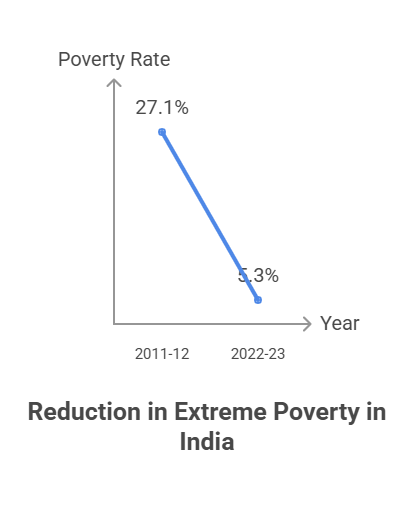
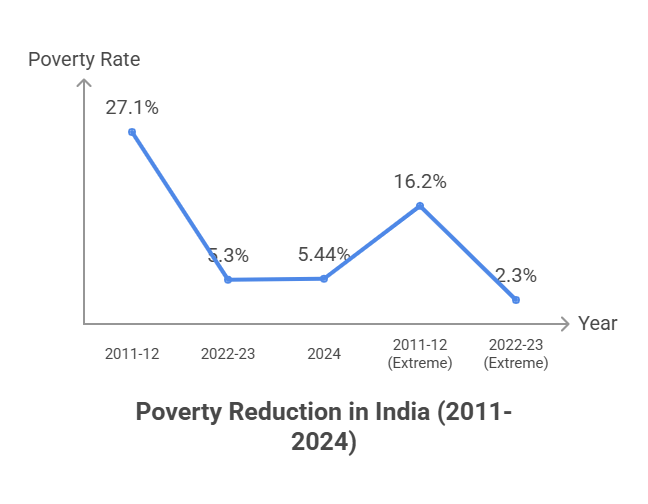
India’s poverty rate decreased to 5.3% in 2022–23 from 27.1% in the previous period, 2011–12, stated the World Bank.
-
Because of inflation and changes in people’s buying power, the new poverty threshold is now set at $3 per day.
Key Points from the World Bank Report
-
Revised poverty line
-
According to 2021 rankings, $3 each day is now the new benchmark.
-
Before, the daily minimum wage was $2.15; now, the new level is 15% higher.
-
-
A big decline in extreme poverty.
-
2011–12: 27.1%
-
2022–23: 5.3%
-
The number dropped by about 22 percent during the past decade.
-
-
Current number of people living in poverty
-
In 2024, over 54 million Indians had an income that was less than $3 a day.
-
By 2024, it is expected that the poverty rate will be 5.44%.
-
-
The Overall Picture of Poverty
-
The term extreme poverty is used for the most serious level of deprivation.
-
There was a decrease from 16.2% in 2011–12 to 2.3% by 2022–23.
-
-
Poverty at lower-middle income line
-
This part of GDP declined by 33.7 percentage points.
-
-
About poverty in India
-
Poverty in India is still a big and many-sided issue, despite the country’s fast economic progress.
-
It means people are deprived of adequate education, health care, housing, and respect as well as income.
-
As per NITI Aayog, showed that about 15% of India’s people are multi-dimensionally poor, but this number has decreased significantly during the last decade.
Types of poverty
-
Absolute Poverty: It is described by a certain amount of income needed (in this case, $2.15/day from the World Bank).
-
Relative Poverty: Where there are differences in the earning power among people in a society.
Reasons of poverty in India
-
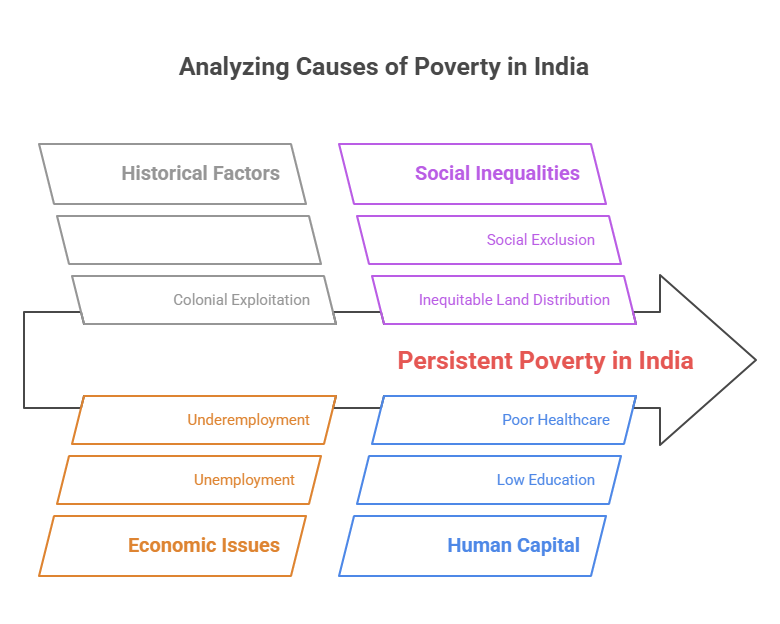
Historical Factors
-
Because there was colonial exploitation, deindustrialization, and the economy stayed low on farms, the base was not strong.
-
-
Unemployment and Underemployment
-
The main feature of the informal sector is low pay and lack of job security.
-
Workers have to deal with unemployment as employers look for skills they do not possess.
-
-
Inequitable Land Distribution
-
The process of distributing land among poor farmers is not finished; majorities of rural poor farm only a little land.
-
-
Population Pressure
-
A big increase in population can reduce benefits and income that society receives.
-
-
Social Exclusion
-
Being discriminated against because of one’s caste, gender, or region keeps many people from accessing opportunities.
-
-
Low Human Capital
-
Lacking education and healthcare makes it difficult for people to get jobs and do their tasks well.
-
Government Initiatives to reduce poverty
|
Program |
Objective |
|
MGNREGA |
Guaranteed 100 days of rural employment |
|
PM Awas Yojana |
Housing for all by 2022 |
|
National Food Security Act (NFSA) |
Subsidized food grains to 67% of population |
|
Ayushman Bharat (PM-JAY) |
Health insurance for the poor |
|
Deendayal Antyodaya Yojana (DAY-NRLM) |
Self-employment and skill development for rural poor |
|
PM Garib Kalyan Anna Yojana |
Free foodgrain distribution during COVID-19 |
Challenges in poverty alleviation
-
Targeting Errors: The last obstacle is when the targeted beneficiaries are not correctly identified.
-
Corruption: Many of the welfare benefits reach certain middlemen rather than the actual recipients.
-
Urban Poverty: When cities grow unexpectedly, it causes the formation of slums and access to basic amenities is lost.
-
Climate Vulnerability: Weather to Climate Vulnerability Poor people are more likely to suffer from disasters.
-
Digital divide: Many digital initiatives do not include the people who are not connected to the internet.
Way Forward
-
Inclusive growth: Government should pay attention to agriculture, MSMEs, and the education and training sector.
-
Direct Benefit transfer: Allow Aadhaar-based payments so that everyone knows the money received through DBT is correct.
-
Universal Basic Services: Everyone deserves access to immigration, education, health, housing, and sanitation as their rights.
-
Social Safety Nets: Provide better pensions, paid maternity leave, and aid for unemployed people.
-
Urban Employment Guarantee Scheme: To assist more impoverished people living in cities.
Conclusion
The World Bank’s new data on India’s poverty means that economic reforms, schemes for social benefits, and better rural networks have succeeded. Still, because millions are below the $3/day line, continuing to work on job growth, inflation, and fair development is important for eradicating poverty.