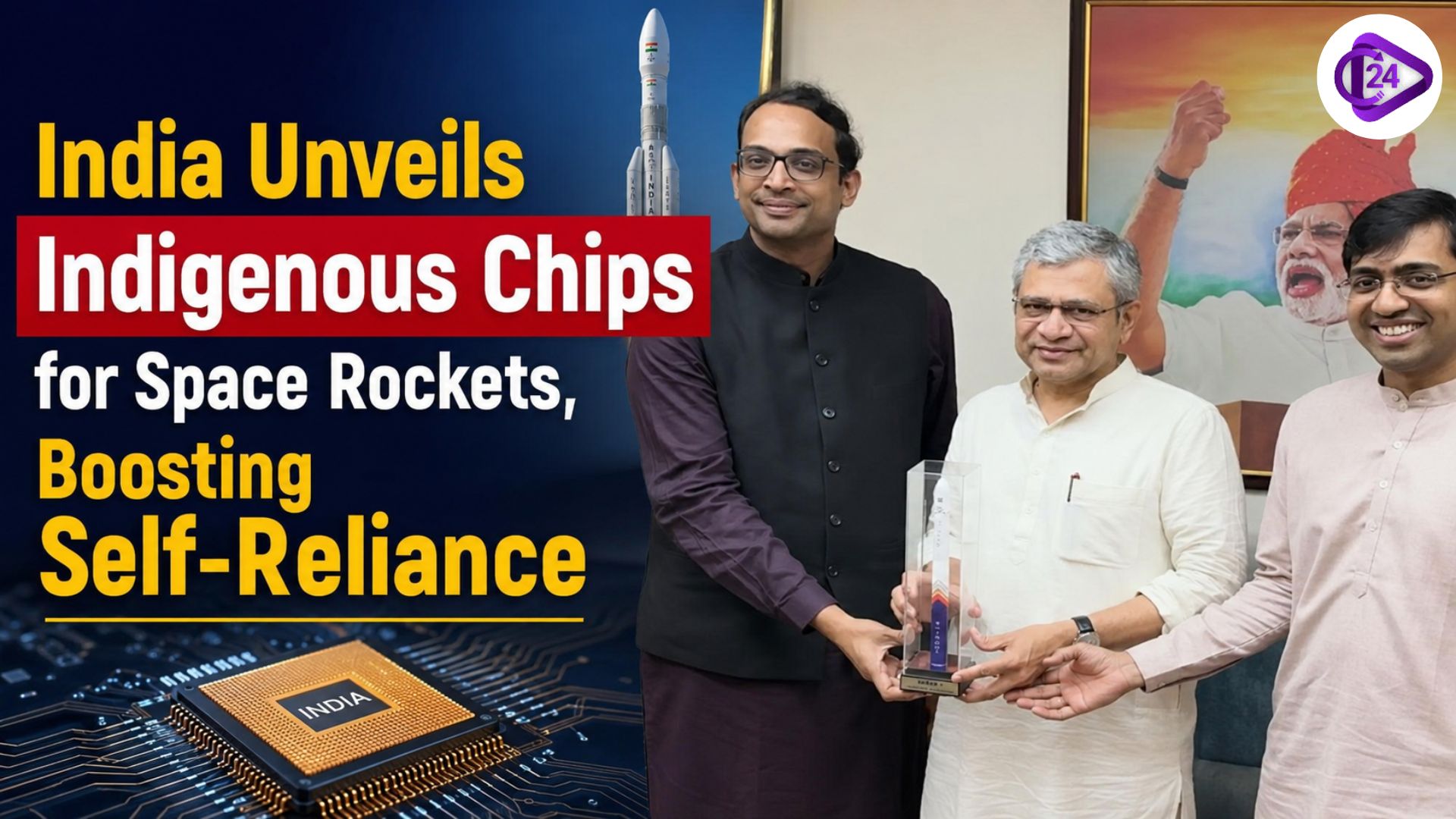


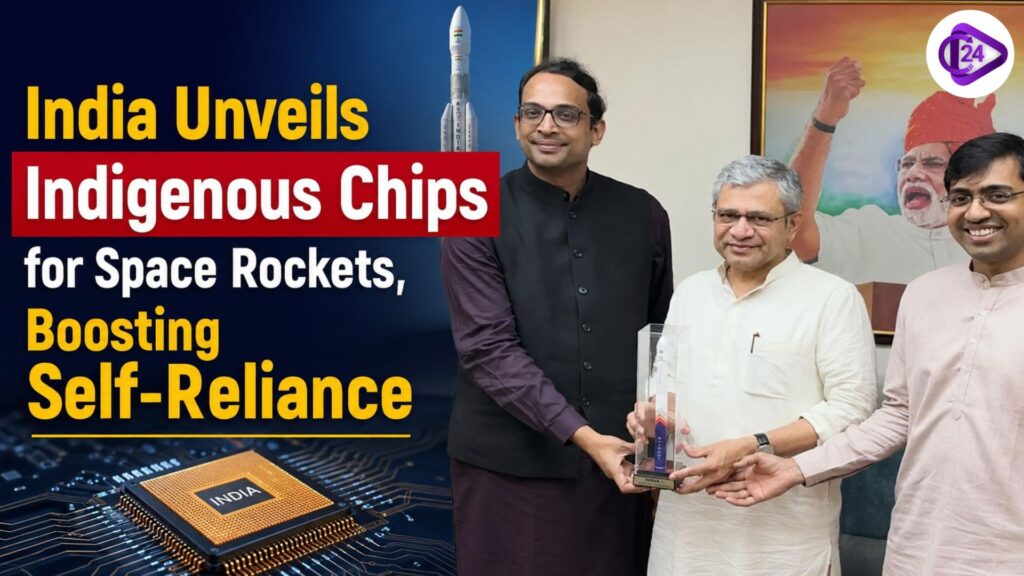
Two indigenous microprocessors, namely VIKRAM3201 and KALPANA3201, each of 32 bits, have been developed for use in space applications in high-reliability systems, marking an important milestone for indigenous development of semiconductors.VIKRAM3201 and KALPANA3201, 32-bit microprocessors for high-reliability space systems – an important milestone for indigenous development of semiconductors. Vikram Sarabhai Space Centre (VSSC), ISRO, developed the processors along with the Semiconductor Laboratory (SCL), Chandigarh. The first batch was delivered on March 5th, 2025.
Of these, VIKRAM3201 represents the first completely “Make in India” 32-bit microprocessor that has been qualified for space flight in the harsh environment of launch vehicles. It was produced in SCL’s CMOS semiconductor fabrication plant, which has a capacity of 180 nm. The development bolsters India’s indigenous strength in terms of the capability of indigenizing processors and in-house avionics systems, as well as the field of semiconductors.
Why in News?
This is a major development for the country as they have indigenous 32-bit microprocessors for space use, the VIKRAM3201 and KALPANA3201.
The processors have been designed and developed at Vikram Sarabhai Space Centre (VSSC) in association with Semiconductor Laboratory (SCL) at Chandigarh, said ISRO. The factory production was officially launched on 5 March 2025 at a programmatic ceremony hosted by SCL in New Delhi and its first production lots were handed over the same day.
Successful flight testing in space, and qualification for the demanding space environment, it has undergone the severe conditions of launch vehicle environments, VIKRAM3201. The initial lot was validated on-board the PSLV Orbital Experimental Module – 4 (PSLV POEM-4) inside the Mission Management Computer (MMC) in PSLV-C60 mission.
Key Highlights of VIKRAM3201 and KALPANA3201
| Particular | Details |
| Processors | VIKRAM3201 & KALPANA3201 |
| Developed By | VSSC, ISRO & SCL |
| SCL Location | Chandigarh |
| Processor Type | 32-bit |
| VIKRAM3201 Fabrication | 180 nm CMOS |
| Major Application | Launch Vehicle & Space Applications |
| VIKRAM3201 Status | Qualified for harsh launch-vehicle conditions |
| Space Validation | PSLV-C60 / POEM-4 |
| Objective | High-Reliability Space Electronics |
| Major Significance | Make in India & Atmanirbharata |
What is VIKRAM3201?
VIKRAM3201 is an indigenous 32-bit microprocessor for space applications. This is the first 32-bit microprocessor, which is completely Indian-made, suitable for use on launch vehicles in harsh environmental conditions.
The 180 nm CMOS semiconductor manufacturing facility of SCL, Chandigarh, was used for its fabrication. It is a high-level integration of the indigenously developed viKey1601, which has been part of ISRO’s launch vehicles’ avionics since 2009.
VIKRAM3201 has a custom Instruction Set Architecture (ISA) and includes floating-point computation and high-level programming capabilities in the Ada language. ISRO has also developed its own software tools like the Ada compiler, assembler, linker, simulator and Integrated Development Environment (IDE).
What is KALPANA3201?
ISRO and SCL have also developed another home-grown microprocessor 32bit KALPANA3201, for space use.
It uses the SPARC V8 RISC architecture and is based on the IEEE 1754 Instruction Set Architecture. KALPANA3201 has been designed to be easily adaptable to any open source software toolset and has been exercised with flight software, ISRO said.
The further development of KALPANA3201 also enhances India’s capacity to design a processor for specialised and high-reliability space systems.
Previous Year Questions on Indian Space Programme
| Exam & Year | Question | Options | Answer |
| UPSC Prelims 2023 | With reference to India’s satellite launch vehicles, consider the following statements: PSLV is used to launch satellites into polar orbits, while GSLV is designed to launch heavier satellites into geostationary orbits. | A) 1 only B) 2 only C) Both 1 and 2 D) Neither 1 nor 2 | C) Both 1 and 2 |
| UPSC Prelims 2022 | With reference to the Indian Space Research Organisation, which one of the following statements is correct? | A) It is under the Ministry of Defence B) It is under the Department of Space C) It is under DRDO D) It is an autonomous private organisation | B) It is under the Department of Space |
| UPSC Prelims 2019 | What is/are the advantage/advantages of the NavIC system over GPS? | A) Only greater accuracy B) Only wider coverage C) Both greater accuracy and regional coverage D) None | C) Both greater accuracy and regional coverage |
| UPSC Prelims 2018 | With reference to India’s satellite launch vehicles, consider the following statements: PSLV has successfully launched satellites useful for Earth observation, whereas GSLV is designed mainly for heavier communication satellites. | A) 1 only B) 2 only C) Both 1 and 2 D) Neither 1 nor 2 | C) Both 1 and 2 |
| UPSC Prelims 2016 | What is/are the importance/importance of the ‘GPS Aided GEO Augmented Navigation (GAGAN)’? | A) Air traffic management B) Navigation services C) Both A and B D) None | C) Both A and B |
| UPSC Prelims 2015 | With reference to ‘Astrosat’, the astronomical observatory launched by India, which of the following statements is correct? | A) It is the first dedicated Indian astronomy mission B) It is only for solar observations C) It is a communication satellite D) It is a weather satellite | A) It is the first dedicated Indian astronomy mission |
| SSC CGL 2022 | Which organisation is responsible for India’s space programme? | A) DRDO B) ISRO C) HAL D) BARC | B) ISRO |
| SSC CGL 2021 | What is the full form of PSLV? | A) Polar Satellite Launch Vehicle B) Public Satellite Launch Vehicle C) Polar Space Launch Vehicle D) Public Space Launch Vehicle | A) Polar Satellite Launch Vehicle |
| SSC CHSL 2021 | What is the full form of GSLV? | A) Geosynchronous Satellite Launch Vehicle B) Geostationary Space Launch Vehicle C) Global Satellite Launch Vehicle D) Geosynchronous Space Launch Vehicle | A) Geosynchronous Satellite Launch Vehicle |
| SSC CGL 2020 | Which Indian launch vehicle is mainly used for launching satellites into polar orbits? | A) GSLV B) PSLV C) ASLV D) SLV | B) PSLV |
| SSC CHSL 2020 | Where is the headquarters of ISRO located? | A) Hyderabad B) Bengaluru C) Chennai D) New Delhi | B) Bengaluru |
| SSC CGL 2019 | Who is known as the father of the Indian Space Programme? | A) Vikram Sarabhai B) Homi Bhabha C) Satish Dhawan D) A.P.J. Abdul Kalam | A) Vikram Sarabhai |
| SSC CHSL 2019 | In which year was ISRO established? | A) 1962 B) 1965 C) 1969 D) 1972 | C) 1969 |
| SSC CGL 2018 | Which was India’s first satellite? | A) Rohini B) Aryabhata C) INSAT-1A D) Bhaskara-I | B) Aryabhata |
| SSC CHSL 2018 | Aryabhata, India’s first satellite, was launched in which year? | A) 1972 B) 1975 C) 1978 D) 1980 | B) 1975 |
| SSC CGL 2017 | Which Indian space mission was India’s first interplanetary mission? | A) Chandrayaan-1 B) Mangalyaan C) Astrosat D) Aditya-L1 | B) Mangalyaan |
| SSC CGL 2016 | Chandrayaan-1 was India’s first mission to which celestial body? | A) Mars B) Moon C) Venus D) Sun | B) Moon |
| SSC CHSL 2016 | Which launch vehicle successfully placed Chandrayaan-1 into space? | A) PSLV-C11 B) GSLV-F01 C) PSLV-C37 D) GSLV-Mk III | A) PSLV-C11 |
| SSC CGL 2015 | What is the primary purpose of a geostationary satellite? | A) Communication and weather services B) Deep-sea exploration C) Mining D) Navigation only | A) Communication and weather services |
| SSC CHSL 2015 | Satish Dhawan Space Centre is located at: | A) Sriharikota B) Thumba C) Bengaluru D) Ahmedabad | A) Sriharikota |
MJPJAY 2026: Mahatma Jyotirao Phule Jan Arogya Yojana
Conclusion
The creation of VIKRAM3201, KALPANA3201 is a significant effort towards India’s autonomous capability in space technology and semiconductor industry. Chandigarh’s ISRO’s Vikram Sarabhai Space Centre (VSSC) and Semiconductor Laboratory (SCL) have developed these indigenous 32 bit processors for strengthening high reliability electronics in the design and development of launch vehicles and space missions. Successful space validation of VIKRAM3201 also showcases India’s capability in designing and producing critical processors in the country. The project helps promote the Make in India and indigenous semiconductor technology, violative reliance on foreign components in strategic space applications, and Atmanirbhar Bharat Platform.