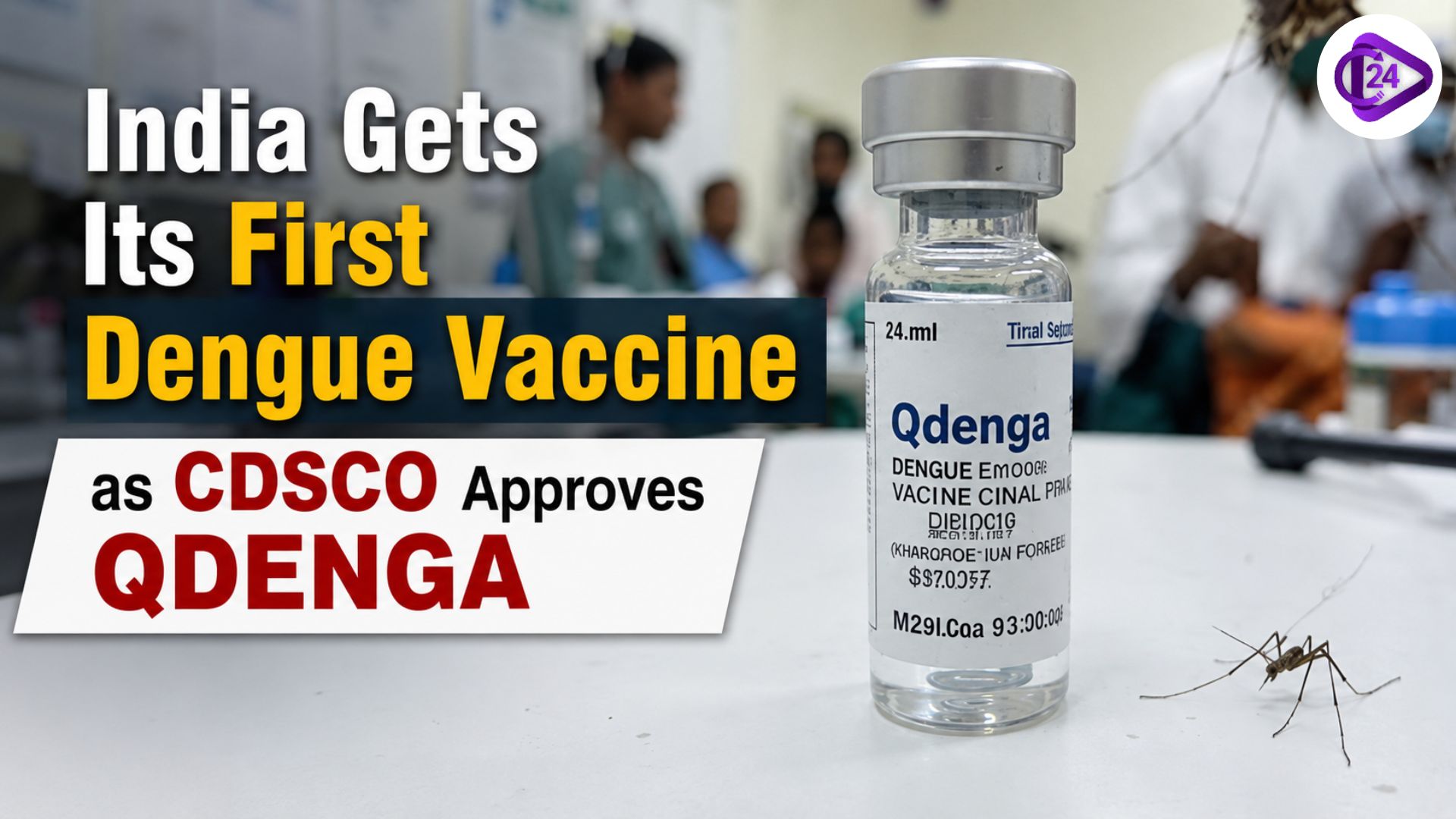


First Dengue Vaccine: India has made incredible advances in public health by the drug regulatory authority, the Central Drugs Standard Control Organisation (CDSCO), approving the first-ever dengue vaccine, called QDENGA, for the nation. QDENGA is a live-attenuated tetravalent dengue vaccine developed by Takeda Pharmaceuticals that targets all four dengue virus serotypes (DENV-1, DENV-2, DENV-3 and DENV-4). The vaccine is indicated for people 4-60 years old, including those who have had dengue in the past. The approval should further boost India’s efforts to tackle dengue, one of the country’s fastest-rising mosquito-borne viral diseases.
What is QDENGA? – First Dengue Vaccine
The first dengue vaccine to be approved in India is QDENGA (TAK-003). It is a live attenuated vaccine containing weak strains of all four of the different serotypes of the dengue virus, so it can stimulate the immune system without causing the disease.
QDENGA can be given regardless of prior infection with any of the four dengue types, whereas the previous vaccines were only recommended for people who have a previous infection from any of the four dengue types. Clinically, the vaccine has demonstrated very good dengue-related hospitalisation and severe disease prevention.
Key Highlights of India Approves First Dengue Vaccine
| Particular | Details |
| Vaccine Name | QDENGA (TAK-003) |
| Approved By | Central Drugs Standard Control Organisation (CDSCO) |
| Developer | Takeda Pharmaceuticals (Japan) |
| Vaccine Type | Live-attenuated tetravalent dengue vaccine |
| Target Disease | Dengue Fever |
| Approved Age Group | 4–60 years |
| Protection Against | DENV-1, DENV-2, DENV-3 & DENV-4 |
| Number of Doses | Two doses (3 months apart) |
| Route of Administration | Subcutaneous Injection |
| Significance | First approved dengue vaccine in India |
Previous Year Questions (PYQs) on Dengue – First Dengue Vaccine
| Exam | Year | Question | Options | Answer |
| UPSC Prelims | 2024 | Dengue is caused by which type of pathogen? | (A) Bacteria (B) Virus (C) Fungus (D) Protozoa | B |
| SSC CGL | 2023 | Dengue is transmitted by which mosquito? | (A) Anopheles (B) Culex (C) Aedes aegypti (D) Mansonia | C |
| RRB NTPC | 2023 | The mosquito responsible for spreading dengue mainly bites during: | (A) Night (B) Evening only (C) Daytime (D) Midnight | C |
| UPSC Prelims | 2022 | Dengue virus belongs to which family? | (A) Retroviridae (B) Flaviviridae (C) Orthomyxoviridae (D) Paramyxoviridae | B |
| SSC CHSL | 2022 | Dengue is mainly spread through the bite of which female mosquito? | (A) Female Anopheles (B) Female Culex (C) Female Aedes aegypti (D) Female Mansonia | C |
| RRB Group D | 2022 | Which disease is also known as “Breakbone Fever”? | (A) Malaria (B) Dengue (C) Typhoid (D) Cholera | B |
| IBPS PO | 2021 | Dengue affects which blood component significantly? | (A) RBC (B) Platelets (C) WBC (D) Plasma | B |
| SSC CGL | 2021 | Which mosquito-borne disease has four serotypes? | (A) Malaria (B) Dengue (C) Filariasis (D) Kala-azar | B |
| UPSC Prelims | 2020 | Which disease is caused by a Flavivirus? | (A) Dengue (B) Tuberculosis (C) Cholera (D) Typhoid | A |
| SSC GD | 2020 | The incubation period of dengue generally ranges between: | (A) 1–2 Days (B) 4–10 Days (C) 20–25 Days (D) 30 Days | B |
| RRB NTPC | 2019 | Which mosquito breeds in clean stagnant water? | (A) Anopheles (B) Aedes aegypti (C) Culex (D) Sandfly | B |
| SSC CPO | 2019 | Severe dengue is also called: | (A) Black Fever (B) Dengue Hemorrhagic Fever (C) Sleeping Sickness (D) Yellow Fever | B |
| UPSC Prelims | 2018 | Which one of the following is NOT transmitted by Aedes mosquito? | (A) Dengue (B) Zika (C) Chikungunya (D) Malaria | D |
| SSC CHSL | 2018 | Which season usually records the highest number of dengue cases in India? | (A) Winter (B) Summer (C) Monsoon & Post-Monsoon (D) Spring | C |
| RRB ALP | 2018 | Which of the following is the principal vector of dengue? | (A) Aedes albopictus (B) Aedes aegypti (C) Culex quinquefasciatus (D) Anopheles stephensi | B |
| UPSC Prelims | 2017 | Dengue vaccine aims to protect against how many serotypes? | (A) One (B) Two (C) Three (D) Four | D |
| SSC CGL | 2017 | Which of the following diseases is NOT caused by bacteria? | (A) Cholera (B) Dengue (C) Typhoid (D) Plague | B |
| State PSC | 2016 | Which mosquito transmits both Dengue and Chikungunya? | (A) Anopheles (B) Culex (C) Aedes aegypti (D) Mansonia | C |
| NDA | 2016 | The World Health Organisation classifies dengue as which type of disease? | (A) Water-borne (B) Vector-borne Viral Disease (C) Air-borne Disease (D) Food-borne Disease | B |
| CDS | 2015 | Which preventive measure is most effective against dengue? | (A) Antibiotics (B) Mosquito breeding control (C) Drinking boiled water (D) Vaccination only | B |
India Commissions First Geothermal Wells at Puga Valley in Ladakh
Conclusion on India’s First Dengue Vaccine Approved by CDSCO
The approval First Dengue Vaccine of QDENGA by CDSCO is a momentous occasion in India’s battle against dengue. It is the country’s first dengue vaccine to be approved and the only one that can protect against all four serotypes of the virus, thus making it very important in reducing more serious cases of infection and hospitalisation. Nevertheless, vaccination needs to be used alongside rather than as a substitute for mosquito control, sanitation and public awareness. These measures taken together can mitigate the disease burden of dengue and strengthen public health preparedness in India.