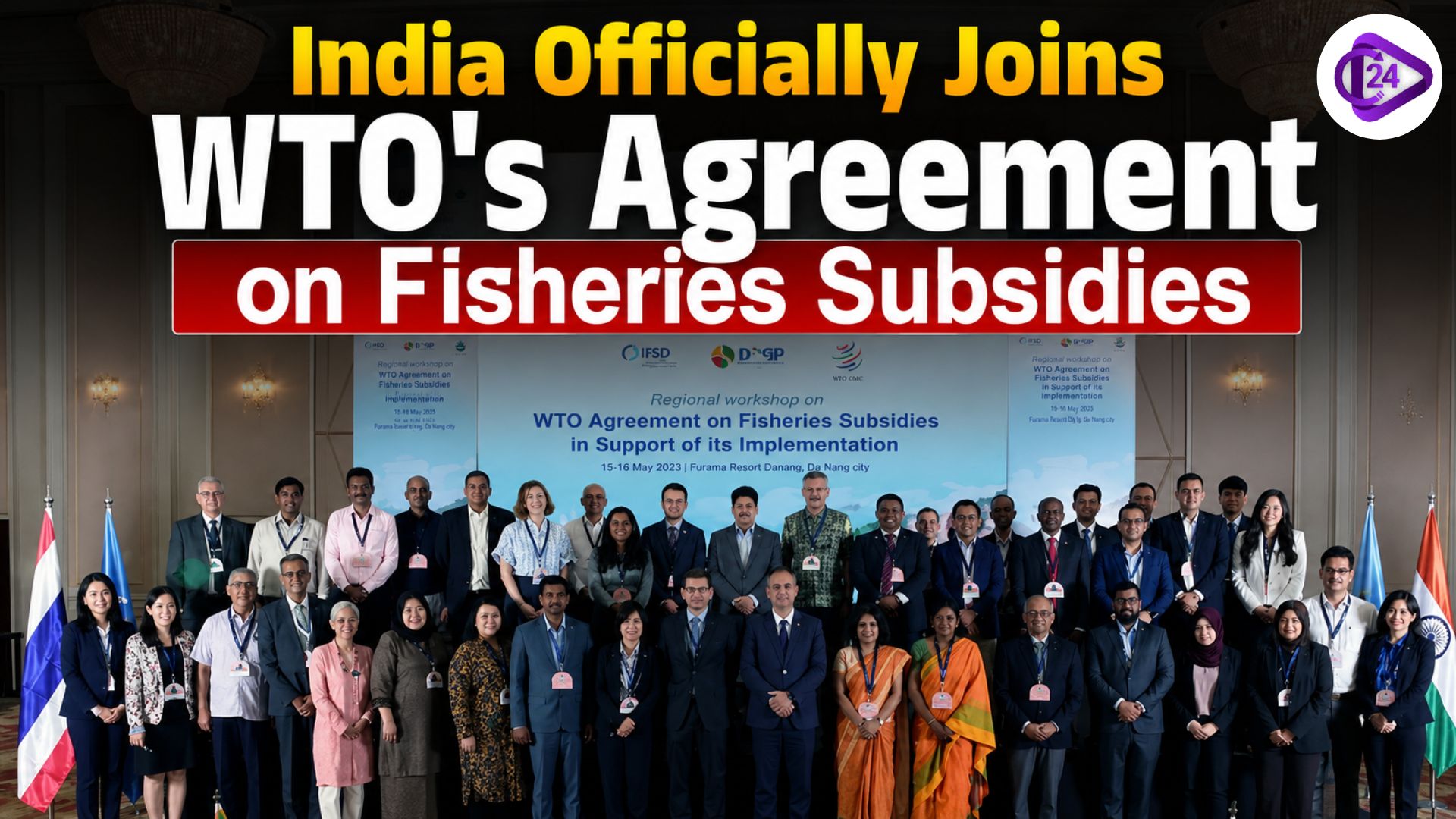


India’s Instrument of Acceptance under the WTO Agreement on Fisheries Subsidies has been deposited with the WTO, which has ratified the country as a member of the agreement. India becomes part of the WTO Agreement on Fisheries Subsidies when it deposits its Instrument of Acceptance, giving it status. This marks a significant step towards promoting sustainable fisheries and protecting marine ecosystems. The Agreement covers the prohibition of harmful fisheries subsidies that may lead to IUU, overfished stocks and (where appropriate) fishing on the unregulated high seas.
The induction of India into a membership that reflects the principle of ‘fishers responsibly managed fishers’ helps give weight to the demands of responsible fisheries management and ensures the protection of the interests of millions of fishers engaged in traditional fishing and fishing by small operators. The action also contributes to the achievement of Sustainable Development Goal (SDG) 14 – Life Below Water, and reinforces the multilateral trading system.
Key Highlights of India Becomes Part of WTO Fisheries Subsidies
- The Instrument of Acceptance (IoA) for India’s Accession to the WTO Agreement on Fisheries Subsidies has been submitted.
- The Agreement was agreed during the 12th WTO Ministerial Conference (MC12) in Geneva, in June 2022.
- It is the first environmental- focussed agreement in the WTO.
- The Agreement will ban any subsidy to Illegal, Unreported and Unregulated (IUU) fishing.
- It also influences the introduction of fisheries to areas that are prone to overfishing and to fishing in unregulated high seas areas.
- India has focused on small and traditional fishers and on protection of their livelihoods.
- The Agreement makes a direct contribution to SDG 14.6 (Life Below Water).
- In doing so, India has enhanced cooperation for sustainable fisheries and fair international trade.
Why in News?
India is thus officially a member of the Agreement on Fisheries Subsidies of the World Trade Organisation, to which it is the newest addition, after the country had finished its domestic acceptance process. The transition underscores India’s dedication towards sustainable marine resource management and responsible international trade, and it remains a call for equitable treatment of developing countries and artisanal fishers.
What does WTO Agreement on Fisheries Subsidies mean?
The first international WTO agreement with a sole focus on environmental sustainability is the WTO Agreement on Fisheries Subsidies. It sets up binding rules for fisheries subsidies that help to deplete marine resources. The Agreement aims to discourage illegal fishing or overfishing of fish stocks, which may be the result of the government providing financial assistance, and to encourage sustainable fisheries management globally.
The purpose of the Agreement
- End subsidies to Illegal, Unreported and Unregulated (IUU) Fishing.
- Ban subsidies for fishing of overfished populations.
- Stop certain fishing activities on unmanaged high seas from being subsidised.
- Encourage sustainable fisheries management worldwide.
- Maintain biodiversity and fish stocks in the marine environment.
- Help achieve SDG Target 14.6.
- Provide long-term food security and sustainable livelihoods.
India’s Stand on Fisheries Subsidies
In addition, India has always looked into sustainable fisheries and always said they should be given special and differential treatment with the developing countries. The Indian position is that millions of traditional and artisanal fisheries communities rely on fisheries for their livelihood, and a policy niche is needed to strengthen the livelihoods of those communities. India’s accession to the Agreement signals its continued dedication to creating a balance between sustainable management of the natural world and the security of livelihoods.
Sustainable Development Goals (SDGs), 17 Goals, Targets, Objectives
Benefits for India
- Promotes sustainable use of marine resources.
- Lays the momentum for India in the WTO.
- Conserves the stocks of fish for next generations.
- Promotes responsible fishing.
- Simplifies fisheries subsidies.
- Facilitates exports by building the merchandise image of India in the world.
- Contributes to the Blue Economy and sustainable coastal development.
WTO Previous Year Questions (PYQs)
| Exam (Year) | Question with Options | Correct Answer |
| UPSC Prelims (2024) | The World Trade Organisation (WTO) was established in which year?
(A) 1993 (B) 1994 (C) 1995 (D) 1996 |
(C) 1995 |
| SSC CGL (2023) | Where is the headquarters of the World Trade Organisation (WTO)?
(A) Paris (B) Vienna (C) Geneva (D) Brussels |
(C) Geneva, Switzerland |
| RRB NTPC (2022) | Which organisation replaced the General Agreement on Tariffs and Trade (GATT)?
(A) IMF (B) WTO (C) World Bank (D) OECD |
(B) WTO |
| SSC CHSL (2022) | The WTO came into existence on which date?
(A) 1 January 1995 (B) 15 April 1994 (C) 1 January 1996 (D) 31 December 1994 |
(A) 1 January 1995 |
| UPSC Prelims (2021) | Which of the following is the highest decision-making body of the WTO?
(A) General Council (B) Ministerial Conference (C) Dispute Settlement Body (D) Trade Policy Review Body |
(B) Ministerial Conference |
| SSC CGL (2021) | Who is the current Director-General of the WTO?
(A) Roberto Azevêdo (B) Ngozi Okonjo-Iweala (C) Pascal Lamy (D) Christine Lagarde |
(B) Ngozi Okonjo-Iweala |
| SSC GD (2020) | The WTO headquarters is located in which country?
(A) France (B) Switzerland (C) Belgium (D) Austria |
(B) Switzerland |
| RRB Group D (2019) | Which agreement led to the establishment of the WTO?
(A) Kyoto Protocol (B) Marrakesh Agreement (C) Paris Agreement (D) Uruguay Protocol |
(B) Marrakesh Agreement |
| SSC CPO (2018) | The WTO is primarily concerned with ________.
(A) Climate Change (B) International Trade Rules (C) Global Health (D) Human Rights |
(B) International Trade Rules |
| UPSC Prelims (2017) | The Trade Policy Review Mechanism (TPRM) is associated with which organisation?
(A) IMF (B) World Bank (C) WTO (D) UNCTAD |
(C) WTO |
Tamil Nadu Launches e-Zero FIR System
Conclusion on India Joins WTO Fisheries Subsidies Pact
India’s accession to the WTO Agreement on Fisheries Subsidies is an expression of its interest in a rules-based world trade system, in sustainable development and fisheries governance. Harmful subsidies will be reduced and marine biodiversity secured for the future through the Agreement. India, meanwhile, is pressing for the interests of traditional fishing communities to be safeguarded by drawing a balance between the implementation of global trade rules and the interests of these communities.