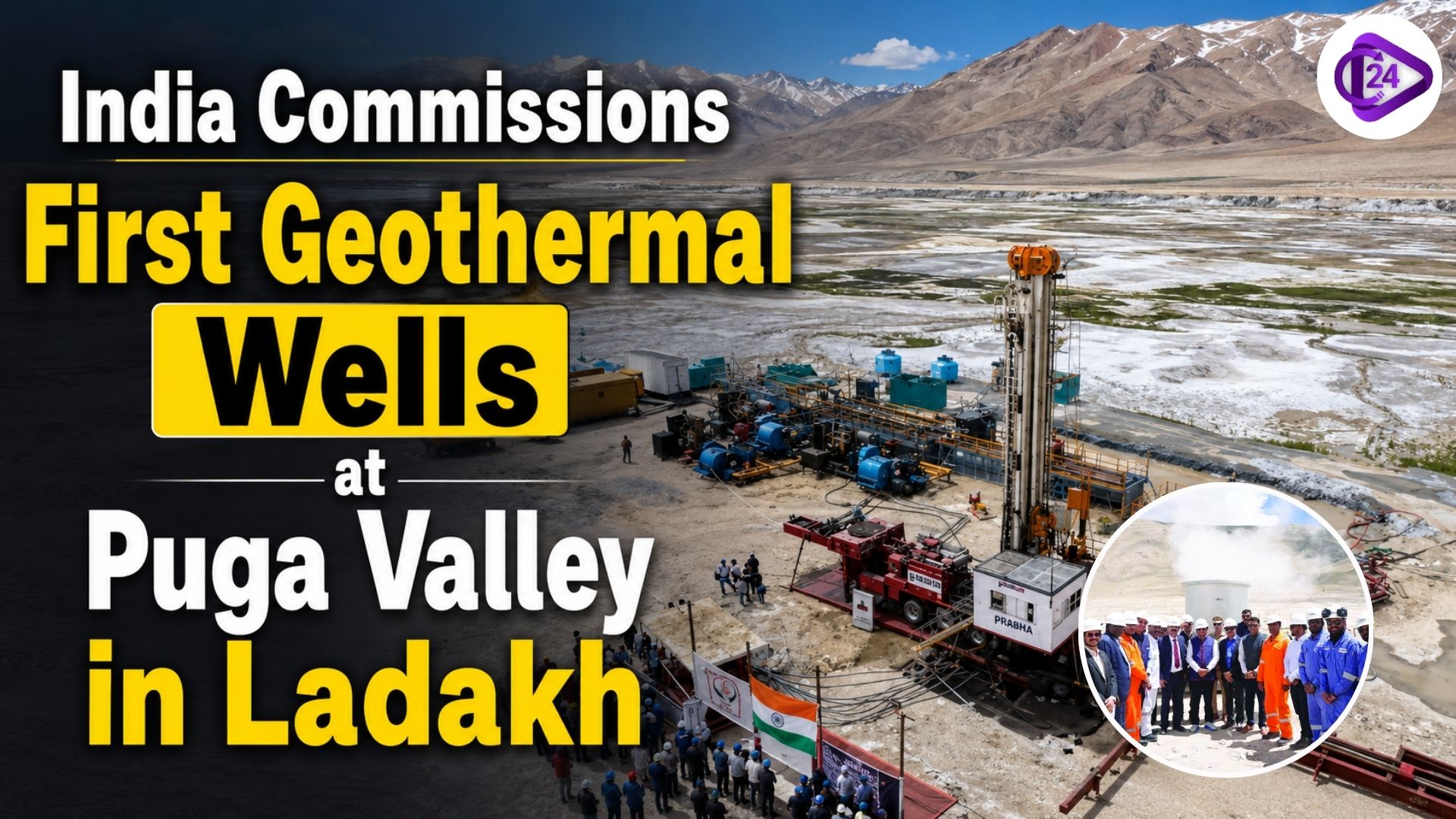


Puga Valley Geothermal Wells: The commissioning of its first geothermal exploration wells at Puga Valley in Ladakh is an important step in India’s transition to renewable energy. The project aims to utilise the internal heat of the earth for the generation of electricity and also use it as a direct heat source, making geothermal energy a new source in India’s clean energy sector.
The naturally occurring hot springs, fumaroles and high-temperature geothermal reservoirs in Puga Valley, in eastern Ladakh’s Changthang region, have the highest geothermal potential in the nation. The initiative is in line with the targets of India’s National Green Hydrogen Mission, Panchamrit goals and the target of achieving elusive Net Zero emissions by 2070.
What is the Puga Valley Geothermal Project?
The Puga Geothermal Project is the first dedicated geothermal development project in India that is meant to test the commercial feasibility of harnessing geothermal energy from geothermal reservoirs found in the earth. It consists of deep exploration boreholes to investigate reservoir temperature, pressure, permeability and reclaims of sustainable energy resources from the reservoir.
Objectives of Puga Valley Geothermal Project
- Determine the commercial potential of geothermal.
- Encourage environmentally sound and dependable base load power generation.
- Decrease the use of diesel-based electricity in remote Himalayan areas.
- Enhance energy security in border areas.
- Facilitate India’s transition towards diversifying its energy mix and supporting renewable energy.
- Improve the capacity for indigenous research on geothermal technologies.
Puga Valley is suitable for geothermal energy for what reason?
The Puga Valley (PV) is known as the most promising geothermal field in India due to its special geological attributes.
Key Features
- In the district of Leh, in the Region of Ladakh.
- Close to the Indus Suture Zone, which is a tectonically active zone.
- Occurrence of hot springs, fumaroles, mud pools and sulphur deposits.
- Underground temperatures that are thought to be in excess of 200°C in the deeper reservoirs.
- One of the hottest geothermal heat flow zones of India.
How Are Geothermal Wells Formed?
A geothermal well is a borehole sunk into a geothermal reservoir lying beneath the surface of the earth, to tap hot water or steam that can be brought to the surface. They are created in areas where the earth’s internal heat near the earth’s surface is caused by volcanic activity, tectonic plate movements or high geothermal gradients. The heat that is removed is then utilised to drive a heat engine, such as a Stirling cycle or used directly for heating.
Formation Process of Puga Valley Geothermal Wells
- Geothermal Reservoir: When the groundwater flows into the deep rocks underground and gets naturally heated by hot rocks or magma, it becomes a geothermal reservoir.
- The sites in question are delineated by surveys and investigations considered to be of high geothermal value, such as hot springs and fumaroles.
- Exploration Drilling: Exploration wells are drilled to measure the pressure, temperature, permeability and reservoir properties below ground.
- Production Wells: Deep production wells are drilled to bring the hot water or steam up.
- Power generation: Steam extracted is fed into turbines driven by generators, with the electricity generated used, or the hot water used in the heating industry.
- Reinjection Wells: Cooled water is reinjected back underground after use to maintain reservoir pressure and to achieve sustainability.
- Unlike fossil fuels, geothermal reservoirs can sustainably deliver dependable, baseload 24×7 renewable energy.
Previous Year Questions (PYQs) Geothermal Energy
| Exam | Year | Question | Answer |
| UPSC CSE (Prelims) | 2013 | Which of the following statements regarding geothermal energy is/are correct?
1. Geothermal energy is the natural heat generated within the Earth. 2. It can be used for electricity generation. 3. It is a non-renewable source of energy. Options: A. 1 only B. 1 and 2 only C. 2 and 3 only D. 1, 2 and 3 |
B. 1 and 2 only |
| SSC CGL | 2023 | Which of the following is a renewable source of energy?
Options: A. Coal B. Petroleum C. Geothermal Energy D. Natural Gas |
C. Geothermal Energy |
| RRB NTPC | 2022 | Geothermal energy is obtained from:
Options: A. Wind energy B. Heat stored inside the Earth C. Ocean tides D. Solar radiation |
B. Heat stored inside the Earth |
| SSC CHSL | 2021 | Which of the following renewable energy sources can provide continuous (baseload) power?
Options: A. Solar Energy B. Wind Energy C. Geothermal Energy D. Tidal Energy |
C. Geothermal Energy |
| CDS Examination | 2020 | Hot springs are generally associated with which type of energy resource?
Options: A. Wind Energy B. Solar Energy C. Geothermal Energy D. Biomass Energy |
C. Geothermal Energy |
| State PSC | 2022 | Which gas is mainly responsible for generating electricity in a geothermal power plant?
Options: A. Oxygen B. Steam produced from underground hot water C. Nitrogen D. Carbon Dioxide |
B. Steam produced from underground hot water |
| SSC CPO | 2019 | Which of the following geological features indicates geothermal activity?
Options: A. Sand dunes B. Coral reefs C. Hot springs and fumaroles D. Glaciers |
C. Hot springs and fumaroles |
| UPPSC PCS | 2021 | The heat used in geothermal power plants originates primarily from:
Options: A. Solar radiation absorbed by rocks B. The Earth’s internal heat C. Friction caused by winds D. Ocean currents |
B. The Earth’s internal heat |
| BPSC | 2023 | Which of the following is NOT an advantage of geothermal energy?
Options: A. Renewable source of energy B. Low greenhouse gas emissions C. Continuous power generation D. High dependence on imported fuel |
D. High dependence on imported fuel |
| CAPF (AC) | 2022 | Which one of the following is the best example of direct use of geothermal energy?
Options: A. Hydroelectric power generation B. Space heating using hot water from geothermal reservoirs C. Windmill operation D. Solar photovoltaic systems |
B. Space heating using hot water from geothermal reservoirs |
Government Adds Iron Ore to Core Sector Index
Conclusion on Puga Valley Geothermal Wells
India has achieved an important milestone towards achieving the goal of achieving clean energy in the country by commissioning the first geothermal wells at Puga Valley, Ladakh. Through a geothermal application, India is growing its renewable energy mix beyond solar, wind, and hydropower and is enhancing energy security in its far-flung and isolated Himalayan areas. Geothermal can provide a solid 24×7 baseload power source with low greenhouse gas emissions and a long-life energy source that can be harnessed for the United Kingdom’s Net Zero emissions by 2070.
The exploration in Puga valley is also likely to open the doors to commercially developing other geothermal provinces around the country in a vision of a diversified, resilient and sustainable energy future for India.