

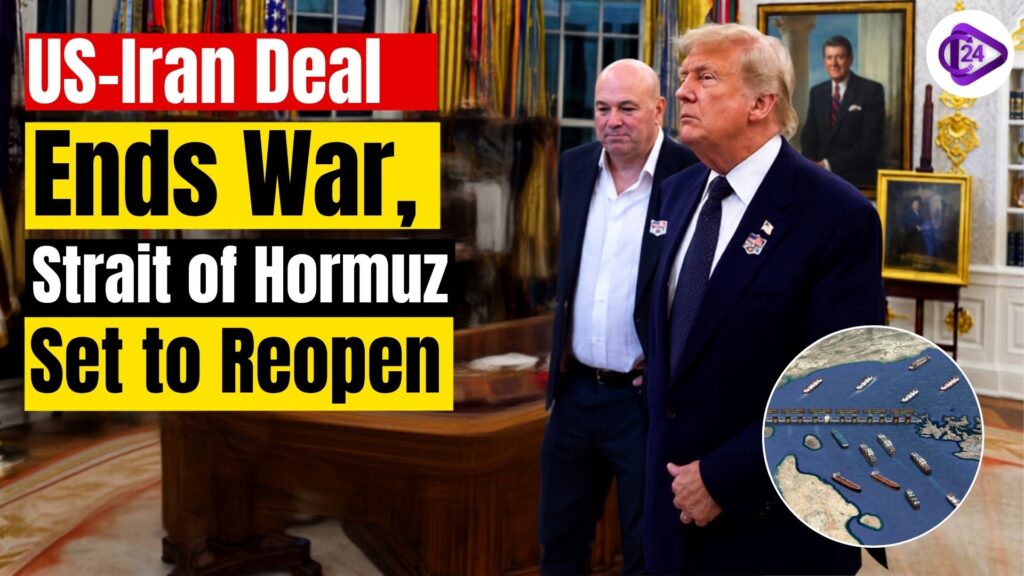
US-Iran Deal: After months of conflict that stalled global energy markets and sea trade, the US-Iran Deal framework of the Strait of Hormuz is a significant diplomatic breakthrough. The initial accord is designed to stop the fighting, to reinstate the trade route in the Strait of Hormuz and to establish a venue for negotiations on sanctions and nuclear issues. Market sentiment immediately improved, as oil prices plunged and global equities climbed due to hopes that oil supplies would grow more abundant and inflationary pressures would abate. But analysts warn it is still a basic accord which needs to be formally followed for lasting stability to be guaranteed.
Key Highlights of the US-Iran Deal Strait of Hormuz
- A tentative deal to halt hostilities had been reached between the US and Iran
- For commercial shipping, the Strait of Hormuz is likely to open again.
- A formal signing ceremony is reportedly scheduled in Geneva.
- The deal also features 60 days to negotiate any open issues.
- The U.S., meanwhile, is expected to refrain from new sanctions during negotiations.
- Iran pledges to stay nuclear-neutral in discussions
- Following the announcement, oil prices also immediately dropped worldwide.
- Shipping firms maintain steady caution until security conditions normalise entirely.
US-Iran Deal Strait of Hormuz: Key Details
| Aspect | Details |
| Agreement Status | Preliminary framework agreement |
| Main Objective | End hostilities and restore maritime trade |
| Strategic Waterway | Strait of Hormuz |
| Expected Reopening | Following formal implementation of the agreement |
| Negotiation Window | 60 days |
| Key Issues for Future Talks | Nuclear programme, sanctions relief, regional security |
| Immediate Market Impact | Oil prices declined; global equities rose |
| Major Beneficiaries | Energy markets, shipping industry, oil-importing countries |
Why the Strait of Hormuz Matters
- A preliminary agreement between the United States and Iran to put an end to hostilities was announced.
- Within the coming days, the Strait of Hormuz should reopen for industrial transport.
- They said in Geneva a formal signing ceremony was expected
- Peters said they agreed to a timeline that gives the parties 60 days to negotiate contract discrepancies.
- Expect the US to suspend fresh sanctions while negotiations are ongoing
- During the talks, Iran has agreed to stop any further work towards nuclear weapons.
- Oil prices across the globe plunged as soon as news broke.
- Shipping firms will be reticent until security conditions improve more fully.
Best Previous Year Questions
| Exam & Year | Question | Options | Correct Answer |
| UPSC Prelims 2011 | Which one of the following straits is a strategic route for oil exports from the Persian Gulf? | (A) Strait of Malacca(B) Strait of Gibraltar(C) Strait of Hormuz(D) Bering Strait | (C) Strait of Hormuz |
| UPSC Prelims 2014 | The Strait of Hormuz connects the Persian Gulf with which of the following water bodies? | (A) Red Sea(B) Arabian Sea(C) Mediterranean Sea(D) Caspian Sea | (B) Arabian Sea |
| SSC CGL 2022 | The Strait of Hormuz lies between which two countries? | (A) Iran and Iraq(B) Iran and Oman(C) Saudi Arabia and Iran(D) Oman and Yemen | (B) Iran and Oman |
| CDS 2021 | Which of the following countries does not border the Strait of Hormuz? | (A) Iran(B) Oman(C) United Arab Emirates(D) Qatar | (D) Qatar |
| NDA 2020 | The Strait of Hormuz is located in which region? | (A) South China Sea(B) Persian Gulf Region(C) Black Sea Region(D) Baltic Region | (B) Persian Gulf Region |
| SSC CHSL 2019 | The Strait of Hormuz is significant because it is a major route for the transport of: | (A) Coal(B) Natural Gas(C) Crude Oil(D) Iron Ore | (C) Crude Oil |
| UPSC Prelims 2017 | Which one of the following countries is not a member of the Gulf Cooperation Council (GCC)? | (A) Oman(B) Kuwait(C) Iran(D) Qatar | (C) Iran |
| CAPF 2023 | The Strait of Hormuz connects the Persian Gulf to the: | (A) Gulf of Aden(B) Arabian Sea(C) Red Sea(D) Mediterranean Sea | (B) Arabian Sea |
| SSC CGL 2021 | Approximately what share of global crude oil trade passes through the Strait of Hormuz? | (A) 5%(B) 10%(C) 20%(D) 40% | (C) 20% |
| State PCS (Various Years) | Which of the following countries has a coastline on both the Persian Gulf and the Gulf of Oman? | (A) Iraq(B) Kuwait(C) Iran(D) Bahrain | (C) Iran |
| NDA 2022 | Which gulf is directly connected to the Strait of Hormuz? | (A) Gulf of Aden(B) Gulf of Oman(C) Gulf of Suez(D) Gulf of Aqaba | (B) Gulf of Oman |
| SSC CGL 2023 | Which country lies south of the Strait of Hormuz? | (A) Iran(B) Iraq(C) Oman(D) Kuwait | (C) Oman |
| CDS 2022 | Which country lies north of the Strait of Hormuz? | (A) United Arab Emirates(B) Oman(C) Iran(D) Qatar | (C) Iran |
| UPSC Prelims 2023 | Which of the following sea routes is most critical for India’s energy security? | (A) Bosporus Strait(B) Strait of Hormuz(C) Bering Strait(D) Strait of Magellan | (B) Strait of Hormuz |
| SSC CHSL 2022 | The Strait of Hormuz connects the Persian Gulf with the Gulf of Oman and further to the: | (A) Mediterranean Sea(B) Arabian Sea(C) Red Sea(D) Black Sea | (B) Arabian Sea |
India Appoints Lieutenant General Dhiraj Seth as New Army Chief
Conclusion on US-Iran Accord Signals End of Conflict
The US-Iran Deal Strait of Hormuz could provide an exit route to resolve a dispute that knocked global trade, energy, and Financial markets off course. The deal has the potential to lower oil prices, improve supply chains and bolster economic stability by reopening one of the globe’s key shipping lanes. However, the framework remains fragile. Establishing a ceasefire; addressing maritime security; and more broadly, finding common ground on sanctions and Iran’s nuclear programme will ultimately determine whether this success is meaningful or long-lasting. If properly managed, these hurdles of the US-Iran Deal Strait of Hormuz may end up the cusp point for both regional peace and global economic recovery.