

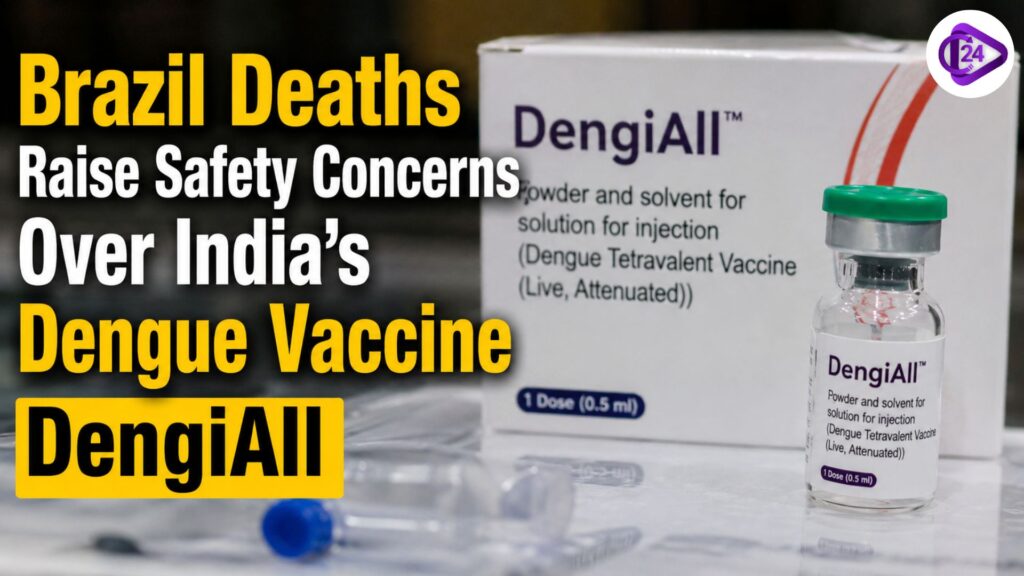
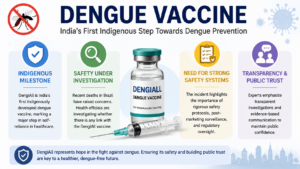
Dengue Vaccine: The recent incidents of deaths in Brazil have given further credence to doubts about the safety of the DengiAll dengue vaccine, hence about the future of India’s first indigenous Dengue Vaccine. Brazil’s health officials have initiated their investigations to see if there is any connection between the death toll and giving DengiAll.
While no causal link has been established yet, the occurrence has prompted more attention to the safety protocols for vaccines, post-marketing surveillance systems, and stricter regulatory monitoring. This has led experts to stress the importance of transparent investigations and evidence-based communication to ensure that the public remains assured in dengue prevention measures.
What Are the DengiAll Dengue Vaccine Safety Concerns?
- The dengue vaccine was scrapped temporarily by Brazil’s Health Ministry as a precaution after it was reported that there were 42 serious adverse events in the population after more than 500,000 children received the vaccine.
- Two fatalities and an additional serious reaction that happened in the past few weeks after vaccination are being investigated.
- Despite these interventions being used, there is as yet no clear link between them and the deaths.
- Features of severe dengue that were being reported comprised ongoing fever, abdominal pain and fever-related shock.
- Brazil’s agency for regulation, the National Health Surveillance Agency, has created an expert committee for an in-depth epidemiological study.
- The regulators are examining clinical trial data, patient histories and surveillance reports of patients after getting vaccinated to look for clues.
- The overall effectiveness of the vaccine is not in question to date, officials said, and the suspension was a precaution.
- With the investigation still underway, public health authorities keep urging users to “trust in official information” and “disconnect from misinformation.
What Is DengiAll and Why Is It Important?
- DengiAll comes out as India’s first indigenous vaccine candidate for dengue – developed by Panacea Biotec in association with the Indian Council of Medical Research.
- It’s a tetravalent vaccine that will be used to protect against all four serotypes of dengue viruses (DENV-1, DENV-2, DENV-3 and DENV-4).
- DengiAll is a live-attenuated vaccine candidate and would be a one-shot vaccine—this may make immunisation easier and more convenient, increasing vaccine coverage.
- The vaccine was approved by the Drugs Controller General of India and started Phase III trials in August 2024.
- The Phase III trial continues with 10,335 patients at 19 centres in 18 states and in the UTs.
- Since there is no approved dengue vaccine currently available for the public in India, DengiAll is also resolving a great public health issue.
- Dengue cases arise and cause many deaths every year worldwide, and a vaccine becomes critical for reducing the severity of the disease, hospital load and mortality.
- The vaccine contributes to India’s goal of achieving self-reliance in the field of vaccines (Atmanirbhar Bharat) by bolstering Indian research and development (R&D) and manufacturing capabilities within the country.
Dengue Vaccine PYQs
| Exam | Year | Question | Options | Correct Answer |
|---|---|---|---|---|
| SSC CGL | 2024 | Dengue is primarily transmitted by which mosquito species? | (A) Anopheles (B) Culex (C) Aedes aegypti (D) Mansonia | (C) Aedes aegypti |
| UPSC Prelims | 2023 | Which statement regarding dengue is correct? | (A) It is caused by a bacterium (B) It spreads through contaminated water (C) It is a mosquito-borne viral disease (D) It spreads through direct human contact | (C) It is a mosquito-borne viral disease |
| NDA | 2023 | Which mosquito is commonly known as the vector of dengue fever? | (A) Aedes aegypti (B) Culex quinquefasciatus (C) Anopheles stephensi (D) Mansonia uniformis | (A) Aedes aegypti |
| CDS | 2022 | Dengue virus belongs to which family of viruses? | (A) Retroviridae (B) Flaviviridae (C) Orthomyxoviridae (D) Coronaviridae | (B) Flaviviridae |
| AFCAT | 2022 | How many serotypes of the dengue virus have been identified? | (A) Two (B) Three (C) Four (D) Five | (C) Four |
| SSC GD | 2021 | Which symptom is commonly associated with dengue fever? | (A) Persistent cough (B) Joint and muscle pain (C) Loss of hearing (D) Skin burns | (B) Joint and muscle pain |
| RRB NTPC | 2021 | Which season usually records a rise in dengue cases in India? | (A) Winter (B) Summer (C) Monsoon and post-monsoon (D) Spring | (C) Monsoon and post-monsoon |
| CDS | 2020 | Which of the following is the most effective method to prevent dengue transmission? | (A) Antibiotics (B) Mosquito control measures (C) Bed rest (D) Antiviral drugs | (B) Mosquito control measures |
| SSC CHSL | 2019 | The dengue-carrying mosquito generally bites during: | (A) Night only (B) Early morning and daytime (C) Midnight only (D) Evening only | (B) Early morning and daytime |
| AFCAT | 2018 | Dengue fever is caused by: | (A) Fungus (B) Protozoa (C) Virus (D) Bacteria | (C) Virus |
| UPSC Prelims | 2017 | Which of the following diseases are transmitted by Aedes mosquitoes? 1. Dengue 2. Chikungunya 3. Zika Select the correct answer using the code below. | (A) 1 only (B) 1 and 2 only (C) 2 and 3 only (D) 1, 2 and 3 | (D) 1, 2 and 3 |
| SSC CPO | 2016 | Which blood component usually decreases significantly during dengue infection? | (A) Platelets (B) Red Blood Cells (C) Plasma (D) Haemoglobin | (A) Platelets |
Indian Shooting Legend Jaspal Rana Dies at 49
Conclusion on India’s Dengi: All Dengue Vaccines Face Scrutiny
The recent responses related to the deaths in Brazil have exacerbated fears over the DengiAll dengue vaccine, emphasising the need to have strong vaccine safety monitoring. Health officials, though, have not made any direct connections between the vaccine and the reported deaths. Trials of the vaccine will continue their investigations, looking at clinical evidence, patient histories and what’s happened after the vaccination to establish the facts. Meanwhile, dengue remains an enormous public health problem, especially in tropical nations. Therefore, proper communication, scientific assessment and robust pharmacovigilance systems are still pivotal to maintain trust with citizens and help plan vaccine strategies for the future.