


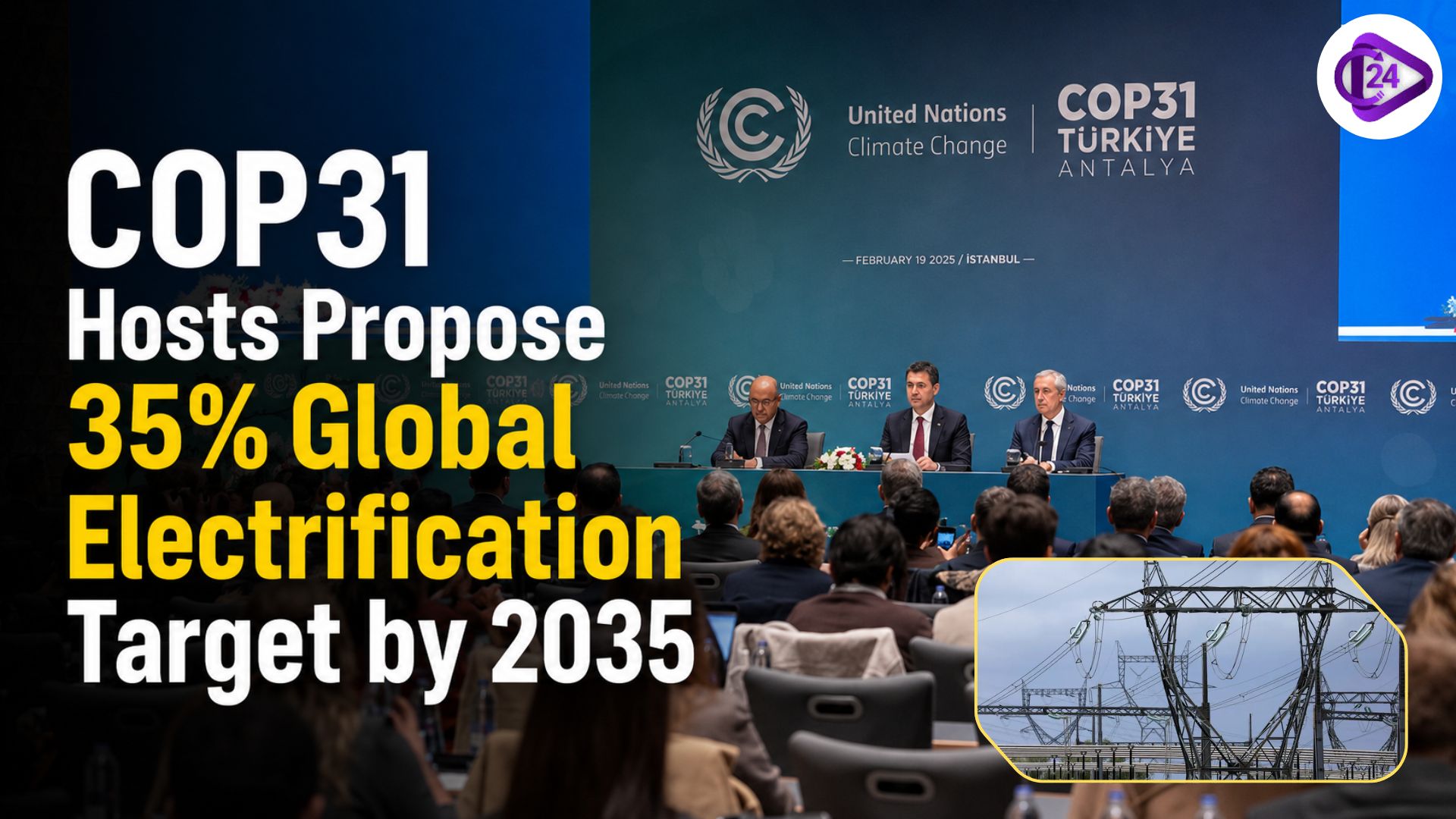
COP31 hosts: This year, the COP31 hosts, Turkey and Australia, have set themselves an ambitious “35 by 35” global electrification goal—a doubling of the contribution that electricity makes to world final energy demand, from current levels of slightly over 20% to 35% by 2035. This proposal was made public during the Bonn Climate Change Conference during the COP31 Action Agenda. The goal aims at moving away from fossil fuels in transport, industry, buildings and household energy systems towards the acceleration of a transition to clean electricity. In the future, using electric vehicles, heat pumps and electric industrial equipment are set to be at the heart of this objective.
The ability to stimulate energy security, minimise reliance on unstable fossil fuel markets and promote global climate goals under the Paris Agreement is also a key aspect of the initiative. In addition, the leaders of COP31 have stressed the importance of technical assistance, capacity development, and financial resources to developing countries to support their electrification efforts and global clean energy transition.
What is the 35% Global Electrification Target? – COP31 hosts
The ‘Global Electrification Target’ (35%) is a proposed climate and energy target put forward by Australia and Turkey, the COP31 hosts, aiming to make electricity reliably a main fuel for 35% of global final energy consumption by 2035. The project will help foster faster adoption of fossil-fuel-free energy systems into the transportation, industrial, building and residential sectors, towards cleaner, more efficient electricity-based energy systems.
Part of the COP31 proposal is to use more electricity to decarbonise countries’ economies, increase energy security and provide sustainable economic development. The target also aligns with the international initiatives to build renewable energy power generation capacity and boost energy efficiency. Looking to clean electricity generated by the sun, wind, water, and other renewables, countries stand to strongly decrease their reliance on coal, oil or natural gas.
Key Objectives of the 35% Global Electrification Target
- Raise the share of electricity in the global energy demand by 25% by 2035.
- Promote transition from fossil to clean energy at a faster rate.
- Encourage the use of EVs and public transport.
- Encourage the adoption of electrification in the industrialisation and manufacturing sectors.
- Promote heat pumps and low-energy consumption items.
- Improve energy security and decrease reliance on fuel imports.
- Reduce world emissions of greenhouse gases.
- Contribute to climate change objectives as stated in the Paris Agreement.
- Scale up integration of renewable energy in electricity networks.
- Provide technical and financial support to developing countries.
Previous Year Questions on COP, UNFCCC, Climate Change- COP31 hosts
| Exam | Year | Question | Options | Answer |
| UPSC Prelims | 2021 | The term “Conference of Parties (COP)” is associated with which organization? | A) WTO
B) UNFCCC C) IMF D) UNESCO |
B) UNFCCC |
| UPSC Prelims | 2016 | The Paris Agreement was adopted under which international convention? | A) CBD
B) UNCCD C) UNFCCC D) Ramsar Convention |
C) UNFCCC |
| SSC CGL | 2022 | COP meetings are primarily related to which issue? | A) Global Trade
B) Climate Change C) Space Research D) Public Health |
B) Climate Change |
| RRB NTPC | 2021 | The United Nations Framework Convention on Climate Change (UNFCCC) came into force in which year? | A) 1990
B) 1992 C) 1994 D) 1997 |
C) 1994 |
| SSC CHSL | 2023 | Which agreement aims to limit global warming and was adopted at COP21? | A) Kyoto Protocol
B) Montreal Protocol C) Paris Agreement D) Ramsar Convention |
C) Paris Agreement |
| UPSC CDS | 2020 | COP stands for: | A) Conference of Parties
B) Council of Presidents C) Committee of Policies D) Conference of Protocols |
A) Conference of Parties |
| SSC GD | 2022 | Which city hosted COP21, where the Paris Agreement was adopted? | A) Glasgow
B) Paris C) Dubai D) Madrid |
B) Paris |
| RRB Group D | 2019 | The headquarters of the UNFCCC is located in: | A) Geneva
B) Vienna C) Bonn D) New York |
C) Bonn |
| UPSC Prelims | 2015 | The Kyoto Protocol is related to: | A) Biodiversity
B) Ozone Layer C) Climate Change D) Wetlands |
C) Climate Change |
| SSC CPO | 2023 | COP28 was hosted by which country? | A) Egypt
B) UAE C) France D) Germany |
B) UAE |
Fitch Cuts India’s Growth Forecast to 6.4% Amid Middle East Turmoil and Global Uncertainty
Conclusion – COP31 hosts
The COP31 hosts’ proposal to reach a 35% global electrification rate by 2035 is an important milestone in moving towards a cleaner and more sustainable energy future. Countries can decarbonise energy access by increasing the use of renewable sources and minimising emissions by modernising transportation and industry sectors. If it is executed correctly, the project could be a substantial part of the solutions to global climate goals and speed up the shift to green energies.
It is a proposal to increase the share of electricity in global energy consumption to 35% by 2035.
The target was proposed by the hosts of COP31.
Electrification helps reduce emissions, improve efficiency, and support clean energy adoption.
Transportation, industry, and residential energy use are expected to benefit significantly.
Through renewable energy expansion, electric transportation, and modern power infrastructure.